
Ahead of BAUTOPIA 7 in Athens, architecture historian Thanassis Moutsopoulos questions whether AI is really changing creativity — or just continuing a century-old pattern of disrupted authorship, vanishing geniuses, and utopias nobody quite believes in anymore.
By Matthaios TsimitakisThanassis Moutsopoulos is refusing the premise that AI represents a rupture. He places it in a long line of technologies that already stretched the definition of authorship — the readymade, John Cage's 4′33″, Photoshop, sampling, Google — and reframes the real question not as "is this a threat to creativity" but as "are we ready for everyone to become a creator, and will the institutions that gatekeep art accept it?" Rather than locating creative agency in institutions, networks or tools, he points to an "age of the individual" — people spending unlimited time on social platforms and AI tools, feeding work back into the same channels — and pointedly declines to call it a revolution.
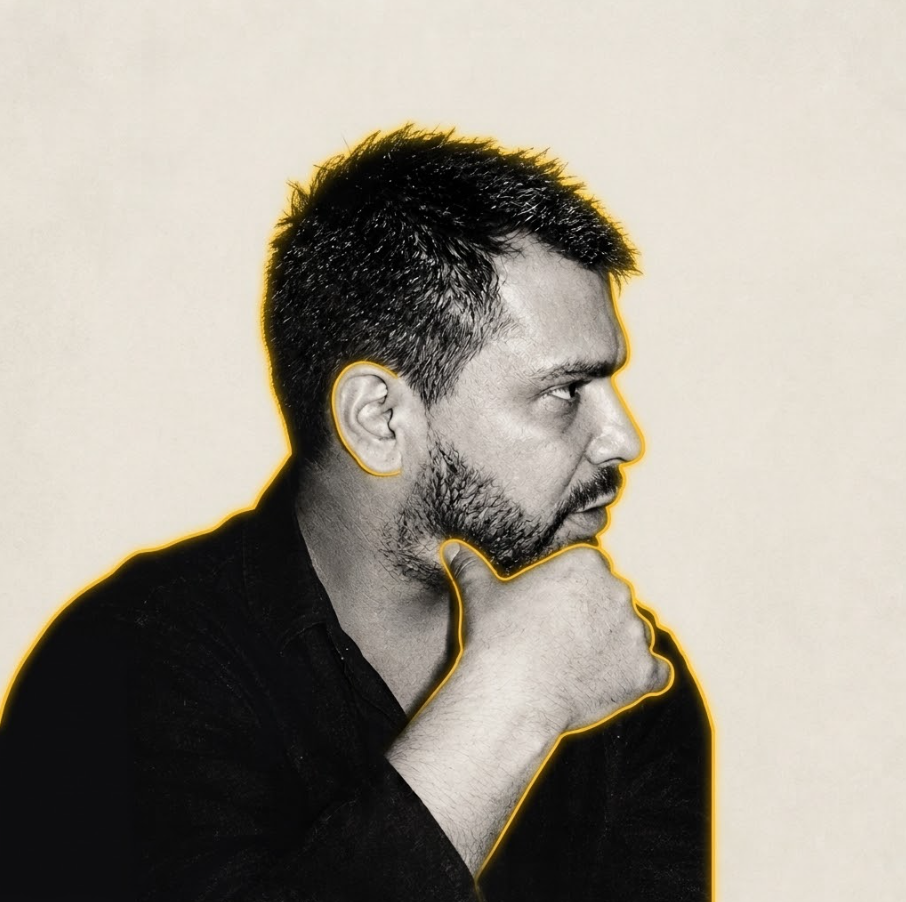
Moutsopoulos teaches History of Art and Cultural Theory at NTUA's School of Architecture. Still, his career has run on a parallel curatorial track: a Master of Design Studies from Harvard, a PhD from NTUA, and a commissionership of the Greek Pavilion at the 2002 Venice Architecture Biennale. He has directed photography and visual arts exhibitions in Thessaloniki, written for international reviews including Mute and Archis, and published on subjects as far afield as North Korean propaganda aesthetics and the mechanics of cultural influence.
BAUTOPIA 7 brings the European Creative Hubs Network back to Athens from October 7 to 9, hosted by BIOS across its network of venues, under the heading "Sustaining Culture & Creativity in the Age of Intelligence". Creatives Unite is organising its own panel on the last day of Bautopia in the Romantso Creative Hub in Athens.
We feel that this is the moment for culture to provide alternatives by questioning the end-times narratives that occupy public debate and our imagination at all levels. Thanassis Moutsopoulos, Igor Simić, Jean-Calmettes Ainhoa, and Angeliki Poulou will open a discussion aimed at breaking new ground rather than closing down the debate. The question is: how can we move beyond the current state of melancholy?
In this interview and in BAUTOPIA's own utopianism, Moutsopoulos notes a real tension worth sitting with: a generation struggling to picture a future better than the present, at the same moment intellectuals and curators are reviving early-20th-century utopian manifestos.
The festival asks how culture and creativity can be sustained in "the Age of Intelligence". As an art and architecture historian, do you see this as a new problem, or does it echo earlier moments when a new technology unsettled who counts as an author or a maker?
It is certainly not a new problem. Since its conception, modernity has challenged the notion of authorship as it was then understood. For example, key paradigm changes, such as Ready-Made in the Visual Arts or John Cage’s 4’33” musical piece, changed forever the limits of what could be understood as art. More recent inventions and tools like Photoshop, sampling or Google changed the notion of what reality, music, photography or knowledge and truth are. Based on that past, what happened more recently with the A.I. involvement with creativity is basically just expanding the limits we had already kept expanding for a while. Maybe the question is similar to that other old question: Is a coffee with a lot of milk still a coffee, or does it rather become milk (with a little coffee)? And are we prepared for the fact that, at the end of the line, we will eventually ALL become "creators"? Will the establishment, the elite or academia accept such expansion and democratisation?
You teach the Renaissance, when the scholar-artist and the written treatise redefined what an architect was. Is a similar redefinition happening now, with the architect or designer becoming an editor, curator, or director of intelligent systems rather than the sole author?
I think that the concept of the Great Architect is today rather obsolete. We experienced the rise of the so-called Star Architects phenomenon a few decades ago, about the same time we experienced another similar (?) phenomenon, that of “The Dictatorship of the Curator”. My feeling is that they were both dead and buried a long time ago. These days, it is rather large corporations, politicians and oligarchs who really set the tone in both fields.
Simultaneously, more architects and curators are produced every year through the academic system, which sounds like an oxymoron. I don’t think it is. It rather proves that there are too many of us around to find the true genius we used to seek in the past.
The festival is called BAUTOPIA, a nod to the Bauhaus and to utopia. What can architects and cultural workers learn from how utopian visions have played out, and is that wariness useful when everyone is talking about the future again?
Well, it has been a while since I seriously thought of an incoming utopia, although a few people around Europe had such an epiphany about ten years ago. My experience with Gen Z people these days is that they are in grave difficulty visualising a future bright enough and clearly better than the present. At the same time these days, intellectuals, artists and curators, more than ever perhaps, are revisiting the glory days of utopian thought and manifestos from the early 20th century. Could that mean something? Perhaps.
This year's theme is "Creative Agency". From where you sit, teaching the next generation of architects and curating exhibitions, where does real creative agency come from today: institutions, networks, individual authors, or the tools themselves?
My feeling is there is a widespread suspicion about all kinds of institutions these days. One could easily lead to thinking that we live through an age of the individual, the lone wolf, a person possibly with a lack of social life as we used to define it. Someone possibly spending unlimited time using all available social media, as well as all kinds of technological tools, including, obviously, AI. These individuals are currently producing some kind of work, feeding it mostly back to the same channels. I think this is BIG in scale. Is it going to be some sort of revolution or a new artistic philosophy? I wouldn’t be so sure about that…