

In an era where artificial intelligence increasingly mediates human expression, questions of autonomy, ownership, and creative control are no longer abstract debates—they are urgent realities for anyone working in culture. Algorithms shape creative visibility, extract human effort as data, and obscure the massive environmental and human infrastructures driving machine intelligence. Against this backdrop of technological opacity, critical cartography becomes a radical act of illumination.
In this interview, artist, researcher, and SHARE Lab director Vladan Joler breaks down his practice of "counter-mapping"—a process of visual dissection that lays bare the hidden supply chains, physical extractions, and invisible power systems underlying modern technology.
By turning cartography back onto black-box systems, Joler challenges us to look beyond the slick interfaces of AI and interrogate what is lost when human creation is reduced to training data. Crucially, he explores how creators, cultural operators, and thinkers can navigate this precarious landscape to reclaim their individual and collective agency.
This interview arrives as a preview to Vladan Joler’s keynote at the BAUTOPIA Festival in Athens (October 7–9, 2026). Hosted by the European Creative Hubs Network at BIOS under the theme "CREATIVE AGENCY: Sustaining Culture & Creativity in the Age of Intelligence".
What does “creative agency” mean when working against systems built to hide agency and accountability?
For me, creative agency begins with the decision to investigate what a system asks us to accept as invisible. An AI service appears as an interface; a surveillance system presents itself as a matter of security or efficiency. Behind both are people making decisions about ownership, labour, classification, access and control.
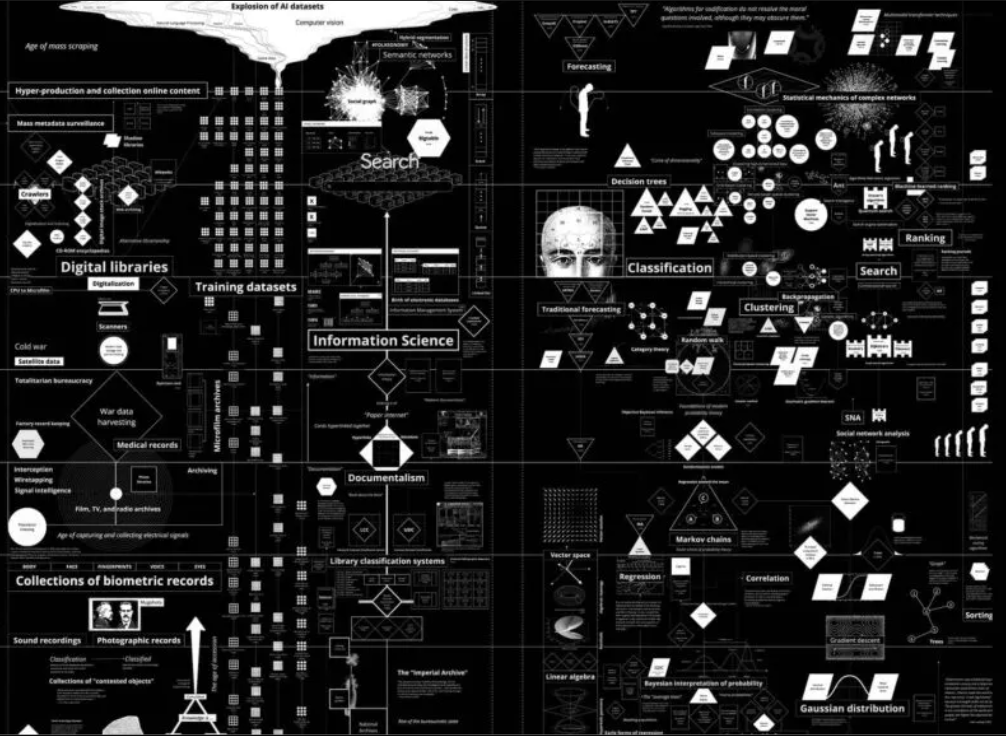
My maps try to make those decisions available for public scrutiny. In Anatomy of an AI System, Kate Crawford and I followed a single device outward into the labour, data and planetary resources required to make it work. In Calculating Empires, we traced longer histories of technology and power. A map cannot make every part of a system transparent, but it can show relationships that an interface conceals and give people a way to ask more precise questions: Who benefits? Who bears the cost? Who can refuse?
What does true creative agency look like for creators pressured to use AI? Can they use these platforms without becoming complicit?
I would be careful about turning this into a test of individual purity. Many artists are under pressure to work faster, produce more and remain visible. Their choices take place within institutions and markets that increasingly make these tools difficult to avoid. Creative agency means having enough knowledge and collective power to make meaningful choices. A creator should be able to ask whether their work is used for training, what happens to material they upload, whose labour supports a service, and what rights they retain over the result. They should also be able to choose other tools and ways of working without being professionally excluded. That requires action from cultural institutions, funders and creative communities, as well as from individuals.
How can artists become counter-mappers, and what do you hope an Athens audience takes away from BAUTOPIA?
Counter-mapping can begin at a very small scale. Choose one tool or system that shapes your work. Follow a piece of data through it. Read its terms, document what you can observe, identify the people and institutions involved, and speak with those who experience its consequences. Work with others to turn those findings into a diagram, an archive, a testimony or a public question. The aim is not to draw a complete map of everything. It is to make one hidden relationship visible enough that others can investigate it, challenge it or act on it.
In Serbia, during the last two years, this approach has also meant gathering testimonies. The projects documenting the March 2025 sonic attack in Belgrade and police brutality in Novi Sad a few months later, grew from collective evidence gathering under urgent circumstances. Athens has its own histories and political conditions. I hope people at BAUTOPIA take away a method they can adapt to their own surroundings and the confidence that creators can do more than respond just to technological change. They can help build the evidence and common language needed to challenge different power structures.
Images: Courtesy of Vladan Joler