
From October 7 to 9, the European Creative Hubs Network's flagship festival turns three Athens venues into a live experiment in what "sustainability" means for culture and creativity — tested not only in materials and methods, but in the professional and political ground creative workers stand on.
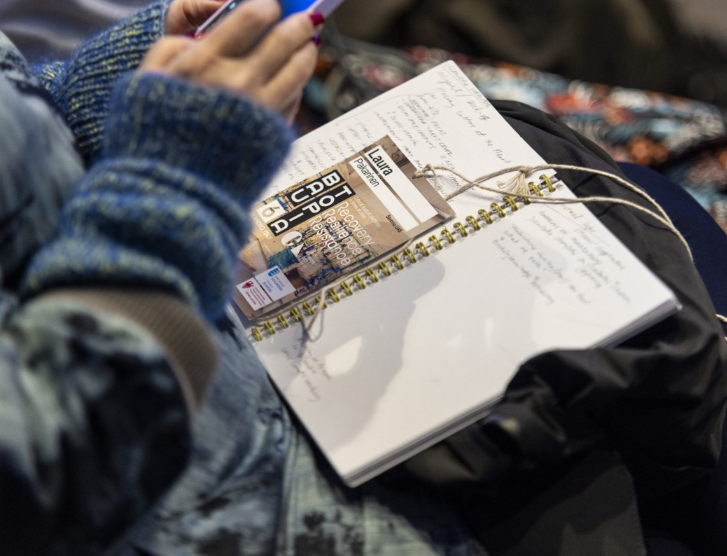
By Creatives Unite NewsroomEvery autumn, the European Creative Hubs Network (ECHN) stages BAUTOPIA, an EU co-funded gathering of creative-hub managers, artists and cultural professionals. This year's edition, its seventh, is by the organisers' own account the largest yet — and the biggest shift is in ambition rather than size alone. Running October 7–9 across BIOS, Romantso, Plex and Latraac, BAUTOPIA 7 carries the title Creative Agency: Sustaining Culture & Creativity in the Age of Intelligence, and it treats "sustainability" as a question with at least three separate answers, staged simultaneously across a single week.
ECOLOGY IN PRACTICE
The most literal answer sits in BAUTOPIA's nine hands-on workshops, which open the festival to anyone curious enough to register — not just industry insiders. Athens Makerspace runs a Precious Plastic Lab session on identifying and upcycling plastic waste; TransfoLAB ATH leads a participatory "Community Re:Making" project tied to a real neighbourhood garden; and a cluster of sessions turns discarded materials into design language — SeaClay, a bio-based material made from oyster shells and algae sourced from the Tagus estuary, and a sustainable-packaging workshop from Lisbon's BioLab exploring beeswax textile wraps and algae-based biofilms. The Open Loom Lab pairs European wool and natural dyeing with digital fabrication, while the IMASUS project's "Imagineering Sustainable Fashion" session asks participants to prototype solutions to real challenges facing the fashion industry. None of this is exhibition-only; it's sustainability treated as a craft practice to be learned.
WHICH POLICY FOR THE SECTOR
The second answer is the one the festival's own framing names most directly, if more quietly: agency as a professional condition. ECHN describes the theme as addressing "the sense of control you feel in your life... your faith in your ability to handle a wide range of tasks and situations" — a feeling that is "increasingly elusive" in precarious creative work. That framing runs underneath the confirmed speaker list, which spans media art critical of algorithmic power (Vladan Joler, whose Share Lab work won a Silver Lion at the 2025 Venice Architecture Biennale), hub leadership (Renata Zamida of Ljubljana's Center Rog), design practice (Simone Rebaudengo, founder of studio OIO) and architectural academia (Athanasios Moutsopoulos, History of Art, NTUA) — a deliberately wide net across the ecosystem BAUTOPIA is trying to speak to.
STARTING A DISCUSSION
The third answer is political rather than material. On the 9th of October, the last day of Bautopia, the Creatives Unite is opening the discussion about end-times narratives in culture and in politics and how to go beyond them. The question of agency seems especially urgent for Gen Z, a generation coming of age amid crisis, war, and climate catastrophe — many of whom take it as a given that their lives will be harder than their parents', and that there's no way out of the catastrophe we're headed toward. "Neoliberalism is fraying at the edges, and its ecological costs are becoming impossible to ignore, while tech monopolies take over the control of the narrative itself. This historical process has a strong cultural element we should not miss," writes the call to the debate. Against that backdrop, the panel asks what role culture and the creative sectors can play at precisely this juncture — not to produce naïve optimism, but to open up narrative and imaginative space beyond the binary of denial and doom. Academics and cultural critics, such as Athanassios Moutsopoulos and Angeliki Poulou (History and Theory of Contemporary Art and New Media, University of Athens); artists such as Igor Simić (Demagog studio); and journalists Aïnhoa Jean-Calmettes (Liberation, Mouvement mag) and Chris Matthews (Investigate Europe) start a discussion that is deliberately open and structured to provoke rather than settle.
MEETING A MOVEMENT
This year BAUTOPIA is also co-programming with TRANSEUROPA 2026, the feminist, transnational and ecological festival organised by European Alternatives, running in Athens October 7–11 under the banner Reclaiming the Cloud(s). TRANSEUROPA's focus — contesting the privatisation and enclosure of digital space and the commons — folds directly into BAUTOPIA's programme through two shared, free workshops: Anna Járai's performance-led animation session and Giun Tym's Ministry of Renewable Extinction, a speculative near-future prototype imagining employment in a climate-collapsed economy. For a network built on EU cultural-policy funding, aligning with a festival explicitly organised around digital sovereignty and resistance to platform enclosure is a pointed statement about where the "Age of Intelligence" framing is meant to point: not just AI as a tool, but AI-era power structures as terrain to be contested.
SONOTOPIA IS THE PLACE
SONOTOPIA, new this year, spreads four nights of programming across BIOS, Romantso, Plex and Latraac, drawing artists from Greece, Switzerland, France, Denmark, the UK and Uganda — including Nyege Nyege Tapes' Kampire, closing with a set orientated toward the global south's dance music rather than a European-centric line-up. A free opening party removes the last barrier to entry.
BAUTOPIA no longer sees itself as a conference with side events but as cultural infrastructure in its own right. "Sustainability" in the cultural and creative sectors cannot be reduced to any single one of environmental, economic or digital-political dimensions without losing what makes the sector's current state distinctive. BAUTOPIA 7 doesn't resolve that tension — no festival could — but it makes an unusually explicit attempt to hold all three at once, in public, with registration open to anyone willing to show up.
BAUTOPIA 7 runs October 7–9, 2026, in Athens. Registration and the full programme are available via the festival's official site.