

A Zagreb arts organisation has turned 257 square metres of a Yugoslav-era (and later Croatian) crumbling printing complex into one of Croatia's most distinctive venues for bio-art and ecological experimentation — and in doing so, proposed a new model for how culture can reactivate an abandoned space. This is its story.
By ECHN for Creative FLIPThere is a building in the southern part of Zagreb that most of the city has forgotten for years. The Vjesnik complex — named after the once-mighty Yugoslavian, and after 1991, Croatian daily newspaper that occupied it from 1940 to 2012 — stretches across more than 30,000 square metres of former industrial ambition. During its peak years in the 1980s, its printing house produced over 267 million copies of different publications, with tens of millions distributed internationally, and more than 6,000 people came to work here every day. By 2019, that number had dwindled to around 200. The machines fell silent. The corridors emptied. And the complex settled into a long, uncertain sleep.
It was into this sleeping giant that KONTEJNER, a Zagreb-based organisation dedicated to contemporary arts and culture, decided to step. The decision was neither sudden nor simple — KONTEJNER had been working toward opening a permanent experimental venue for nearly a decade, and the scarcity of spaces for contemporary culture in Zagreb made the need feel urgent.
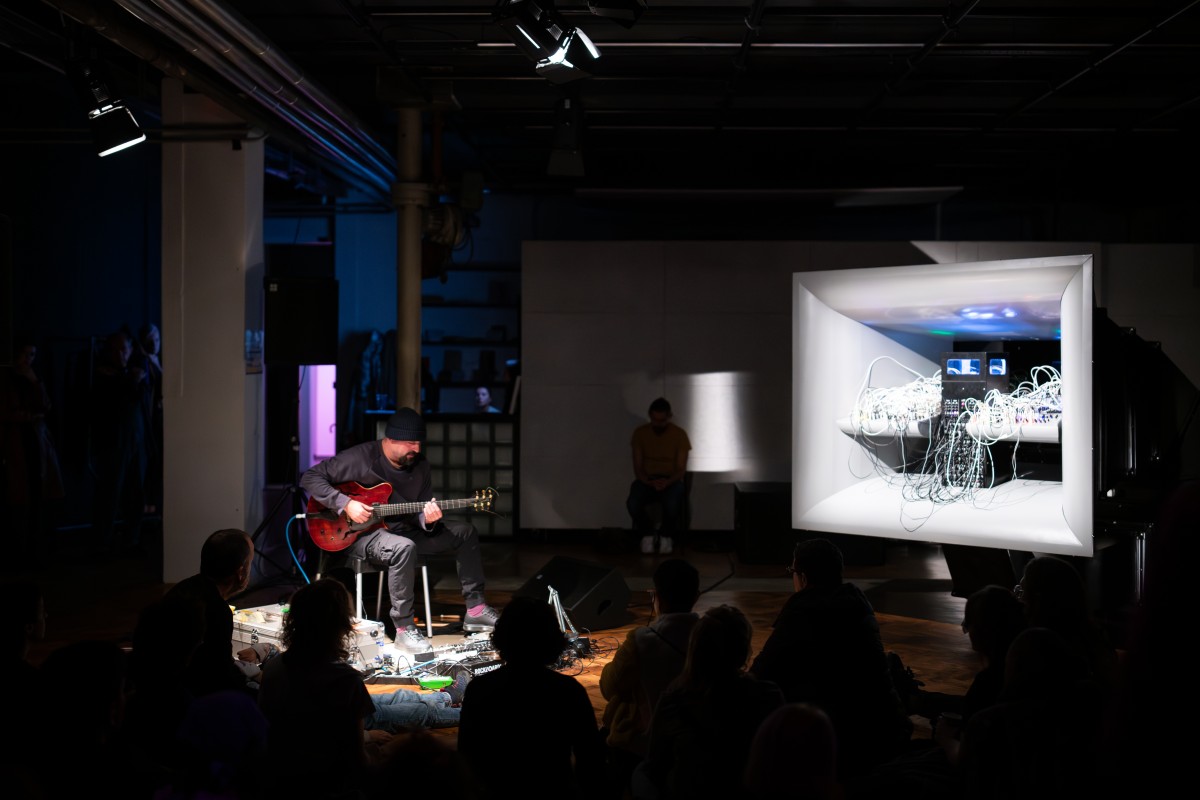
In the southern base building of the Vjesnik complex, they rented 257 square metres and set about transforming them into something the city had not seen before: a temporary testing ground for some of the most investigative, interdisciplinary, and intermedia artistic practices in Europe. Its practice focuses on progressive contemporary intermedia art, sound art and experimental music, with a special focus on bio-art, bio-media, and artistic practices dealing with living organisms.
From the very beginning, KONTEJNER invited local artists, designers, technicians, and other professionals active in the local art scene to contribute their expertise in rebuilding the space. One collaborator later reflected, "This space and programme brought a lot of joy to the life of contemporary art in Croatia, but also hope that such subjects, actors and other stakeholders can happen and develop." That hope was not accidental. It was the product of a deliberate philosophy – one that had guided KONTEJNER since its founding – of stimulating cooperation among creatives of various profiles: artistic, scientific, technological, and beyond. The inauguration of the new venue gave that network a physical home for the first time.
The artistic programme that filled the space was equally intentional. Rather than approaching biodiversity as a literal investigation of the site as an ecological system, KONTEJNER made a defining early decision: to bring high-quality national and international artists dealing with biodiversity, inter-species relations, and bio-media to the venue and to create programmes that integrated these themes critically into the site and its surroundings.
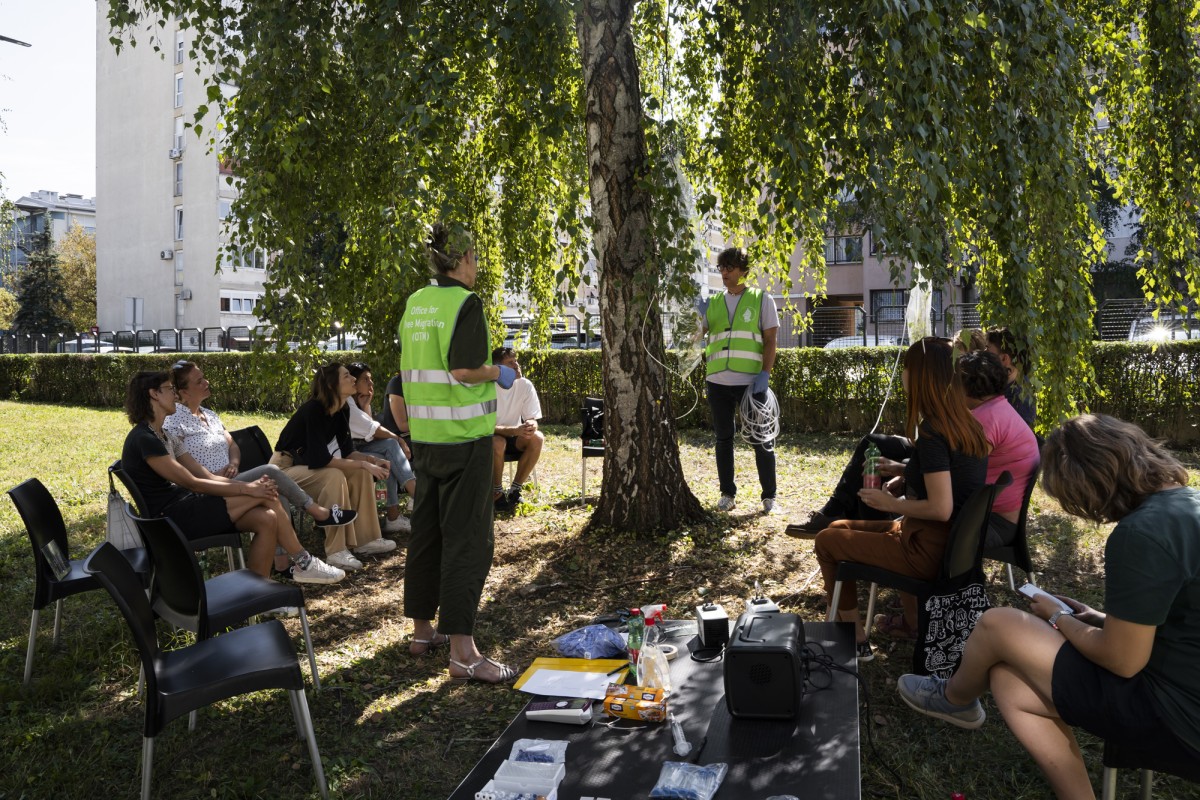
Every presented project included a workshop, an artist talk, or a presentation, opening the addressed topics to a wider audience – particularly the neighbourhood's diverse community. As one student put it after visiting a workshop: "It shows how KONTEJNER's bioart programmes aren't just art for art's sake but also have a social and environmental impact."
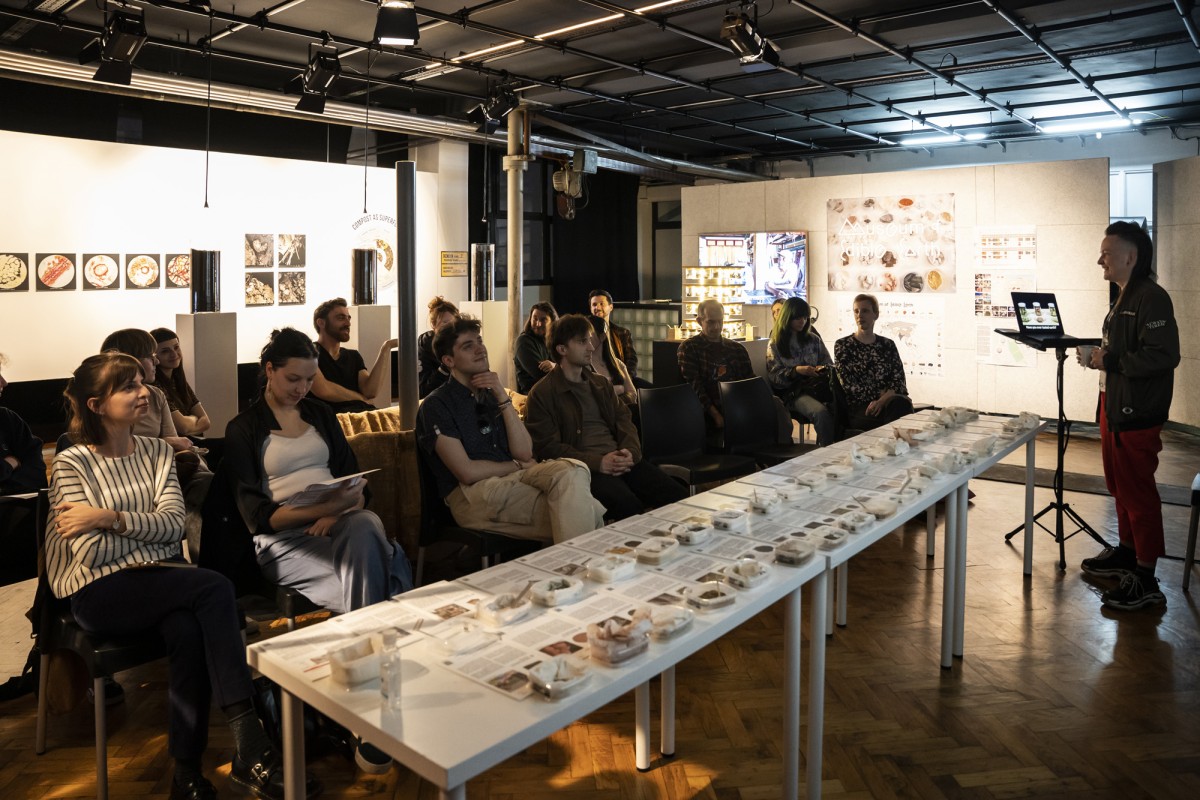
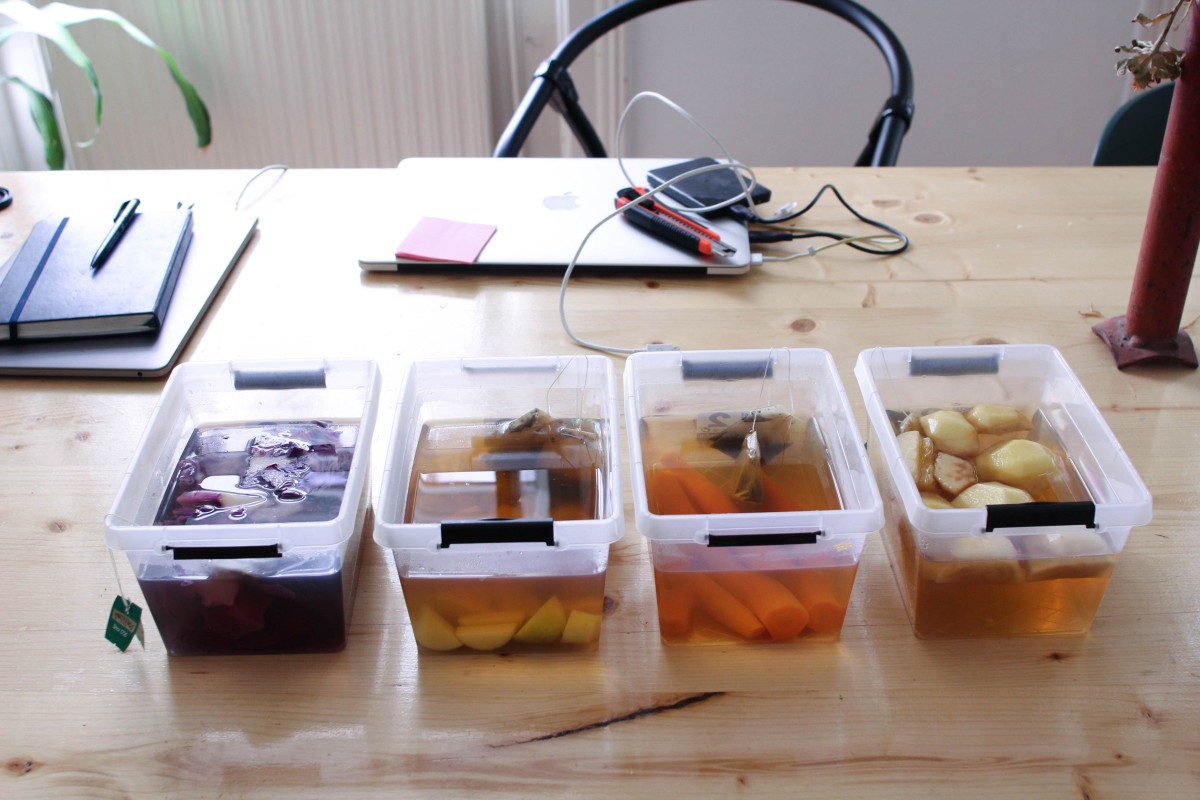
A vivid example of this approach was Bacteria Babies, a bio-art research and production project that ran from April 2023 to February 2024, led by artists Katja Banović and Xavier Madden. The project brought participants into direct, hands-on engagement with living organisms, guiding them through DIY bio-art and science experiments they could also conduct at home.
At the culminating Bacteria Babies: Sip & See exhibition and Adopt a Baby Kombucha event in February 2024, visitors, partners, and collaborators took home kombucha growing kits to continue their bio-art experiments beyond the gallery walls. Some of the students who grew their own kombucha went on to produce bacterial celluloses, which they then — entirely on their own initiative — exhibited at a show organised by the Academy of Fine Arts in Zagreb. The project had moved well beyond its original container.
Alongside its artistic programme, KONTEJNER developed a practice of sensitive mapping workshops, exploring the Vjesnik complex through smell maps, sound maps, and other unconventional cartographies. Unlike standard archival data, which offers a detached and factual account, sensitive mapping engaged the senses and invited people to connect with the space on a visceral and emotional level. Scents brought forth memories; sounds captured atmosphere and feeling.
These workshops deepened both KONTEJNER's own understanding of the spatial context they now inhabited and the emotional attachment of their collaborators to the new space. The knowledge gained allowed the organisation to tailor future activities more thoughtfully — programmes that resonated more deeply with the community while simultaneously building a stronger rapport with the changing landscape of the complex.
The impact extended well beyond the walls of the rented venue. A design, woodwork, and metalwork studio that had collaborated with KONTEJNER on the renovation decided to relocate into the same complex, establishing their practice right next door.
Their move was motivated directly by that collaboration, and it became a living example of the organic growth of a DIY creative community. The studio is now actively involved in most of KONTEJNER's projects — the renovation of the space had naturally led to exhibition setups and artwork productions — and the studio is gaining increasing recognition for its own practice in the process. Adjacent to KONTEJNER, an architectural studio also renovated its offices at the same time, and the public began to notice the shift: once run-down buildings were slowly coming back to life with new and different content.
The path was not without difficulty. The asset structure of the Vjesnik complex is complicated: while KONTEJNER's space is rented from a private owner, the majority of the 30,000-square-metre site is owned by the Croatian government. Access to different parts of the complex was never straightforward, and the rules of engagement remained undefined. Then, in November 2025, the landmark skyscraper at the heart of the complex — the building around which everything else had been built — burnt down.
For two months, KONTEJNER was locked out of its own venue as the police closed off the area. The future of the entire complex is now uncertain, with plans to demolish the skyscraper and no clear path forward for the broader site. The organisation's hope for a wider cultural activation of the Vjesnik complex — something like La Friche in Marseille — remains alive, but the road ahead has grown considerably more difficult.
What endures, despite the uncertainty, is the community that has formed. As an artist who collaborated with KONTEJNER observed: "KONTEJNER is working towards establishing a steady relationship between the public and its participants." That relationship – built through art experiments conducted at kitchen tables, through smell walks in crumbling corridors, through workshops that treated participants not as an audience but as partners – is the real legacy of the Zagreb pilot site.
The space may be temporary, the complex's future unresolved, but the connections made within it are not. They are, as KONTEJNER has always understood, the living material of which genuine cultural communities are made.
Key Takeaways

KONTEJNER | bureau of contemporary art praxis, Exhibition and performance venue — Zagreb, Croatia
Founded in 2002, KONTEJNER is a non-profit organisation engaged in curatorial work, art production, education and critical theory. Its practice focuses on progressive contemporary intermedia art, with emphasis on projects investigating the role of science, technology and the body in society and the ecological and interspecies questions that define the present.