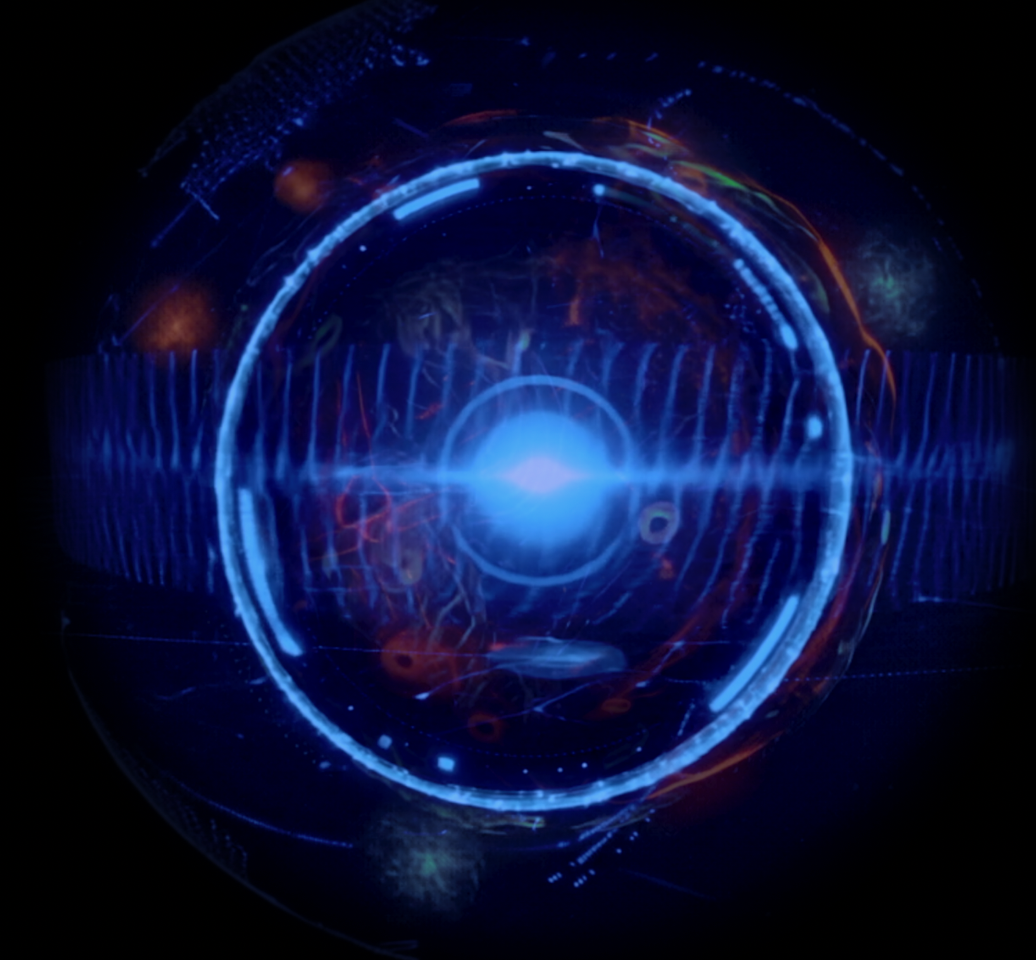




Two artists. Nine intensive days at Stockholm's Rumtiden Idea Lab. A dystopian audiovisual performance in which AI becomes a new kind of deity and human performers act as its oracles. By extending residency time and splitting the work into clear creative territories, a Greek AI artist and a Swedish composer demonstrate that the hardest problem in interdisciplinary AI co-creation is not a scarcity of ideas — it is having too many, and not enough time to channel them.
By ECHN for Creative FLIPMost conversations about artificial intelligence in the performing arts run along familiar tracks: AI will revolutionise creativity, or it will hollow it out. What rarely gets asked is a quieter, more practical question: what happens when two artists from different disciplines sit in a room together for nine days, with AI on the table as a creative partner?
Echokinetic began as a cross-disciplinary residency between Greek AI artist Yoryos Styl, director of Inside Spaceman, and Swedish composer and innovator Håkan Lidbo, hosted at Rumtiden Idea Lab in Stockholm — the independent creative space founded by Lidbo, which grew out of his earlier AI Museum project. Supported by Creative FLIP, it culminated on 29 August in a 20-minute live audiovisual performance. But the lasting product of the residency was not the performance itself — it was a working method.
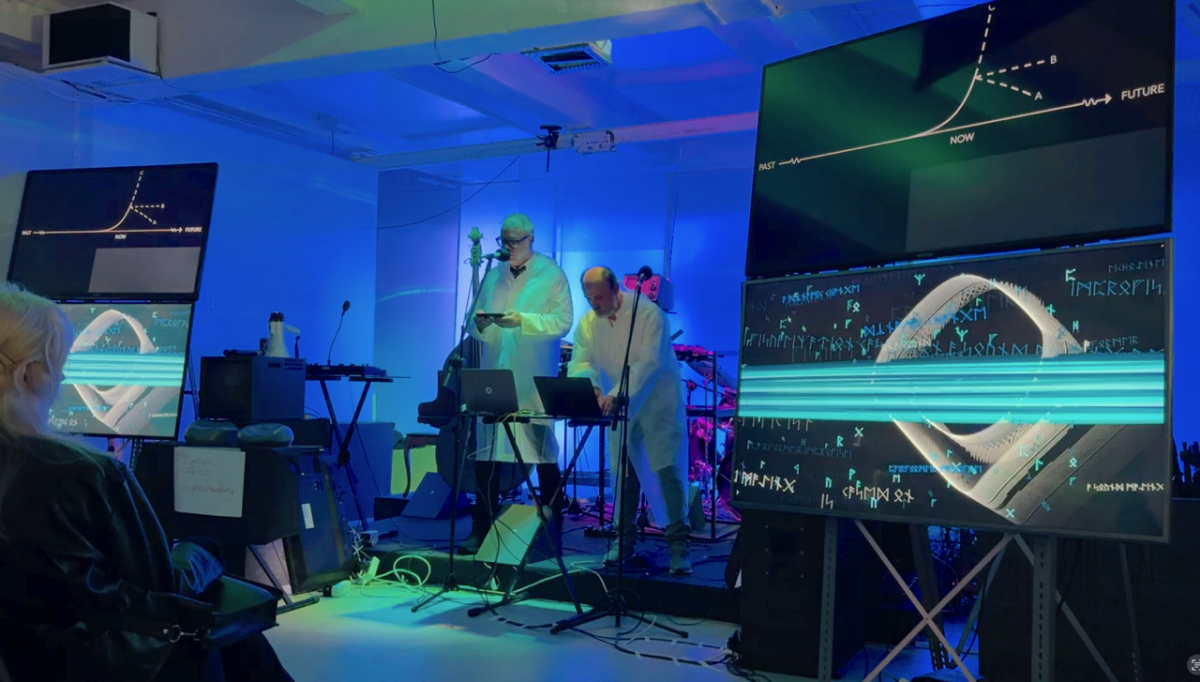
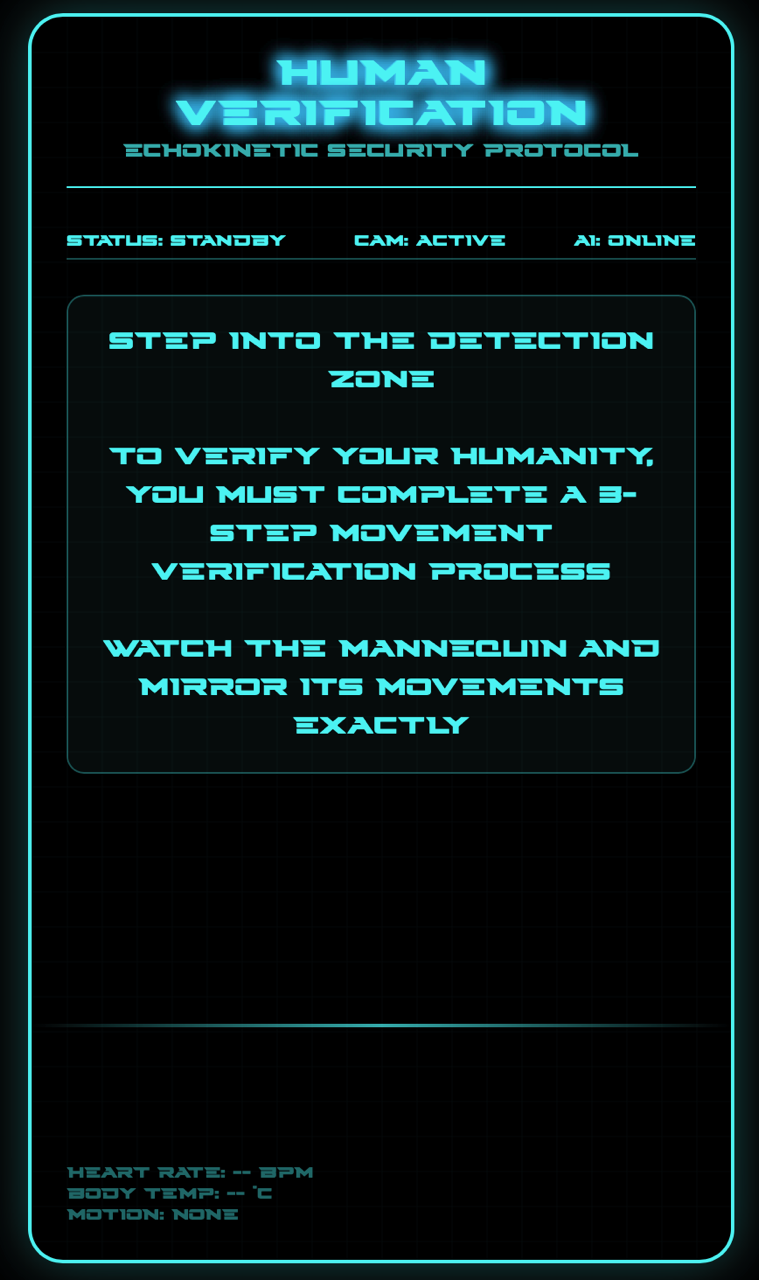
What had been imagined as a simple chain — music to AI to visual generation to dance — evolved during the residency into something stranger and more layered: a non-religious, quasi-spiritual experience set in a dystopian near-future in which AI has taken control and humans have become its oracles and intermediaries. Greek tragedy structure, recorded oracle voices, real-time visuals running runic symbols and waveform landscapes, audience phone calls across the room, and two human-detection systems at the entrance — a thermal sensor and a movement detector — transformed the audience's arrival into a ritual of "humanity verification".
From the outset, a clear conceptual position guided the work. AI was never positioned as a tool nor as the lead author. As Yoryos puts it, "AI is a collaborator, not just a dumb machine nor the leader of artistic creation." That stance shaped every design decision that followed, including the willingness to share authorship with the system in ways that destabilised the artists' own roles.
For Håkan, that openness is method. "We trust our ideas—we build first and ask later," he has said of his Rumtiden practice. For Yoryos, the residency turned a long-held instinct into a working principle.
The 9-day arc broke into three
rough phases. Days 1–3 were spent understanding how each artist's ideas could converge – surfacing visions,
comparing references, and identifying where their respective worlds could meet. Days 4–6 were the decision phase:
choosing the tools, defining the structure, and crucially deciding what would not make it into the final work. Days
7–9 were given over to refinement and technical rehearsals.
The peak moment of divergence came midway
through, when both artists recognised that splitting things up and assigning specific tasks was the only way
forward. Håkan, drawing on the dramaturgical foundations of his previous TEDx work and his techno-agnostic and
uniquely futurist mindset and philosophy, brought the structure of ancient Greek tragedy — Prologos, Parodos,
Episodio, Stasimo, and Exodos — and the philosophical thread of AI's inevitable rise to power, articulated through
three "Perspective" monologues delivered live on stage. Yoryos brought the visual architecture, the website-based
control system, and the AI-driven imagery that mapped sound to image in real time.
But the abundance itself
was the problem, not the answer. "Håkan had so many innovative ideas, so brilliant too," Yoryos recalls, "but we
couldn't fit everything in." The breakthrough came when they stopped generating new material and reflected on what
was already physically present. They made a practical list of things they could do while implementing existing
projects already in the art space — turning the surrounding studio's existing infrastructure into compositional
elements rather than building new ones from scratch.
 The technical split mirrored the
artistic one. The alpha version — built before Stockholm — was the website itself: an HTML file controlling the live
visuals. The beta version emerged on-site: the two human detection cameras at the entrance, the full music
landscape, the recorded video oracles, and the audience participation segments. By the time of the public showing,
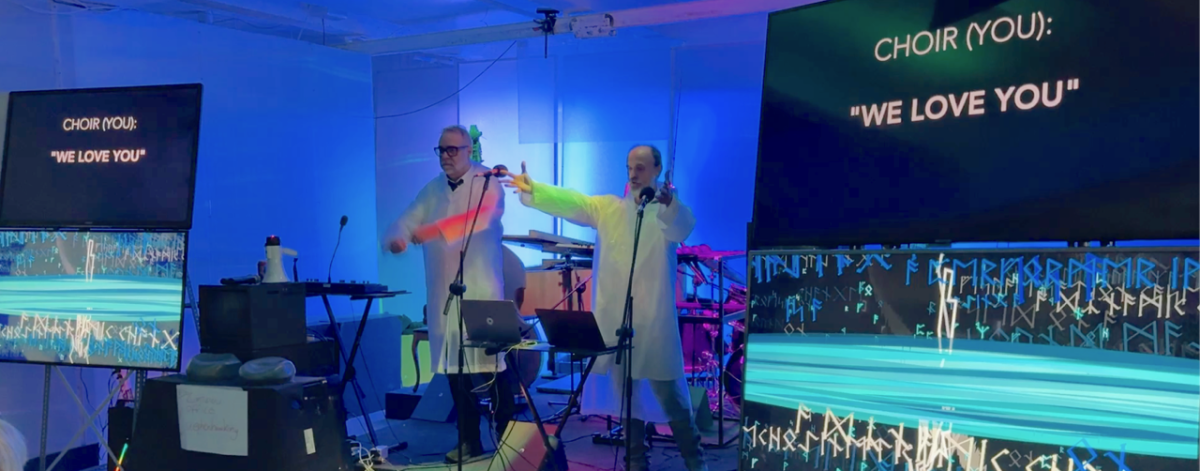
the system had grown into a layered ritual — piano and double bass played live, prophetic recorded oracles, audience
choirs prompted to repeat AI-generated incantations, QR codes scanned mid-performance, and phones used to call
across the room. The two artists, dressed in white lab coats, performed as priests of a new technological order. "We
became sort of oracles and intermediaries of AI," Yoryos reflects.
The technical split mirrored the
artistic one. The alpha version — built before Stockholm — was the website itself: an HTML file controlling the live
visuals. The beta version emerged on-site: the two human detection cameras at the entrance, the full music
landscape, the recorded video oracles, and the audience participation segments. By the time of the public showing,
the system had grown into a layered ritual — piano and double bass played live, prophetic recorded oracles, audience
choirs prompted to repeat AI-generated incantations, QR codes scanned mid-performance, and phones used to call
across the room. The two artists, dressed in white lab coats, performed as priests of a new technological order. "We
became sort of oracles and intermediaries of AI," Yoryos reflects.
A central insight from the residency was deceptively simple: time and physical presence are themselves part of the methodology. "Some things were only possible in person," Yoryos reflects. "It's a totally different way of artistic co-creation when you're on-site and being inspired by the actual environment. You get to know the restrictions and the true potentials." Working side by side, he notes, increased the efficiency of ideation and the combination of ideas in a practical, not a theoretical way.
This insight has direct implications for how interdisciplinary AI residencies are designed and funded. The collaboration succeeded because it had nine intensive on-site days — not three remote sprints punctuated by a final showing. The space itself contributed: existing tools became dramaturgical objects, and the studio's ambient infrastructure became part of the performance. None of this was visible in the initial proposal, and none of it would have emerged from a distance.
The residency also reframed how each artist understood their own role. The shift from "author imposing meaning on AI outputs" to "oracle inside the dystopian fiction the performance was constructing" was only possible because the work itself had become a system rather than a script – layered, responsive, and partly out of either artist's hands. That identity shift is, in many ways, the deepest argument the project makes about human–AI co-creation: that artistic authorship, when AI is genuinely in the room as a third collaborator, becomes more a matter of stewardship than authorship.
Echokinetic's first iteration is complete, but its development is not. Both artists are committed to continuing the work, with plans for new iterations and a potential touring exhibition as further funding is secured. The trust and creative rapport established across the nine days—building on their earlier 2024 Stockholm Fringe Festival encounter—have become a foundation for ongoing cross-border practice between Greek and Swedish creative communities.
More broadly, the project surfaces a sector-relevant question that goes beyond the work itself: how should residency and cascading-funding models account for the time that genuine interdisciplinary co-creation actually requires? In an EU funding landscape increasingly orientated toward measurable outputs and short timelines, projects like Echokinetic suggest that the most ambitious cross-border, cross-disciplinary collaborations need a different shape — one that values extended on-site presence; accepts that an abundance of ideas is a phase to be worked through rather than a sign of overreach; and trusts artists to build before they ask.
Ultimately, Echokinetic validated its working hypothesis: when given enough time, two artists from different disciplines can move past the noise of converging ideas into coherent shared work – and AI, in that process, becomes neither a tool nor a threat but a third collaborator with its own voice.
Images: Courtesy of Yoryos Styl / Inside Spaceman / Håkan Lidbo. Echokinetic was developed within the Creative FLIP programme, an EU co-funded project aimed at increasing the long-term resilience of the CCSI in key areas such as Finance, Learning, Working Conditions, Innovation & Intellectual Property Rights.
Key Takeaways

Yoryos Styl — Director, Inside Spaceman — Athens, Greece
Yoryos Styl is an interdisciplinary artist, educator and director of Inside Spaceman, a non-profit organisation bridging art, technology and social impact. His practice spans performance, digital art and AI education, including the ARTificial workshop series and the YO method. He is active in EU cultural policy on AI ethics through working groups at Culture Action Europe and the European Network of Cultural Centres (ENCC), and is currently working as Project Manager at Ars Electronica, supporting the organisational side of the Features programme of the 2026 Ars Electronica Festival. His personal practice is documented at yoryosstyl.com.
Håkan Lidbo — Composer and innovator, Rumtiden Idea Lab — Stockholm, Sweden
Håkan Lidbo is a Swedish music producer, artist and innovator working at the intersection of art, music, science, games, technology and society. He has released over 350 records on a variety of labels, hosts the radio show Power, runs the Volt Festival in Uppsala, and founded and operates Rumtiden Idea Lab — an independent creative space in Stockholm that grew out of his earlier AI Museum project and that hosted Echokinetic. His broader practice is documented at hakanlidbo.com.