Europeana is Europe's digital platform for cultural heritage, aggregating and providing access to millions of objects from museums, archives, libraries and galleries across the continent. The Europeana Foundation, which operates the platform from its base in the Netherlands, has long understood that digitisation alone is not enough. Making heritage digitally accessible requires people — conservators, educators, marketers, archivists, and technologists — who know how to work in a digital environment and who can adapt as that environment shifts. The Europeana Academy was the institutional response to that need: a training programme and platform, years in preparation and formally launched in 2024, that places skills development at the centre of the cultural heritage sector's digital transformation. Here is how:
The ambition from the outset was clear. "Knowledge was the key power element in the past," says Sebastiaan ter Burg, training and development advisor at the Europeana Foundation. "This changed through the digital world. Skills are the power of the future. Increasing the democratic access to skills and knowledge is in line with the European and Europeana values." That framing – skills as a democratic resource, not a competitive advantage – runs through every dimension of the programme, including the decision to license all courses under Creative Commons, making them freely reusable by anyone, anywhere.
A sector that does not speak with one voice
The most significant design challenge the Academy faced was also the most fundamental: the cultural heritage sector in Europe is not a single thing. It encompasses institutions of vastly different sizes, mandates, budgets and technical capacities. A small volunteer-run local museum may be attempting to publish its first website. A major national archive may be working with APIs, large-scale metadata pipelines and crowdsourced annotation tools. Any training programme that assumes a common starting point will fail most of its audience.
"Knowledge was the key power element in the past. This changed through the digital world. Skills are the power of the future. Increasing the democratic access to skills and knowledge is in line with the European and Europeana values." — Sebastiaan ter Burg, Training and Development Advisor, Europeana Foundation
To address this, Europeana established an internal digital transformation task force charged with mapping the actual range of skills needed across the sector and determining the most workable programme architecture. The task force concluded that a fixed curriculum was not fit for purpose. A modular approach, in which participants can enter at the level appropriate to their context and follow pathways relevant to their specific role and institution, was the more honest and more useful design.
The result is a programme that offers two distinct modes of engagement: self-paced online courses that participants can access flexibly and reuse freely, and instructor-led courses in which learners work toward defined outcomes and receive direct feedback. "The Europeana Academy is an open format to anyone, anywhere", says Gina van der Linden, Senior Events Manager at the Europeana Foundation, "whatever their personal or professional background, to learn and discuss the digital transformation related to the cultural heritage sector."
As a flagship initiative funded by the European Union, the data space enables the sharing and reuse of cultural heritage data across Europe. Built on cutting-edge technical infrastructure, it offers a suite of tools, standards and frameworks, supported by a vibrant and collaborative community. Led by the Europeana Initiative, the data space empowers cultural heritage institutions and Member States to embrace and drive digital transformation.
The content of the Academy spans a wide range, from storytelling and audience engagement at one end to 3D digitalisation and metadata quality at the other. AI is increasingly present across the programme, though the team is careful to resist the assumption that AI is a single subject. Metadata enrichment, image enhancement and automated tools have been part of the cultural heritage workflow for years; what is new and rapidly expanding is generative AI, and with it a set of questions that are as much ethical as technical.
The pace of change in this space creates a structural problem for any training provider. "One of the biggest challenges is that we may develop a course about a tool that looks very different only a few months later," says Eleftheria Tsoupra, training-resources developer at the Europeana Foundation. "Quality assurance in times of rapid technological change requires constant adaptation." The academy's response has been to shift emphasis away from tool-specific instruction and toward transferable principles, critical thinking, and the underlying logic of digital systems—equipping participants to navigate change rather than simply operate within the current moment.
"One of the biggest challenges is that we may develop a course about a tool that looks very different only a few months later. Quality assurance in times of rapid technological change requires constant adaptation" — Eleftheria Tsoupra, Training Resources Developer, Europeana Foundation
The ethical dimension is particularly alive in the context of AI. Cultural heritage institutions hold vast quantities of data — images, texts, metadata, and provenance records — and the question of how that data is used, by whom, and under what conditions is not a secondary concern. Understanding data ownership, maintaining control over institutional assets, and developing the critical literacy to evaluate AI applications on their own terms is increasingly treated within the academy as a core competency, not an elective.
The reach of the programme has already extended beyond Europe. "Most of our participants are from Europe, but the courses have also gained international interest," says Maike Dulk, software developer at the Europeana Foundation. 'I was most impressed by a comment from a participant writing 'fantastic' in Arabic after they completed a training. We are considering now providing our training in more languages than English. "The Summer Academy planned for 2026 will further extend the programme's scope, bringing participants together in person for the first time and combining skills development with the kind of cross-institutional networking that no online course can fully replicate.
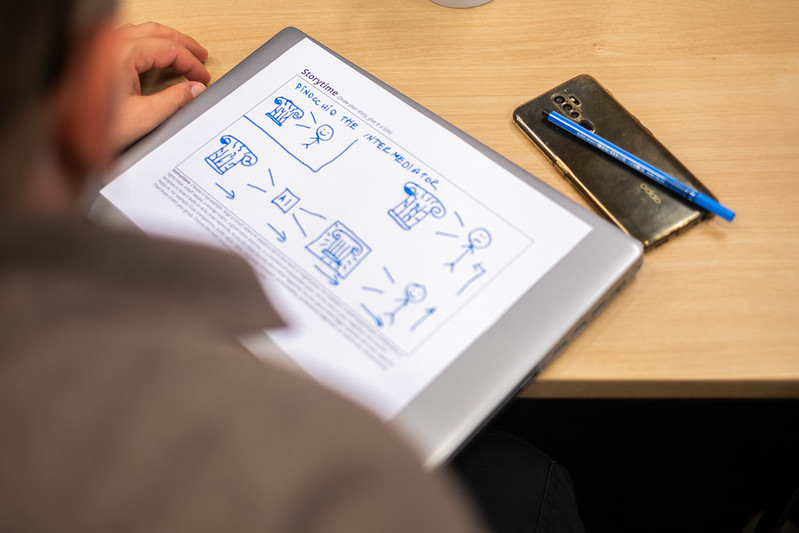
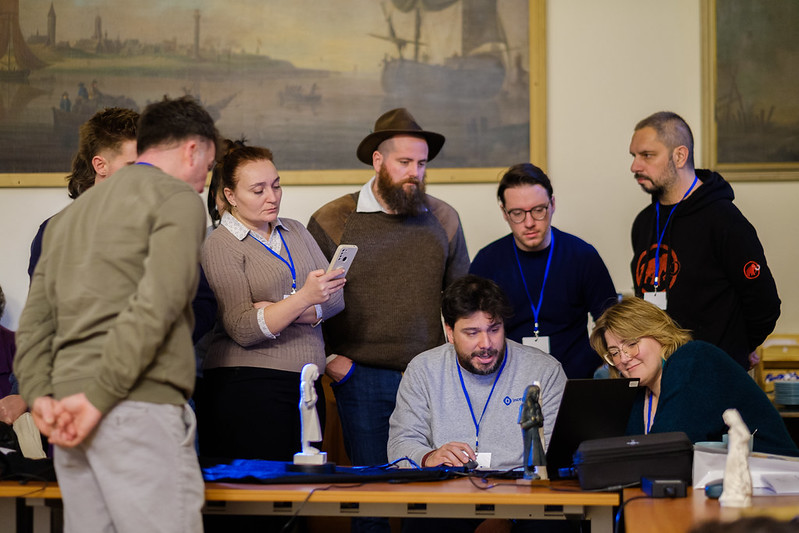
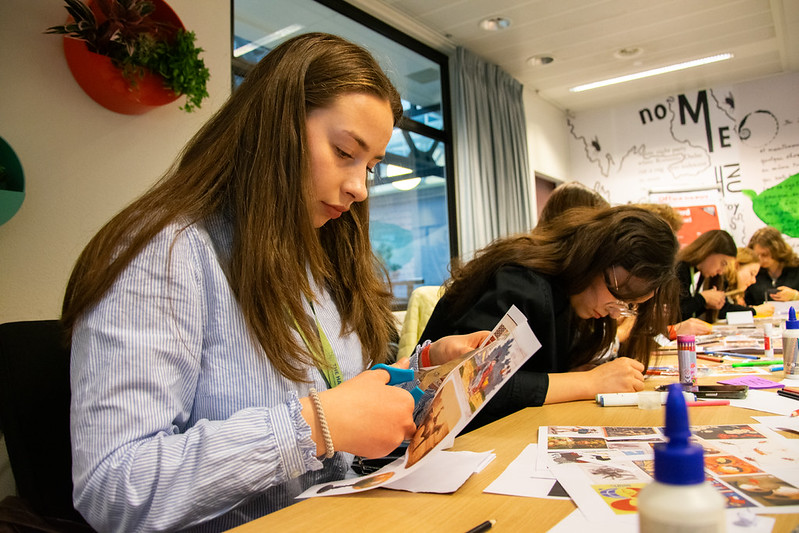
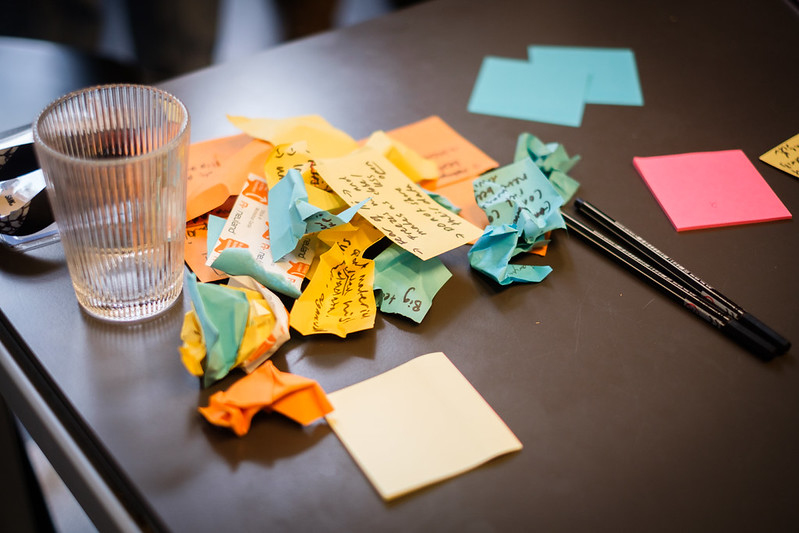
Images: 3D-4CH Winterschool 2026 & Cross-community workshop on Culture for AI, Courtesy of Europeana Foundation, CC BY 4.0
This case study was created under Creative FLIP, an EU co-funded project aimed at further increasing the long-term resilience of the cultural and creative sectors in key areas such as Finance, Learning, Working Conditions, Innovation and Intellectual Property Rights.
Key Takeaways
- Digital and AI training should be designed as interconnected learning pathways, recognising that topics such as AI and 3D modelling involve diverse skills and applications.
- Developing digital training platforms requires strong expertise in GDPR compliance, open-source solutions, and data sovereignty, including the potential need for proprietary platforms.
- European values underpin the licensing of Europeana Academy courses under Creative Commons; however, restricting access to content remains technically complex, and AI misuse reflects broader challenges related to data use and abuse.
Interviewee

Sebastiaan ter Burg Training and Development Advisor, Europeana Foundation — The Hague, Netherlands (top left)
Sebastiaan ter Burg works on digital capacity building for the cultural heritage sector. He has a background in business administration, management and content production and worked as a freelance workshop designer, facilitator, videographer and photographer for Europeana before joining the organisation in 2020. A long-standing advocate for open access, he co-founded Open Nederland, an association promoting the use of Creative Commons licences in the Netherlands.
Eleftheria Tsoupra Training Resources Developer, Europeana Foundation — The Hague, Netherlands (top right)
Eleftheria Tsoupra has worked with Europeana since 2018, initially in data aggregation and metadata quality. She co-chaired the Europeana Data Quality Committee and coordinated work on data quality improvement across the platform. She now develops training resources for the Europeana Academy, supporting cultural heritage professionals in building new digital skills and knowledge.
Gina van der Linden Senior Events Manager, Europeana Foundation — The Hague, Netherlands (lower left)
Gina van der Linden leads the strategy, planning and delivery of international events at Europeana, bringing together professionals from across Europe's cultural heritage sector. She specialises in conferences, workshops and community gatherings that foster collaboration and knowledge exchange, with a focus on making Europeana's mission tangible for the communities it serves.
Maike Dulk Software Developer, Europeana Foundation — The Hague, Netherlands (lower right)
Maike Dulk studied physics and visual arts and has worked as a programmer across the Netherlands and Canada. At Europeana, she works on the software infrastructure underpinning the Academy's training platform. Outside work, she makes music, creates 3D animations, draws, and writes poetry in Sindarin.
Related articles