
HBKsaar’s pilot project explores how design education can drive a regenerative economy. By integrating circular principles, ecological responsibility, and sustainable creative practices, the initiative empowers designers to foster environmental renewal and positive systemic societal change.
By ECHN for Creative FLIPHBKsaar's entrepreneurship education already taught graduating students how to build a business. What it didn't teach was how to think about the sustainability and regenerative economy questions those same graduates would run into almost immediately in professional practice – questions the school's product design and communication design cohorts, in particular, needed answers to before they left.
The pilot ran into a language problem almost straight away. Local SMEs took to "regenerative economy" as a genuinely useful reframing of sustainability – it's sharper, more strategic, and less exhausting as a term. Students, by contrast, tended to hear "regenerative" and "sustainable" as the same word wearing different clothes, which undercut the distinction the whole pilot was built on.
A second problem ran deeper, and it wasn't really about sustainability at all. It was about what art school teaches students to believe about themselves before any of this comes up. "The minute you walk in the door of an art academy, the first thing you're told is you're unique. You're an individual. You're singular." — Dr Sönke Zehle, HBKsaar
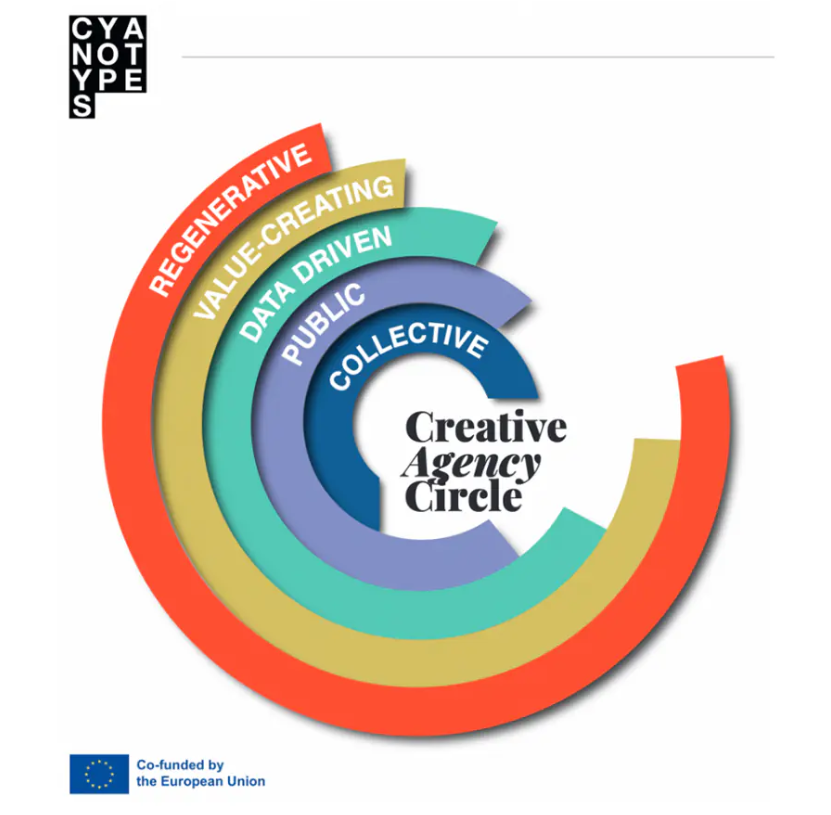
That instinct is useful for a portfolio. It's much less useful for "collective agency" — one of the core CYANOTYPES clusters the Regenerative Economy Lab depended on. Dr Zehle described the starting point plainly: teaching collective work in an art school context means starting from a deficit, a built-in scepticism toward anything held in common.
Since 2022, twenty organisations across Europe have been working under a single, slightly unusual banner: CYANOTYPES – Strategic Skills for Creative Futures, an Erasmus+ Alliance for Sectoral Cooperation on Skills coordinated by HKU University of the Arts Utrecht.
The project takes its name from the iron-based photographic process that gave us the word "blueprint" and its ambition from a straightforward but demanding premise: that the cultural and creative industries need anticipatory, not reactive, ways of building skills for the transitions now reshaping the sector. Rather than hand its partners a fixed curriculum, CYANOTYPES built a framework – creative agency clusters, cross-cutting themes, and a "triple-loop" logic meant to help people "learn how to learn" – and invited them to test it through a series of open pilots.
HBKsaar's answer was to embed CYANOTYPES tools — the Creative Agency Model, the Blueprinter AI navigation tool, and the project's card deck — directly into the existing entrepreneurship curriculum rather than teach them as a bolt-on module. The framing Dr Zehle used with students and staff was deliberately not "This is regenerative economy theory" but something closer to a shared working premise:
A lab, in this framing, isn't a room or a set of tools — it's a set of shared techniques for handling data, authorship and process together, which is exactly the ground on which the collective agency problem needed to be fought. Rather than lecturing students out of their scepticism, the creative agency model was used to bring different departments together on shared projects, putting collaborative practice in the room instead of leaving it as an abstract argument to win.
The same instinct shaped how HBKsaar responded once it became clear the SME relationship wasn't working as designed. Dr Zehle has described his broader approach to institutional change as "bypass, not battle" — building workable alternatives that slot into existing workflows rather than arguing people out of the ones they already have. Applied here, that meant not trying to talk students into using the word "regenerative" correctly but redesigning the encounter itself: shifting from a format where students learnt about SMEs to co-creation formats, where students and business partners worked to explore the extent to which regional SMEs already adopt regenerative principles, focusing on how value creation was organised in practice rather than the terms used to describe it.
The pilot also travelled somewhere it wasn't designed to go: a nearby vocational school, already working on future-skills and student-resilience questions of its own, adopted the framework independently — evidence, in Dr Zehle's telling, that the CYANOTYPES structure is modular enough to move between very different educational contexts without losing what makes it useful. Regional SME interest has grown alongside it, driven in part by businesses looking for longer-term strategic thinking in an uncertain policy environment — exactly the appetite the "regenerative" framing was built to speak to.
What doesn't show up in a grade book?
Asked what the pilot actually achieved, Dr Zehle didn't reach for a conventional metric. He pointed instead to something harder to put a number on: students' resilience and their willingness to sit with the existential weight of climate change and AI-driven uncertainty rather than look away from it. In his account, this is where the real work of the lab happened — not in test scores, but in whether students came out of it more able to, as he put it, help
That's a difficult thing to build an impact framework around, and Dr Zehle was candid that CYANOTYPES hasn't fully solved it. It's part of why the project is now revisiting its own Creative Agency Circle framework — reopening its thinking on collective agency in particular to account for developments in AI that have moved faster than the framework's original 2022 design anticipated. The Regenerative Economy Lab, in other words, isn't just a pilot CYANOTYPES ran. It's one of the experiences the project is now learning from.
Images: HBKsaar / CYANOTYPES project materials
Key Takeaways
Embedding a European skills framework inside existing entrepreneurship teaching, rather than bolting it on, gave it staying power: the Regenerative Economy Lab has become a permanent part of HBKS's curriculum, not a one-off pilot.
"Regenerative" and "sustainable" landed very differently with SMEs and students — closing that gap took a redesign of the SME relationship itself, not a better explanation of the term.
Collective agency is a hard sell in a culture built on individual authorship; HBKS met that resistance with structure (the Creative Agency Model) rather than argument.
The pilot's most-cited impact — student resilience in the face of climate and AI-driven uncertainty — doesn't show up in conventional assessment metrics, prompting CYANOTYPES to reconsider how it measures impact across all its Open Pilots.

Dr. Sönke Zehle is based at HBKS Saar (Hochschule der Bildenden Künste Saar), where he leads the university's CYANOTYPES Open Pilots, including the Regenerative Economy Lab and the Generative Arts and Design Lab. Also listed as pilot contacts: Sónia Alves and Hannes Käfer (HBKS project supervision).