


In the breadbasket of southern Ukraine, a transdisciplinary team is reimagining reconstruction — using straw, hemp, wool, and mycelium. They're not only rebuilding houses but also communities, traditions, and most importantly, the sense of home in the war-devastated country.
HOPE HOME • НАДІЯ began as a question posed at the end of a thirteen-year travelling exhibition titled EXAMPLES TO FOLLOW!. It focused on current artistic and scientific approaches to traditional building materials such as hemp, wool, willow, straw, and their interconnections. It has since grown into a pilot project demonstrating that ecological reconstruction is possible in active war zones — and that the act of building together can be as restorative as the building itself.
The vote among participants pointed to a war zone or an area struck by natural disaster—places where human suffering and displacement were compounded by severe ecological damage. Collapsed houses, whether from shelling or flooding, carry consequences far beyond the immediate destruction. Conventional building materials like concrete and steel, typically deployed in rapid reconstruction, come with a devastating environmental cost: the construction sector is responsible for 30% of CO₂ emissions, 40% of energy consumption, 50% of resource consumption, 60% of waste generation, and 70% of surface sealing. 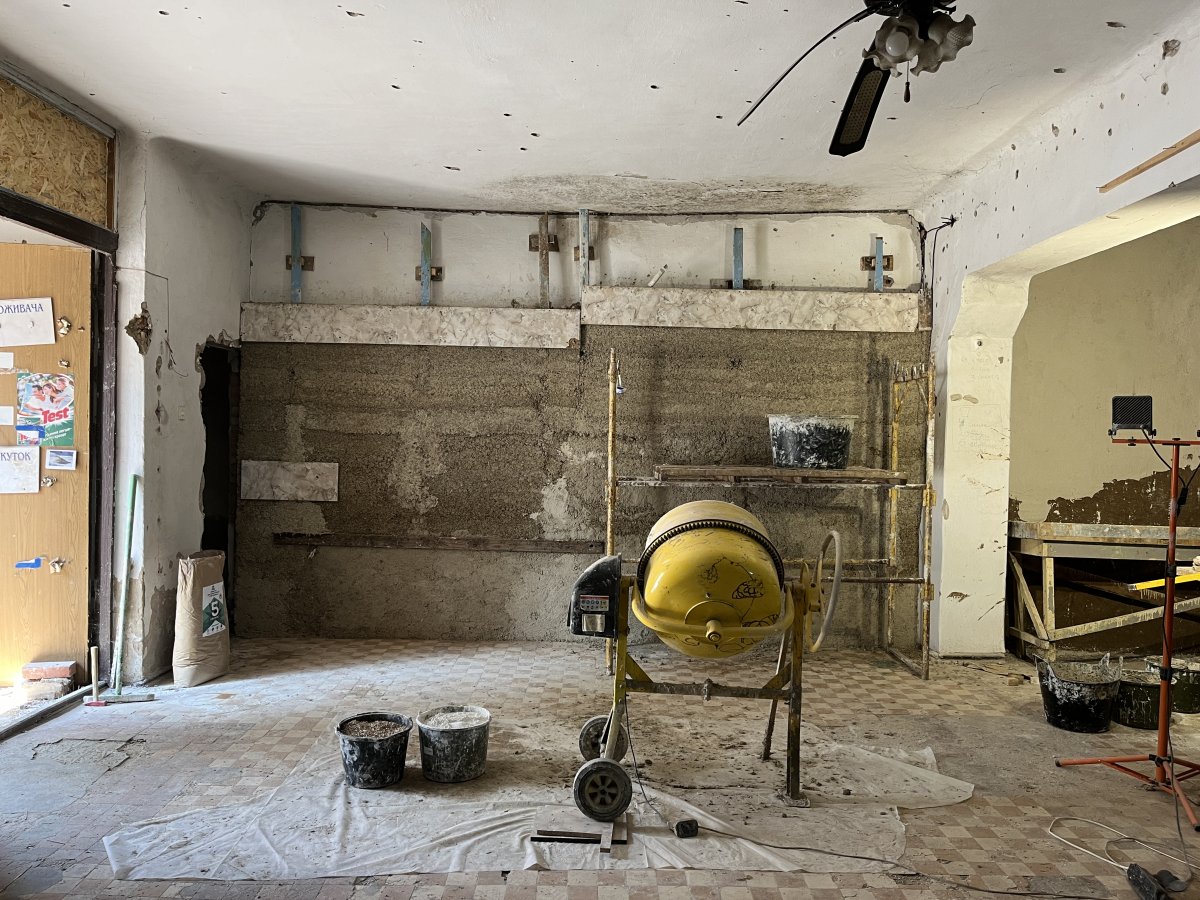
Against this backdrop, the renewable, CO₂-neutral, and compostable materials at the heart of HOPE HOME • НАДІЯ represents something more than an aesthetic or philosophical preference—it represents an unforeseen potential for transforming one of the world's most polluting industries, precisely at the moment when large-scale reconstruction is unavoidable. So the Mykolaiv region in Ukraine's south became the project's pilot territory. The choice was deliberate on multiple levels.
Mykolaiv is the breadbasket of Ukraine, a place where straw — the project's most important building material — is the most significant agricultural by-product. Rural village structures, operating in what the team describes as "the slipstream of the concrete construction industry cartel", offered the best conditions for working with traditional techniques.
And crucially, the region provided fertile ground for building on 'Toloka' – the deeply rooted Ukrainian cultural tradition of neighbours helping one another with harvesting, house-building, and repairs. A necessary memorandum was signed with the head of the Mykolaiv military administration.
At the village of Pervomaiske the team developed a holistic pilot demonstrating comprehensive ecological rebuilding, connecting natural sciences and agriculture with local entrepreneurs; universities and colleges from both Ukraine and Germany; companies; NGOs; and the village council itself.
The project's founding conviction was that the dimensions of physical reconstruction and social integration cannot be separated. As the team put it: "Integration begins in the very process of rebuilding: through working together, through shared responsibility, and through the use of materials that people understand, trust, and can work with themselves."
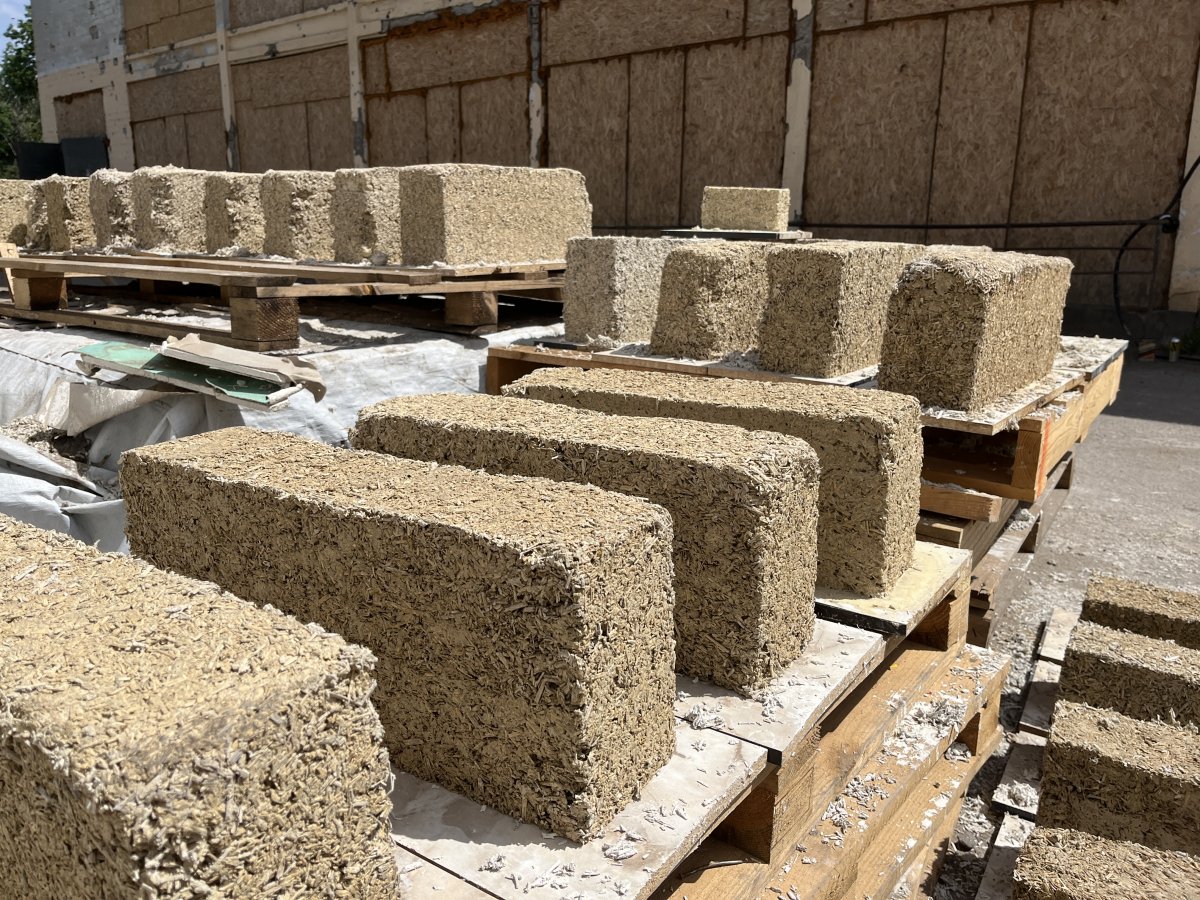
That conviction had to contend with the widespread assumption the team encountered on the ground: that concrete is modern, whereas traditional materials are inferior. Working with young people from Pervomaiske on walls and bricks made from straw-clay and hemp-lime composites, the team helped prepare a 150-square-metre space for a youth club. The transformation in how participants perceived both the materials and themselves was striking.
Within days, the technical narrative about the concrete's properties gave way to something more powerful: "Now we can repair my grandmother's house," followed by another question: "Could we start a small eco-construction business in the village?"
At this moment, the team met the project's deepest ambition, as "a valuable sense of self-efficacy and community became tangible".
The credo of HOPE HOME • НАДІЯ – moving from showing to doing together – is rooted precisely in this kind of experience: the moment when knowledge becomes personal capability and recipients of aid become active builders of their own environment.
The team draws on the concept of home as a "third skin" – an extension of the self that provides orientation, safety, and belonging. When a home is destroyed, whether by shelling or flood, the loss is not only structural. 'The loss of one's home is not only a physical loss but also a loss of orientation, safety, and what could be described as an 'inner home'. Without addressing this dimension, integration remains incomplete," they say. Rebuilding with one's own hands becomes more than construction: it becomes a process of reconnecting to oneself and to the world.
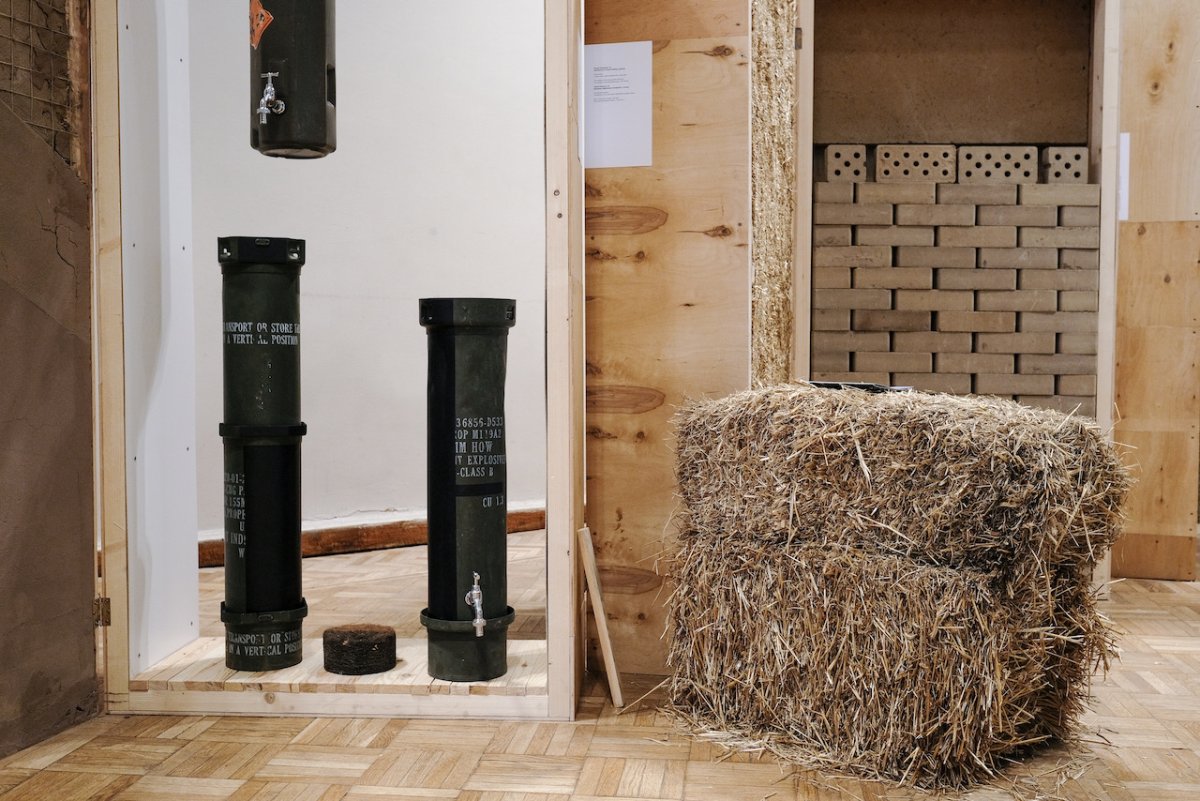
A major milestone came in September 2024 with a material exhibition at the Chamber of Architects in Kyiv. After months of intensive online workshops between experts from Ukraine and Germany, the project took a striking physical form: a long wall of panels made from sheep wool, willow, straw, clay, hemp, reed, and mycelium – alongside what the team called 'waste materials', including tetrapaks and even grenade casings. The exhibition made visible the range of possibilities and the network of expertise that had been quietly assembled across borders, under conditions of war.
Later, the establishment of a mycelium lab at the intersection of the Kyiv National University of Architecture and Construction and the Ostriv Platform, inspired by a Citizen Lab model from TU Berlin, started producing building components. Among other things, the lab is pursuing a question that sits at the intersection of ecology and the aftermath of conflict: can fungi, as a composite with straw or hemp, encapsulate toxic war debris in a way that poses no risk to the environment, people, or nature? An answer — if one can be found — could have implications beyond Ukraine.
 All of this work has been captured and made freely available. From the project's various phases, a reader on natural building materials has emerged as an open-source resource, designed to be accessible in three languages to anyone eager to learn, study, or research. The team is explicit about its relationship to knowledge: "Sustainable solutions often already exist, embedded in local practices, traditions, and materials. The task is not only to create something new but also to recognise, connect, and reinterpret what is already there."
The project does not shy away from the structural obstacles it faces. International aid organisations, as the team has discovered, are often limited to funding only windows and roofs — and even that is insufficient. The destruction inside homes and within the people who lived in them rarely enters the accounting.
HOPE HOME • НАДІЯ operates phase by phase, planning together with the people of Pervomaiske. The project's ambition – to make Ukraine a pioneer of ecological, regenerative building practices and to strengthen regional economic cycles – is held side by side with a much smaller, real, everyday scale: a repaired room; a shared meal; a grandmother's house made liveable again.
When asked what someone overwhelmed by the scale of global challenges might do, such as war or climate catastrophe, the team's answer returns to the sensory: "Pay attention to your immediate environment, to the materials, the space, and the people around you. Recovery begins with recognising the value of what already exists," they say.
Repairing a room together, experimenting with local materials, starting a conversation, and sharing knowledge are means to heal and restore a sense of connection to place, to community, and to oneself.
Download the HOPE HOME • НАДІЯ Material Book which explores natural building materials that have shaped Ukrainian architecture for centuries, including wood, clay, straw, and reed. The publication brings together traditional knowledge and contemporary research, demonstrating the durability, ecological value, and thermal performance of these materials, while also addressing architecture’s role in trauma-sensitive and healing processes.
Key Takeaways

Adrienne Goehler is the initiator and curator of the pilot project HOPE HOME • НАДІЯ. It builds on the exhibition EXAMPLES TO FOLLOW!, through which she spent 13 years travelling the world to highlight pioneering initiatives. With HOPE HOME • НАДІЯ, she takes the next step from showcasing to active implementation. The knowledge gathered through the exhibition, combined with recent research and close exchange with practitioners across disciplines, led to a central question: where could this knowledge have the most meaningful practical impact? “Somewhere where it really, really matters” became the guiding idea.
With Sofiia Halat, she found a co-curator and project lead in Ukraine who shares this holistic perspective. Sofiia is an architect based in Kyiv, currently a PhD candidate at the Kyiv National University of Construction and Architecture (KNUCA). She also teaches materials science and runs her own architecture studio in Kyiv.
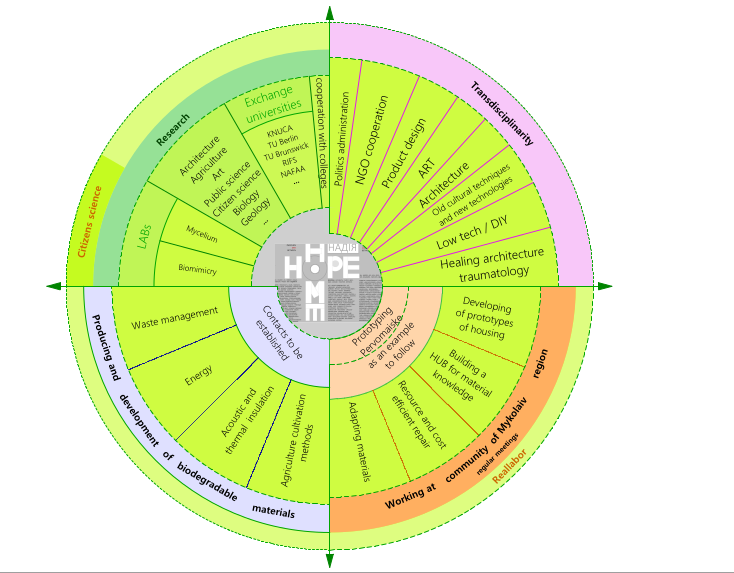
Since early 2024, they have built a binational, interdisciplinary team and network spanning universities and academic institutions, craftspeople, experts from science, art, and citizen science, farmers, and practitioners directly involved in building processes, as well as actors from local and regional politics and administration. This network enables HOPE HOME • НАДІЯ to work across disciplines and contexts, fostering active exchange between diverse forms of knowledge.