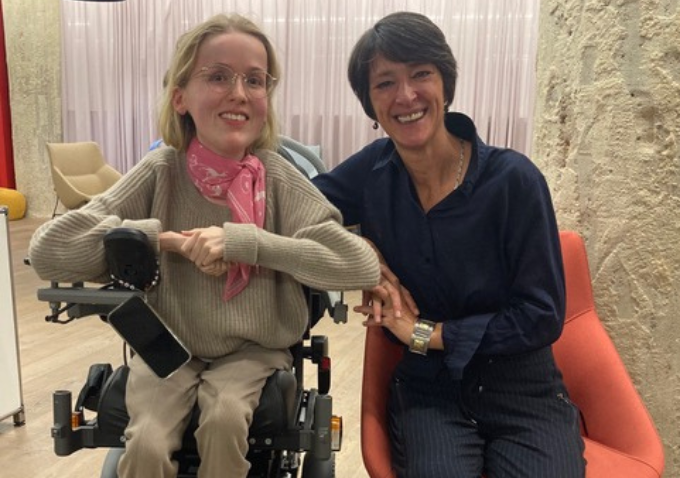



Most clothes labels are uncomfortable, often unreadable, and ignored by the majority of people who wear them. For the estimated one in four Europeans living with a disability, they represent something more serious: a design system that was never built with them in mind. Fashion, broadly speaking, has the same problem — and it is not only a social one. The design failures that exclude people also undermine circularity: when labels are cut off for comfort, the material data needed for recycling goes with them. Rut Turró a fashion product expert and founder of MovingMood consultancy, focuses on improving real-life usability in fashion design.
Fashion has long operated through prototypes of exclusivity – as though it were made for a narrow and homogeneous body of consumers. Clothes labels concentrate many of their failures in one small piece of fabric: the writing is tiny, the information is disorganised, the material rubs against the skin, and most people end up cutting them off for comfort. For people with visual impairments, dyslexia or cognitive disabilities, they are simply inaccessible. Many garments are not designed to be worn by people who use wheelchairs or have limited mobility. And for elderly users whose dexterity, vision or cognition has shifted over time, mainstream fashion offers little accommodation.
But the consequences extend beyond inclusion. A garment whose label has been removed cannot be properly recycled — its fibre composition is unknown, and its care instructions are gone. Poor accessibility and poor sustainability turn out to be symptoms of the same underlying problem: a design process that has not asked enough of itself. As Turró puts it, "From a circular and sustainable perspective, we lose valuable information when it comes to the recycling process. We don't know which materials this t-shirt or jumper is made of. You see, one problem leads to another."
Rather than creating separate adaptive collections, Turró's work focuses on embedding accessibility criteria directly into the design process so garments function better in everyday use — for people with disabilities and everyone else. As she says, "We believe that everyone should be able to wear clothes that are both stylish and functional, regardless of their ability or disability."
The textile, clothing, leather and footwear sector employs around 2.2 million people across the EU, making it one of Europe's most significant manufacturing industries. Consumers across the continent already struggle to make sustainable fashion choices, in part because labelling is unclear and unstandardised. With terms like "eco-friendly" and "natural" left largely undefined, green claims made by companies are difficult to verify—opening the door to widespread greenwashing, according to a recent analysis published through the European Commission's Structured Dialogue on culture and climate issues.
The accessibility dimension is equally pressing, and the two are more connected than they might first appear. "According to research, all people live approximately eight years with a disability. As you get older, you lose mobility, vision, and hearing," Turró explains. This is not a niche condition affecting a minority. It is a universal experience, deferred. Designing for it is not charity — it is good product thinking, and increasingly, good environmental thinking too.When asked about the nature of innovation in this field, Turró pushes back against the assumption that it must be technological. "We tend to associate innovation with technology, but a lot of it involves providing solutions," she says. "Do you use the internet? Do you use the telephone, the remote control, email, or text message? All of these inventions were designed to solve a problem of people with disabilities — reduced mobility, hearing, speaking, and different challenges." The implication is clear: some of the most transformative tools in daily life began as accessibility solutions. Fashion, she argues, can follow exactly the same logic.
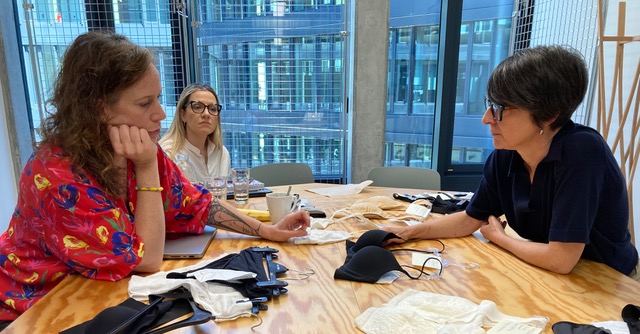
This reframing is central to how MovingMood positions its work. Through the consultancy, Turró works with designers, brands and institutions to improve garment usability and decision-making across the product development process. Her programmes combine product expertise, design frameworks and targeted training to help teams identify where garments create friction — and how to fix it before those garments reach the market. "In our case, accessibility is a major field for innovation," she says, "as one thing is designing clothes, and another is solving problems."
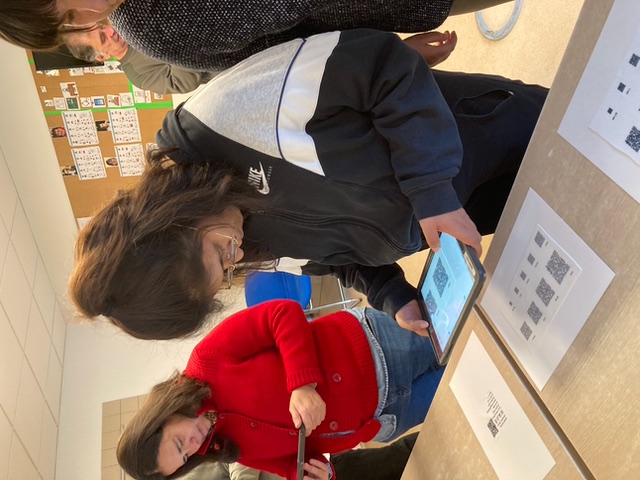
The process MovingMood applies follows a deliberate sequence. It begins with research: workshops with users—including the visually impaired, people with dyslexia, those with cognitive and intellectual disabilities, and elderly participants—to map the friction points that arise when buying, using and recycling garments. "Before we address the needs of any customer, organisation or company, we research," Turród explains. "We apply different labels on the garments — comfortable, useful for washing — then conduct interviews, and the designer starts. We move to functionality tests with different materials, and we end with beauty."
That ordering matters. Aesthetics come last, not first. It is a deliberate inversion of how fashion typically operates, and it reflects a core conviction: that a garment's ability to function well for a wide range of bodies is a precondition of good design, not an optional enhancement to it. The innovation, Turró notes, also multiplies outward. "It comes when a group of designers start adding accessibility to their collections. They work with other focus groups — people with disabilities — thinking out of the box and taking designers out of their comfort area." The process is as much about shifting professional culture as it is about producing better garments. The innovation comes when designers start adding accessibility to their collections — thinking out of the box and being taken out of their comfort area.
For the label project specifically, Turró is collaborating with Lisi Badia of Badia Boutique Studio to develop a policy recommendation on accessible textile labels. The ambition is to build a clear framework applicable to any label format — physical or digital — that unifies the needs of people with disabilities and elderly users into a single, coherent standard. "We must unify the needs of people with disabilities and seniors and develop a clear framework easy to apply to any label format, physical or digital," Turró says.
 The timing is deliberate. With the EU's new circular and sustainable textiles strategy advancing, and a digital product passport set to transform how garment information is communicated, there is a genuine window of opportunity to hardwire accessibility into the regulatory framework — alongside sustainability. MovingMood is already cooperating with EU policymakers on the textile label regulation to ensure that accessibility becomes a mandatory criterion in what comes next, not an afterthought grafted onto a system designed without it.
Key Takeaways

Rut Turró is a fashion product expert and founder of MovingMood, a consultancy focused on improving real-life usability in fashion design. She has 23 years of experience researching textiles and disability across Europe, Australia, Mexico and India, and has received multiple awards for innovation and social impact, including Worth, Social Challenges and S4F.