

By treating AI as a collaborative tool rather than a competitive threat, two artists, a digital innovator from rural Galicia and a Belgian textile upcycler, developed a methodology that empowers artists to control their creative process, minimise waste, and reimagine sustainable design.
By ECHN for Creative FLIPCreators can copy their personalised AI training to mirror specific artistic styles. By digitally pre-visualising designs on garments before cutting, artists minimise waste. This enables a "concept-to-order" model: selling AI-generated prototypes online and physically producing the piece only after a sale, effectively eliminating unsold inventory and material risk.
Most conversations about artificial intelligence in the creative sector revolve around two poles: enthusiasm and fear. AI will unlock new possibilities, or it will hollow out artistic practice. What rarely gets asked is a more practical question: what happens when an artist actually takes control of it? AI for Upcycled Futures began as a five-day residency between a digital innovator from rural Galicia and a Belgian textile upcycler. What it produced was a working methodology and a rather compelling argument for authorship over anxiety.
The project emerged from a cross-sectoral collaboration between Ignacio Márquez of Rural Hackers, a non-profit organisation working at the intersection of technology, rural living and art, and Lotte Van Ermengem, a textile artist and upcycling specialist at Atelier Luu in Belgium. Developed within the Cross-Sectoral Pioneers programme, funded by Creative FLIP, it positioned itself from the outset as an alternative to the dominant narrative around AI, focused not on optimisation or automation, but on experimentation.
At a time when most AI technologies are proprietary, commercially driven, and largely inaccessible to small-scale creatives, the central question the two collaborators brought to the residency was disarmingly simple: how can AI function as a visual companion in the creative process, supporting artists before any physical transformation takes place?
From the outset, a clear conceptual position guided the work. Artificial intelligence was never intended to replace human creativity. It was framed as a supportive tool, one that amplifies intuition, extends imagination, and remains transparent and artist-led. As the residency's guiding manifesto put it: "AI should be at the service of the artist, not the other way around."
For Ignacio, the project resolved a tension he had long carried. "I came into this project already believing that AI could serve the artist rather than replace them," he says, "but it felt like a fragile belief, hard to defend in regular conversations dominated by fear or hype." What changed was the nature of the evidence. "What this project gave us was evidence. Not theoretical evidence, but the kind you can point to: a sweater that exists because a machine-generated suggestion met Lotte's hands and became something. That changed how I hold the idea."
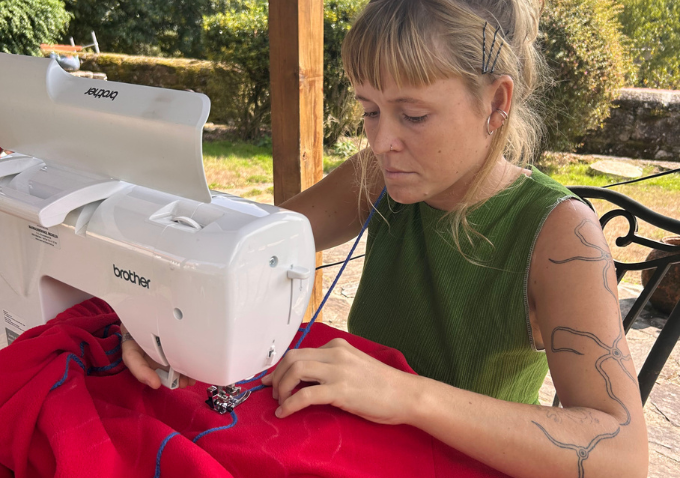
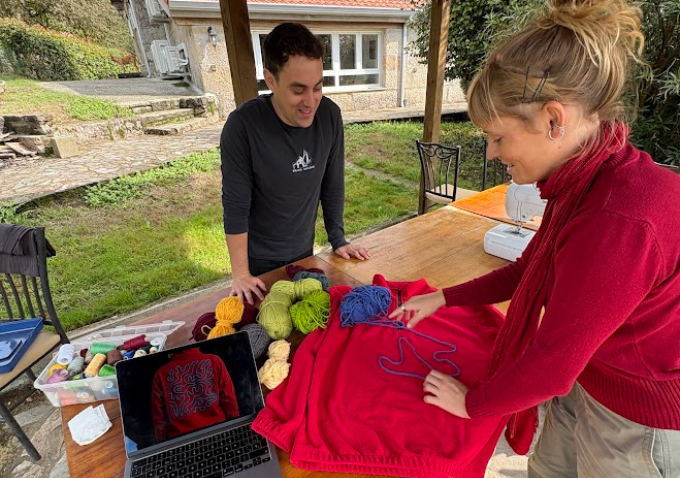
One of the project's key practical outcomes was the use of AI as a preparatory tool for textile upcycling. Sketches and drawings were digitally applied to second-hand garments, allowing variations in colour, texture, scale, and placement to be explored before any material was cut or altered. This digital pre-visualisation reduced waste significantly, enabling freer experimentation and more intentional design decisions. The commercial implication was equally concrete: as the collaborators observed, artists can sell the concept with AI on their websites, and only later, if somebody buys it, make that exact design in the clothes.
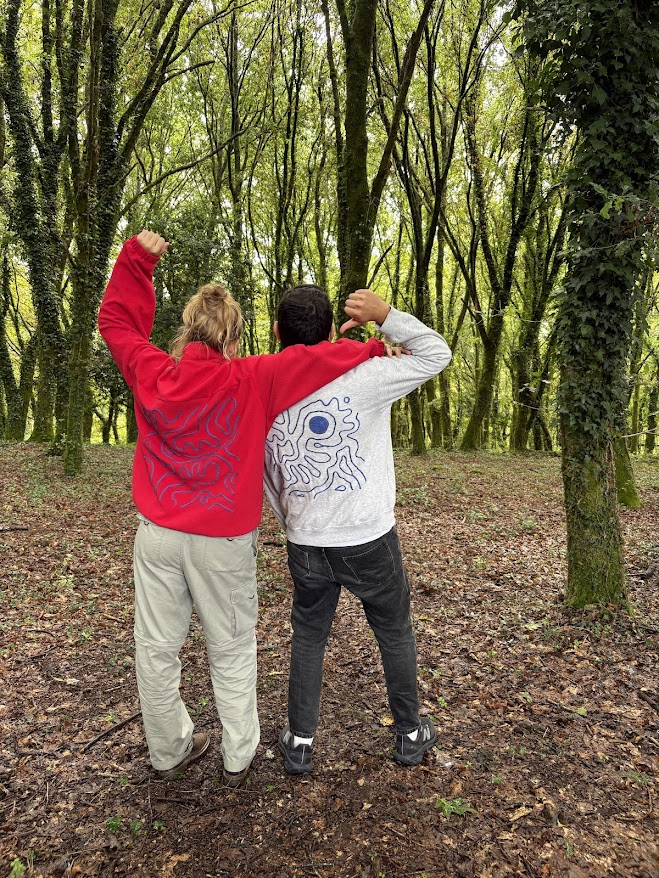
In parallel, the project explored training AI on an artist's visual form language. By feeding the system with Lotte's drawings and recurring patterns, the AI began generating stylistically coherent variations that did not replace authorship but introduced unexpected directions, enriching the early stages of design development. One such exploration directly inspired the upcycling of a sweater, a physical piece shaped by an ongoing dialogue between machine-generated suggestions and hand-crafted textile work.
The experience reframed how Ignacio thinks about the relationship between technology and artistic identity. "What we discovered is that the artist antidote isn't rejection of AI, it's authorship," he says. "When the artist controls the training data, sets the aesthetic terms, decides what to keep and what to discard, AI stops being a threat and becomes something closer to a very fast, very patient collaborator."
"When the artist controls the training data, sets the aesthetic terms, decides what to keep and what to discard, AI stops being a threat and becomes something closer to a very fast, very patient collaborator."
Beyond tangible outputs, the project generated important intangible outcomes. Both collaborators developed new skills in AI training, dataset preparation, and adapting digital tools to creative processes. The cross-disciplinary exchange was equally significant: where technological logic met textile intuition, the project demonstrated how tools can be shaped around human practices rather than imposed upon them.
Community engagement ran throughout. By sharing their process with the communities of Anceu Coliving, Rural Hackers, and Atelier Luu (through informal presentations, blog posts, social media, and direct dialogue) the collaborators contributed to broader conversations around sustainable fashion, upcycling, rural innovation, and ethical approaches to AI. Rooted in the Rural Hackers network, the project also affirmed rural contexts as powerful spaces for creative innovation, where artists can emerge as active agents of ecological transition rather than passive observers of it.
That ambition is inseparable from Rural Hackers' founding purpose. As Márquez puts it: "That, ultimately, is what Rural Hackers as a cultural movement has always wanted to be: not bringing technology to art, or art to technology, but finding the place where neither makes sense without the other."
What began as a five-day residency evolved into a scalable, long-term idea. While initially focused on textile art, the methodology proved transferable: visual artists, designers, architects, and performers could all adopt this approach to digitally explore ideas before committing physical resources. In this sense, AI became not only a creative ally but an ecological one.
The project also underscored the need for open-source, community-driven AI tools that small creative communities, particularly in rural areas, can access without prohibitive costs or technical barriers. Time constraints limited the depth of exploration, and the complexity of AI reinforced the need for technical mediation. Yet these limitations proved instructive, confirming the value of collaborative frameworks where technologists actively support artists rather than lead them.
Ultimately, AI for Upcycled Futures validated its core hypothesis: when framed as a partner rather than a competitor, artificial intelligence can open new creative directions without undermining artistic authorship. More broadly, it raises a timely question: in a landscape dominated by proprietary AI systems, how can the creative sector reclaim artificial intelligence as a shared, commons-based resource?
Key Takeaways

Ignacio Márquez
Co-founder, Rural Hackers — Anceu, Pontevedra, Spain
Ignacio Márquez is co-founder of Rural Hackers. His work focuses on how digital tools and cultural practices can revitalise rural communities and foster sustainable, community-based innovation.
Lotte Van Ermengem
Textile artist and upcycling specialist, Atelier Luu — Belgium
Lotte Van Ermengem is a textile artist and upcycling specialist whose practice centres on the creative reuse of second-hand materials. Through Atelier Luu, she develops processes that combine craft knowledge, sustainable thinking and experimental approaches to textile design and transformation.