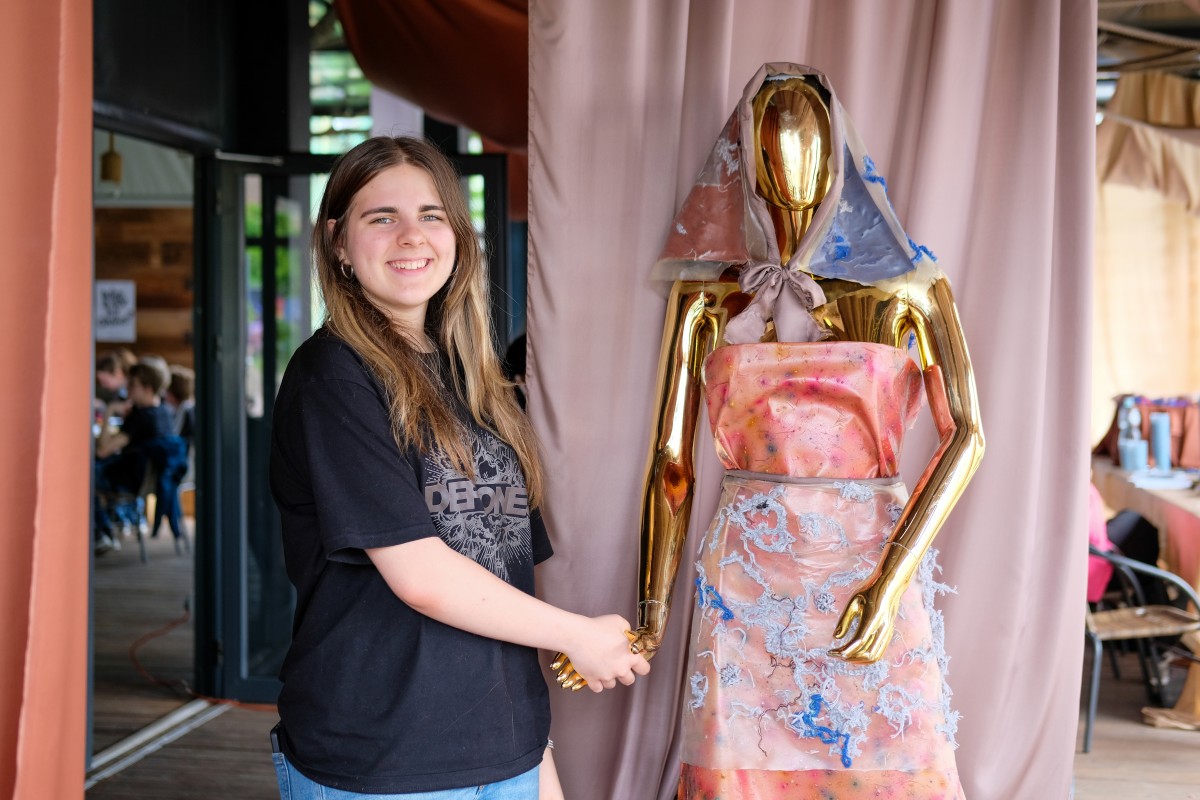




How can fashion and education come together to create a more sustainable future? Through hands-on workshops, the Learning Lab created by Fashion Revolution Polska, explores innovative materials like recycled denim insulation and Baltic algae. The LLab culminates in a public exhibition at the Gdynia Design Days in June 2025.
By Goethe-Institut Brussels
In a classroom usually reserved for calculations and English grammar, 16–19-year-old students at Państwowe Szkoły Budownictwa in Gdańsk, Poland, found themselves stirring Baltic algae, mixing vinegar, and collecting wood shavings. It was not a science experiment; it was fashion. Or rather, ‘plant-based’ fashion. Through hands-on experimentation, students learnt how waste and natural resources can be transformed into wearable materials, challenging their assumptions about what fashion is made of and where it comes from. By cooking bioplastics and testing organic matter, they began to understand material origins, circular thinking, and their own potential to shape a more sustainable future, setting the tone for a radical reimagining of fashion.
As part of the 2024–2025 edition of the Creative FLIP Learning Labs (LLabs), Fashion Revolution Polska launched the LLab Innovating Waste for a Sustainable Future, an interdisciplinary collaboration between education and creatives that brought together fashion, biomaterials, and sustainability. The goal was to empower young people to rethink waste, explore new materials through hands-on learning and envision a greener, fairer future.
“I never thought I’d enjoy 'cooking' bioplastics—it was messy, creative, and totally different from what we do in school.” — student
The programme brought together creative professionals and educators to co-create engaging learning experiences that integrated design thinking, biomaterials, and awareness around ethical and environmental issues in the fashion industry. It unfolded over seven sessions, each designed to challenge students’ assumptions and spark new ideas. It began with a deep dive into textile technology and material as well as supply chains in the fashion industry, led by Agnieszka Wąsowska-Telęga. Students examined clothing labels and were stunned by their own lack of awareness. “I had no idea what my clothes were actually made of—it made me think for the first time about where things come from,” admitted one participant.
From there, the students were introduced to biomaterials and polymers by facilitators Blanka Byrwa and Natalia Gwiazdowska. The concept of biodegradable fashion was foreign to most, but curiosity grew with the use of visual aids. The session clearly highlighted a significant educational gap and the need for foundational learning about material ecology.
The turning point came during the bioplastic workshop. Students were split into small groups and created their own bioplastics using algae-based recipes. They experimented with variations in ingredients and proportions and then ventured around the school grounds to gather natural and industrial “waste” materials (wood shavings, cement dust, charcoal, etc.) to incorporate into their mixtures. Each group created distinct samples and was encouraged to document the process as if conducting scientific research. The freedom to explore and self-organise encouraged creativity and teamwork.
“Writing down our recipes like scientists made it feel real, like we were inventing something, not just playing,” said one student.
As a result of this session, the facilitators noticed a shift in the students: “They started the session shy and passive, but once they could get their hands on materials, something shifted—they came alive,” one facilitator recalled. The following workshop focused on material exploration and analysis by reviewing the bioplastic samples they had created and assessing their strengths, textures, and structural properties. Furthermore, they worked with new materials such as wood veneer, paper pulp, and vinegar-based textile glues.
Later sessions introduced intellectual property rights, design thinking, and speculative design. Students were asked to imagine futures shaped by climate change — and then build prototypes that reflected their emotional responses. “Real learning happened when students felt the project was theirs – not something handed to them, but something they shaped,” said a facilitator. The students developed mounting techniques for biomaterials, sketched fashion production plans, and documented their processes like professionals.
The culmination of the project was a public exhibition at Gdynia Design Days in June 2025. Held at HUBa, the event featured student-led bioplastic-making stations, upcycled textile planters, short films on fashion’s global impact, and interactive embroidery games. “Seeing their work in a new space, outside of school, changed everything. They walked taller and explained things with pride. It had meaning,” said one teacher. Another reflected, “They weren’t just showing their samples — they were hosting, inviting others in, and becoming teachers themselves.”
The Learning Lab transformed students from passive learners into active, future-shaping change-makers. Through hands-on experimentation with biomaterials, design thinking, and real-world challenges, participants gained not only technical skills but also a more in-depth understanding of sustainability, intellectual property, and creative agency.
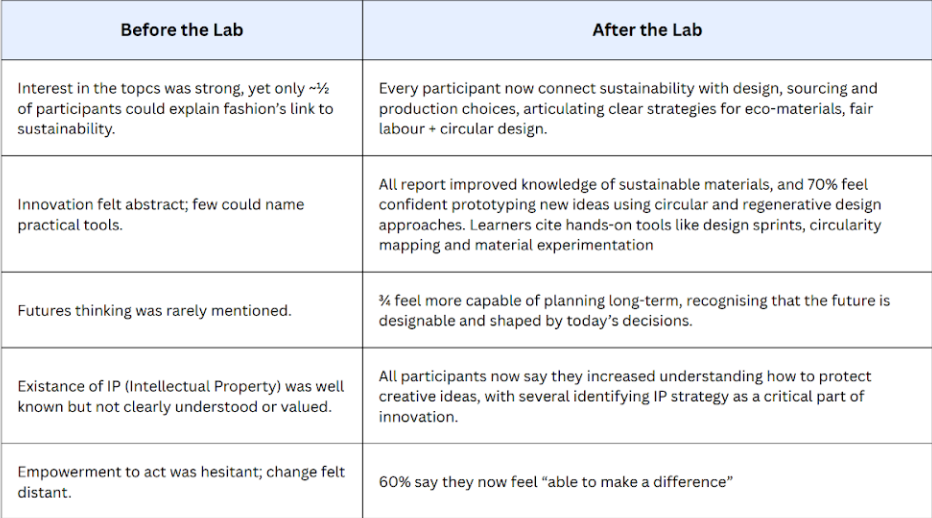
The shift was visible through the students’ surveys conducted before and after the workshop sessions:
Students who began the programme hesitant and unsure ended up confidently presenting their work to the public, embodying the role of young innovators. The experience underscored key takeaways for future programmes: start with tactile learning to spark curiosity, allow flexibility for spontaneous exploration, dedicate more time to the design phase, and harness the power of peer learning. Most importantly, connect classroom learning to real-world action — because every so often, all it takes to spark change is a vocational school, some Baltic algae, and a little curiosity.
Image: Fashion Revolution Polska
This case study was created under Creative FLIP, an EU co-funded project aimed at further increasing the long-term resilience of the CCSI in key areas such as Finance, Learning, Working Conditions, Innovation & Intellectual Property Rights.
Key Takeaways

Fashion Revolution Polska is part of a global movement with branches around the world, focused on transforming the fashion industry into a more transparent and sustainable one. Fashion Revolution’s goal is to celebrate the positive impact fashion has on the world and all those who contribute to it every day.
Państwowe Szkoły Budownictwa, Gdańsk, Poland
High school students (16–19 years old)