


As sustainable fashion gains urgency, three Creative FLIP Learning Labs—Studio WOUW in Belgium, Fashion Revolution Polska in Poland, and France’s Illustrious Lab—engage students in hands-on plant-based materials, natural dyeing, and biomaterial design to rethink garment making and ecological impact. Here are their stories.
By Goethe-Institut BrusselsAs global awareness of fashion’s environmental and social impact grows, innovative educational models are emerging that reconnect young people with the material realities of clothing production. The Creative FLIP Learning Labs (LLabs) project exemplifies this shift, engaging students with sustainable fashion through hands-on experimentation and creative inquiry. Among the ten selected LLabs for the 2024–2025 cycle, three stand out for their inventive use of plant-based materials and community-rooted pedagogy: Studio WOUW (Belgium), Fashion Revolution Polska (Poland), and Illustrious Lab & Studio Abi (France)
At its core, the LLabs mission is to make sustainability tangible for young learners, steering away from abstract theory toward experiential exploration. These initiatives are encouraging students to rethink both what clothes are made of and how they come into being.
In Poland, Fashion Revolution Polska collaborated with Państwowe Szkoły Budownictwa in Gdańsk to launch Innovating Waste for a Sustainable Future, a seven-session interdisciplinary Learning Lab. The programme blended design thinking with biomaterials research, inviting students to experiment beyond conventional textiles by using locally sourced waste such as Baltic algae, wood shavings, and cement dust. One student admitted that they “never thought I’d enjoy ‘cooking’ bioplastics — it was messy, creative, and totally different from what we do in school,” underscoring the novelty and engagement of the hands-on experience.
In Ghent’s multicultural Muide-Meulestede district, Studio WOUW’s “Future of Fashion – Upcycling & Natural Dyeing” engaged 5th and 6th graders in plant-based textile transformation. Students foraged local flowers, leaves, and stems, then used them to dye discarded fabrics. According to the facilitators, “The Learning Lab had a meaningful impact beyond creative skills, also contributing to emotional well-being and social cohesion.”
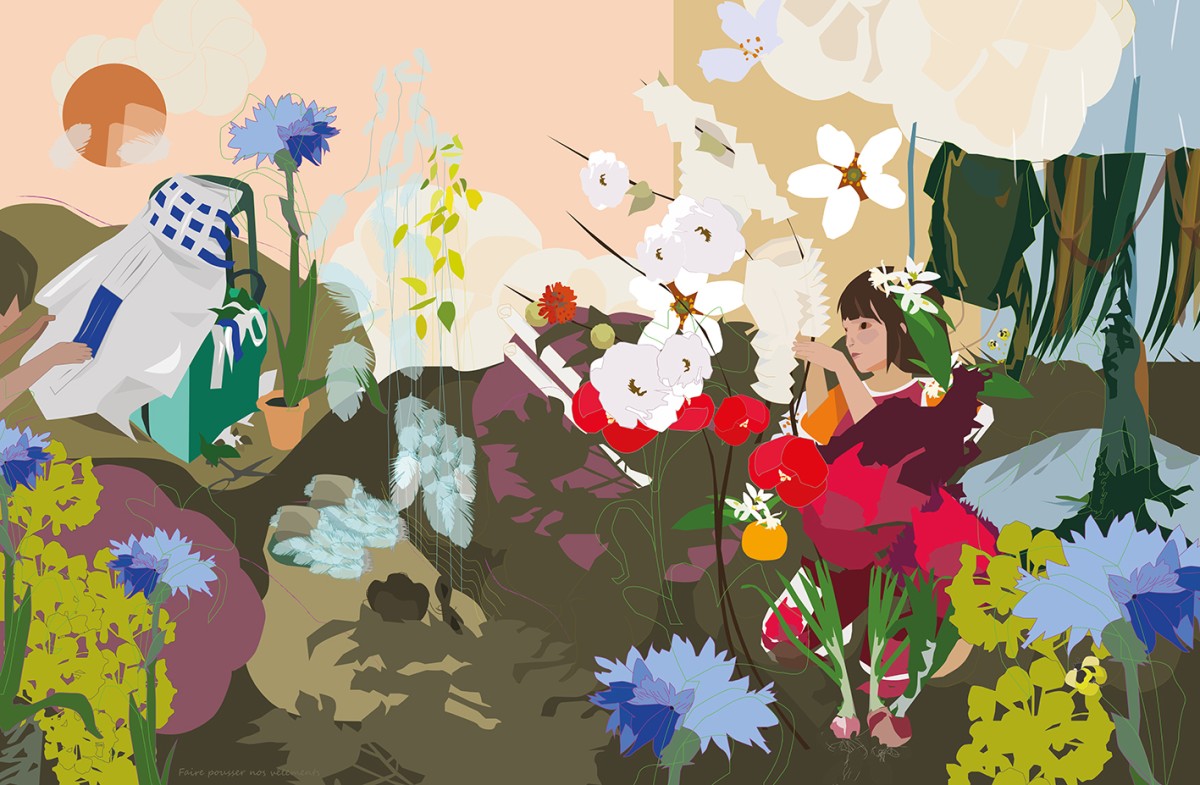
In France, a more radical interpretation of plant-based fashion took hold with the BLISS Learning Lab, in which children aged 10–11 were encouraged to see themselves as “gardeners” of garments. Here, students explored the full lifecycle of clothing — from raw materials to design and distribution — and created prototypes using innovative materials such as seaweed and orange peel. One student reflected on the immersive experience, saying they now “imagine creating clothes (a lot)”, capturing the program’s capacity to spark both imagination and critical reflection.
Collectively, these Learning Labs offer a vibrant counter-narrative to fast fashion’s disposability. Through bioplastics, plant dyes, and speculative design, participants gain sensory access to concepts normally confined to textbooks or marketing slogans.
By making sustainability experiential, the labs empowered young people to think critically about fashion’s ecological footprint and the societal structures that perpetuate unsustainable practices.
Picture: One of the results of the BLISS Learning Lab. Copyright - BLISS LLab
The case studies mentioned here were created under Creative FLIP, an EU co-funded project aimed at further increasing the long-term resilience of the CCSI in key areas such as Finance, Finance, Learning, Working Conditions, Innovation & Intellectual Property Rights.