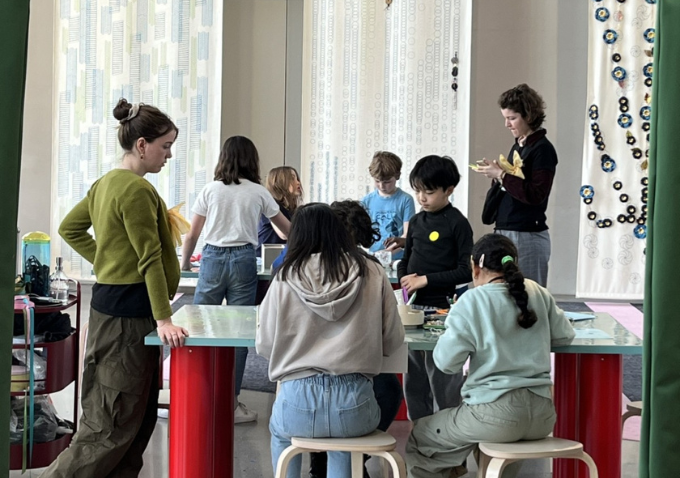



Have you ever thought of fashion as a form of gardening? Can you imagine a garment designed to grow as you do? This is the concept behind the BLISS LLab, which encouraged students aged 10-11 from Pantin, France, to become ‘gardeners’ and explore the entire lifecycle of a garment, from raw materials to circulation. The aim was simple: expand the clothes’ lifespan and reduce waste!
By Goethe-Institut BrusselsBLISS LLab, implemented by Illustrious Lab and Studio Abi, involved 10- and 11-year-old students, with the aim of developing new sustainable forms of cooperation and education between fashion professionals and schools. Through a series of interactive workshops, the students explored the entire lifecycle of a garment, from raw material production to modularity and expansion, all with a focus on designing clothes that adapt and grow alongside them! The project was chosen as one of the Top 10 projects in the 2025 Creativity in School Award by GIOCT Global Institute of Creative Thinking, UNESCO IITE (Institute for Information Technologies in Education) and OECD Education and Skills.
Have you ever thought of fashion design as a form of gardening? Can you imagine a garment designed to grow as you do? This is the concept behind the BLISS Learning Lab, which encouraged students aged 10-11 from Pantin, France, to become ‘gardeners’ and explore the entire lifecycle of a garment, from raw materials to circulation. The aim was to change the way we look at clothing, our uses, and the links we maintain with textiles and our clothing to therefore understand its value, economic and ecological cost. This translates to expanding the clothes’ lifespan and reducing waste. Such as stimulating people to want to make and encouraging them to repair, which leads them to a certain empowerment.
As gardening has its own cycles and processes, so does fashion design: from sourcing the raw materials to designing the garment and then producing and distributing the final product. Through the “Grow Our Clothes” LLab, Laetitia Barbu of Illustrious Lab and Anne-Charlotte Hartmann-Bragard of Studio Abi brought the students of Louis Aragon Primary School in touch with the process of ‘growing’ a garment. As a student put it, they now “imagine creating clothes (a lot)”.
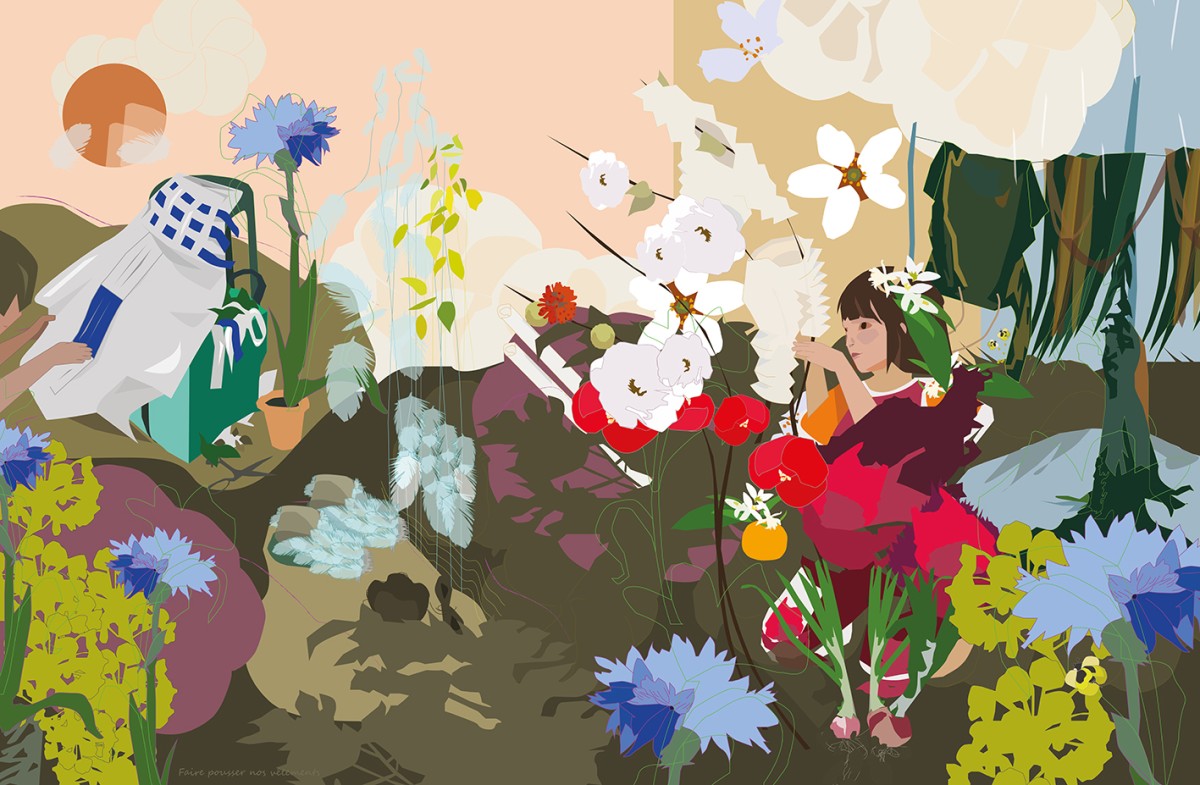
The children were immersed in the world of fashion – a connection made stronger by the fact that Aubervilliers and Pantin, located close to Paris, hosts the annexes and creative spaces of many important fashion houses, like Chanel and Hermes. By building bridges, the project also helps to better connect the textile and fashion industry to sustainability and nature. Through the process of ‘cultivating’ their own garments, the children gained insights into the fashion industry and all the different professions and tools involved in it.
The methodology addressed how clothing can be a source of knowledge and a tool for knowledge, therefore sustainability matters were also prominent, as the project was centred on green materials and the entire life cycle of a garment. Another topic that was explored was ownership and IP rights. The creation processes sparked questions, such as who owns the rights to the prototypes they created and how could they protect their creations.
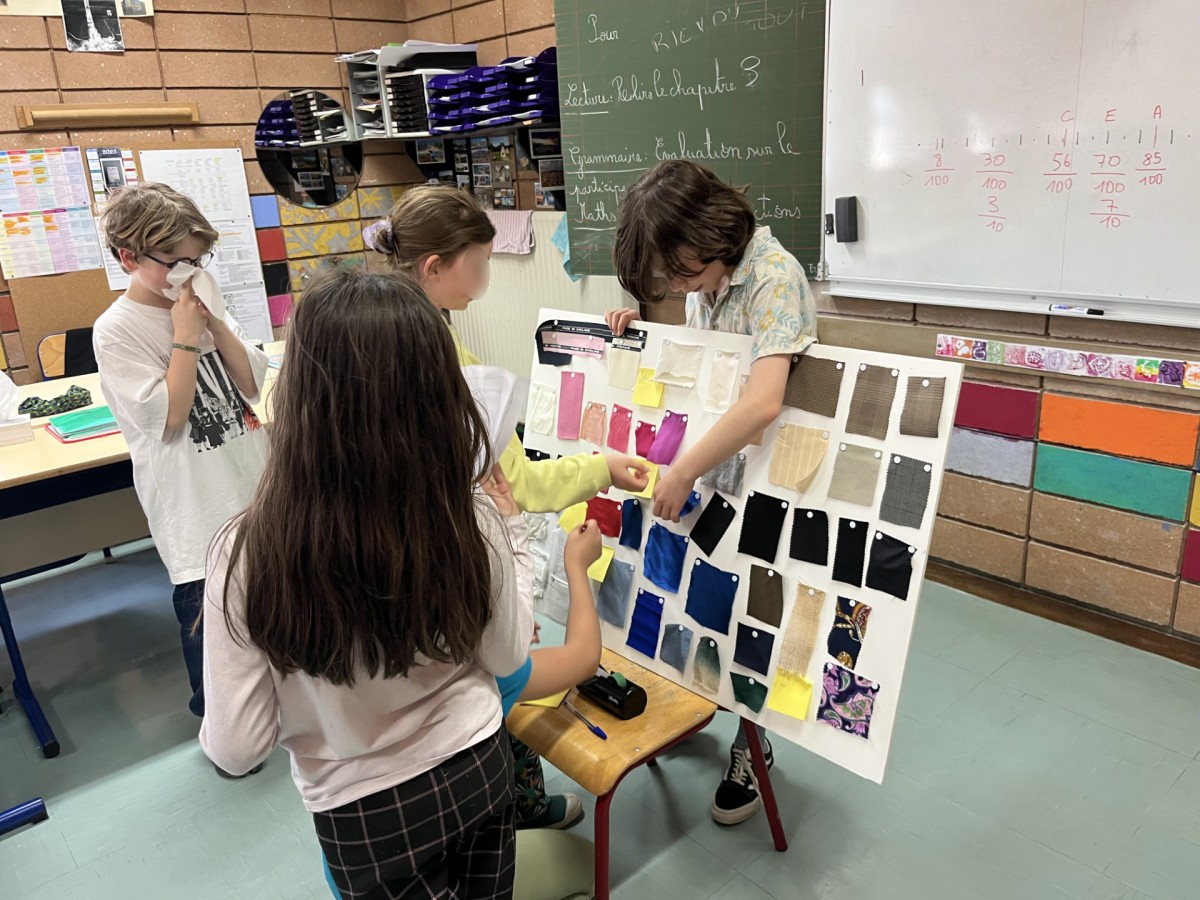
The Learning Lab consisted of six interactive workshops, familiarising the students with all stages of garment production – from sourcing the raw material and turning them into textiles to creating actual pieces of clothing. The students were divided into four teams, each one developing, with the help of the workshop curators, their own innovative and sustainable materials (including synthetic and artificial). The children experimented with seaweed, orange peel, onions, feathers, as well as traditional paper and textile materials from dead stocks, among others, to create the basis of their creations.
To support and enrich the design process, professional digital tools were introduced to the class, helping to transition their creations from 2D to 3D. AI was used to reconstruct and interpret missing parts of the garments, offering students a realistic 360° view of their designs. This allowed them to better reflect on their garment, imagine the next steps in its development, and consider the potential of their advanced creations existing in a purely digital form. The project has been chosen as one of the Top 10 projects in the 2025 Creativity in School Award by GIOCT Global Institute of Creative Thinking, UNESCO IITE (Institute for Information Technologies in Education) and OECD Education and Skills.
Many sessions also included specific activities on IP rights, as questions of ownership arose during the workshops. The students also visited 19M — The House of Crafts of CHANEL in their neighbourhood, a quite inspiring trip for them, as they had the chance to “learn more about clothing, about Chanel”, as a student shared.

The final result was a display of the fruits of their harvest to the whole school. The pieces included a biodegradable jacket made from seaweed, a feathered shoe that makes walking easier, and a shirt and pants set made from plant-based Hanji paper that grows with the child thanks to a folding system. The process turned the children into designers, encouraging them to search for solutions to technical problems, ponder on questions of sustainability, and push the limits of their creativity.
Fashion is often linked to luxury and high-end brands, especially in France. Bringing the students in contact with all the stages of garment production and focusing on textiles allowed for a deeper, more nuanced comprehension of the fashion industry. Moreover, it made obvious that fashion concerns everyone, and that it is directly related to environmental and societal issues. As the clothing industry is one of the most polluting industries worldwide, “education for sustainable development efficiently can’t wait”, say the Learning Lab’s creators.
When it comes to difficulties in implementation, the Learning Lab faced only one: the time that must be dedicated to back-and-forth discussions with the school administration to implement such an activity, at least in France.
Overall, Laetitia and Anne-Charlotte were “very satisfied and [..] already exploring ways to continue developing it, especially targeting directly teachers’ training”. They also highlighted the need of addressing several schools and classes at the same time through a dedicated platform and specialised training for teachers and education professionals. The model developed through the LLab is replicable and accompanied by a kit of ready materials and tools, marking a big step towards that direction.
So next time you are shopping for clothes, maybe take a moment to think of them – and yourselves – as part of a bigger fashion ecosystem!
Image: Copyright - BLISS LLab
This case study was created under Creative FLIP, an EU co-funded project aimed at further increasing the long-term resilience of the CCSI in key areas such as Finance, Finance, Learning, Working Conditions, Innovation & Intellectual Property Rights.
Key Takeaways

1. Illustrious Lab & Studio Abi
— Illustrious Lab is a hybrid model – physical and virtual research laboratory — that brings together experts from diverse fields, incl. sociology, ethnography, education, and media, to collaborate on workshops, publications, and training while conducting explorations. It applies a Design Driven Innovation approach and explores the potential of co-creation to develop innovative solutions.
— Studio Abi is a research-creation lab dedicated to textile education, working at the crossroads of sustainability, creativity, pedagogical innovation and children’s rights. It is encouraging children to explore the creative and cultural dimensions of fabric, while fostering awareness of the ecological and social challenges of the textile industry.
2. The CM2 A class at the Louis Aragon public school in Pantin, in a neighbourhood undergoing gentrification and sociocultural and economic effervescence: a mixed group of 21 students (including 3 students with disabilities) and their teacher, highly motivated and committed to this project, from the initial presentation in January to the exhibition-restitution to the whole school in June, six months later.