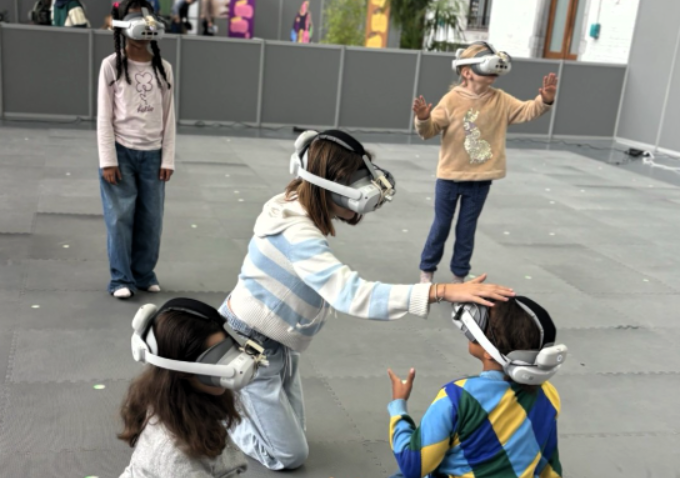




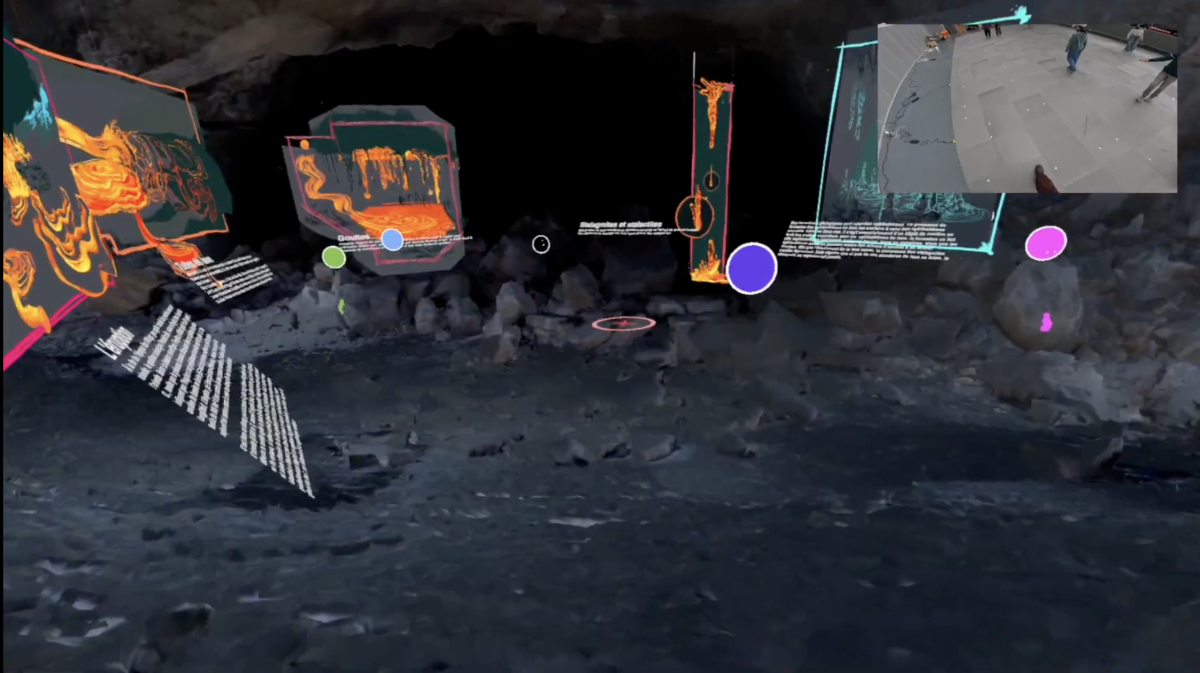
Cave Walk started as a cross-sectoral collaboration between an arts education researcher in Brussels and a Danish visual artist working with immersive technologies. The result is a multi-user VR experience that allows visitors to step inside a 3D-scanned lava cave and discover how geology, folklore, and artistic storytelling can converge underground.
Cave Walk is a cross-sectoral collaboration between Elvira Crois, an arts education researcher at the Vrije Universiteit Brussel, and Bob Lundgreen, a Danish visual artist from the collective Nyskaben. Together, they set out to build something neither could have made alone: a shared virtual reality experience that allows visitors to step inside a 3D-scanned lava cave and encounter geology, folklore, and artistic storytelling at the same time.
The project draws on a broader team. VR programmer Hannibal Glaser built the immersive environment, while geological experts Sophie Verheyden of the Royal Belgian Institute of Natural Sciences and Serge Delaby of the UNESCO Global Geopark Famenne-Ardenne contributed the scientific grounding. Up to ten participants can navigate the virtual cave simultaneously, encountering geological explanations, layered visual narratives, and the cultural meanings that human communities have long attached to underground spaces.
For Crois, the project challenged a deeply embedded habit in academic research: the tendency to treat public engagement as something that happens after the work is done. Knowledge gets produced, peer-reviewed, published — and only then, if there is time, shared more widely. Cave Walk was built on a different premise. Artists were involved from the beginning, co-devising the project rather than being asked to translate results that already existed.
The practical outcomes of this approach extended well beyond the public exhibition. The team expanded their technical expertise in multi-user VR development, headset management, and designing safe onboarding procedures for large groups. They deepened their understanding of lava cave formation, glacial conservation challenges in Iceland, and the cultural narratives associated with subterranean landscapes. Alongside this came new research skills: interviewing scientific specialists, processing photogrammetry and LiDAR data, and translating that data into an accessible and imaginative format.
The original Cave Walk was not set in Iceland. The team had planned to build around a 3D scan of a limestone cave in Belgium and had gained access to the scan — but permission to use it in the project was ultimately denied by the private owners of the site. It was an obstacle that forced a fundamental rethink.
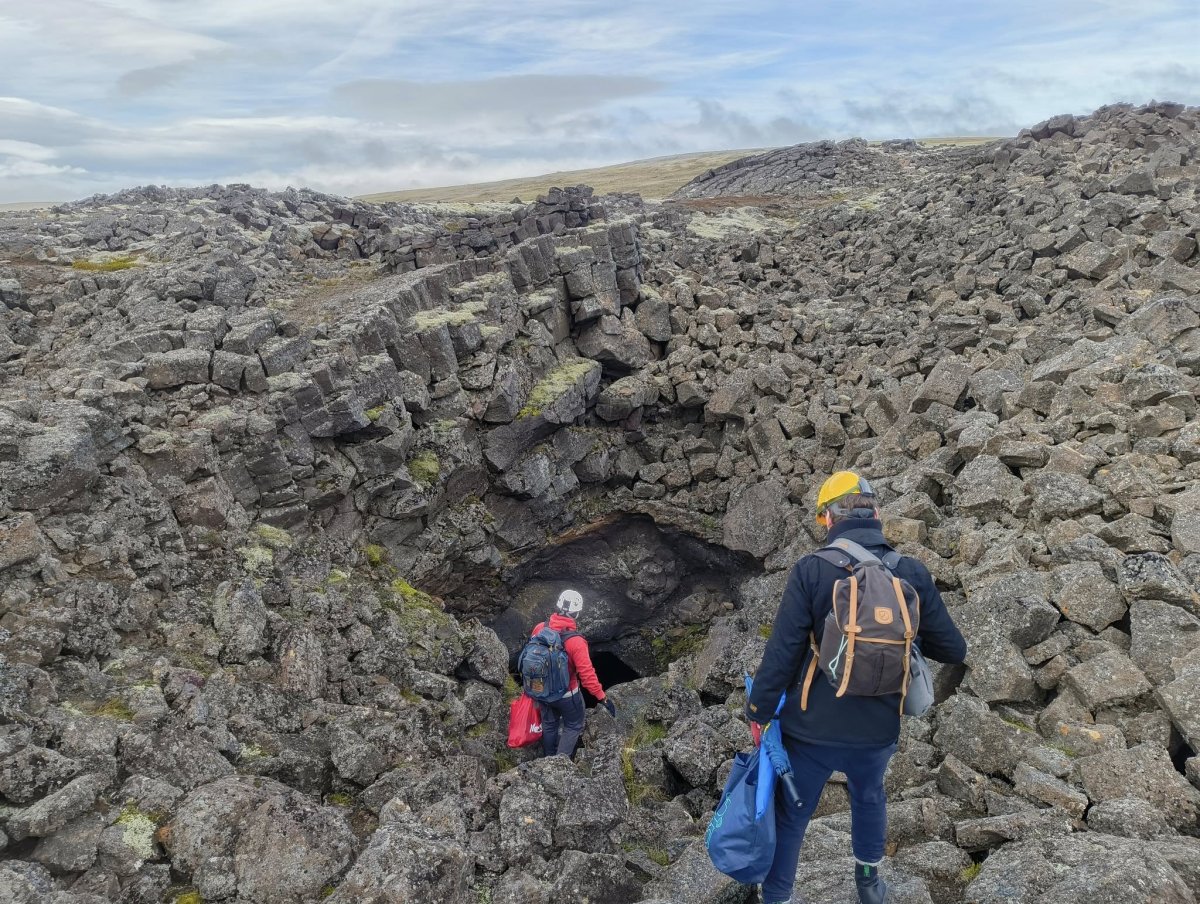
This unexpected obstacle required the team to rethink their approach and shift part of the project’s development to Iceland, where VR programmer Hannibal Glaser is based. Existing scientific contacts helped facilitate access to a suitable lava cave, which Bob travelled to Iceland to scan together with Hannibal. Following the fieldwork in Iceland, Bob continued the project through a five-day mobility period in Belgium, where the team further developed the artistic and VR concepts. During this phase, Bob also worked remotely with Hannibal on the technical preparation and implementation of the VR environment, alongside consultations with geological specialists.
What the collaboration produced
The cross-sectoral nature of the team proved to be one of Cave Walk's greatest assets. Art, education research, VR technology, and geology brought genuinely different ways of seeing the same material — and the combination produced something that none of those fields would have arrived at independently. The project built on an earlier collaboration between Crois and Lundgreen around a cave-themed comic project, and encounters during the I Love Science Festival opened further opportunities for interdisciplinary work.
The prototype was presented at the I Love Science Festival in Brussels from 10 to 12 October 2025. Over three days, the team guided more than 1,100 participants through the experience, approximately 80% of whom were children under the age of twelve. The project will continue its journey in 2026 at Phenomenal Viborg in Denmark, expanding its reach to new audiences.
The team now considers the current version of Cave Walk a functional prototype. Future iterations will develop the interactive elements further — for example, allowing users to trigger events within the cave environment, such as the appearance of ghost stalactites. Closer in-person collaboration between the visual artist and the VR programmer is also a priority for the next phase, having identified geographical distance as one of the factors that slowed production during this first iteration.
Key Takeaways