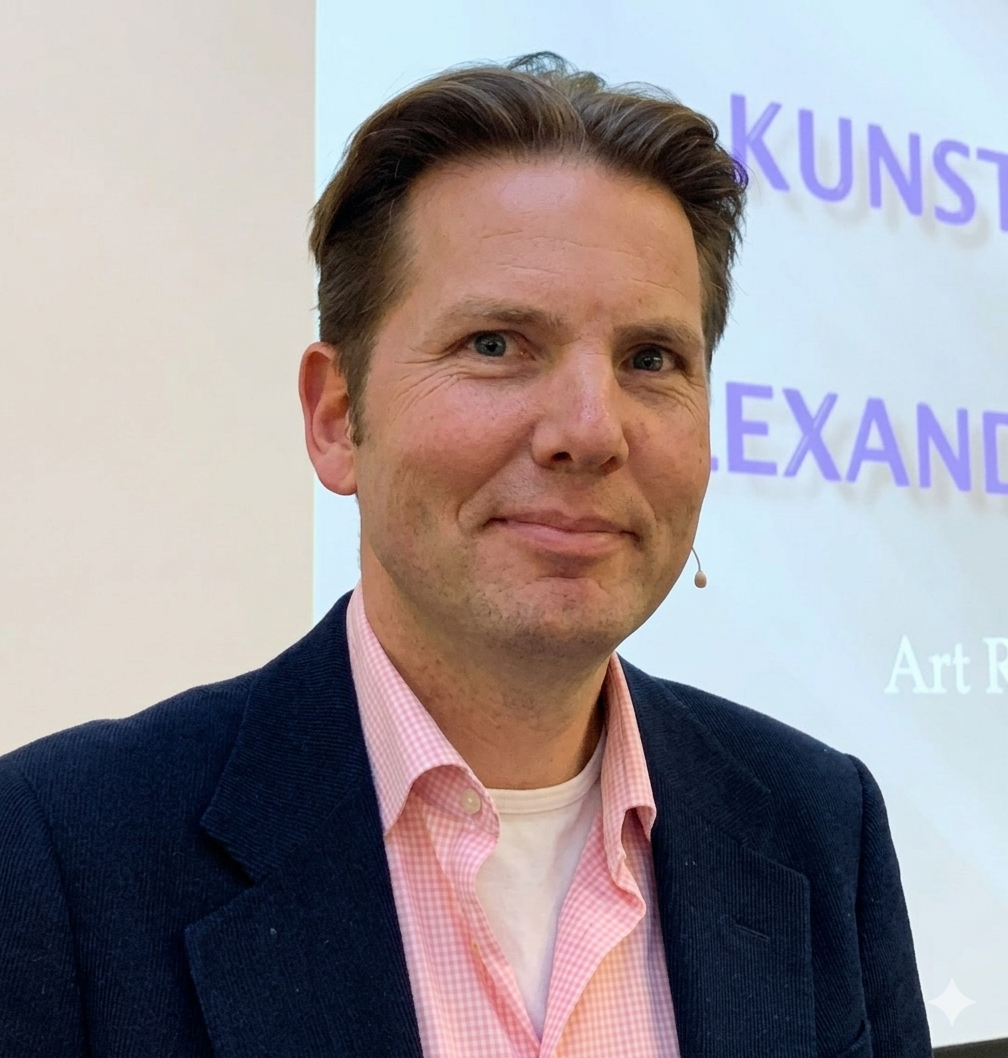
Alexander Ramselaar started his career in the development of logistical property in the Rotterdam harbour. His cultural career started with buying photos and visual art. He became an art collector and befriended artists. By merging these interests, his career took a new course as an advisor to artists and cultural institutions, where his special talent for speaking the languages of art, real estate, and finance became a unique proposition.
Nowadays, he is involved in multi-million-dollar property developments for cultural and arts organisations. But he still cherishes helping small cultural institutions and artists to take ownership of their buildings and to develop financing structures that help them to become more financially resilient.
In talking finance, CU's special feature interviewing experts in the field, Alexander Ramselaar shares his expertise in bridging the gap between artistic ambition and property development. From securing €4 million to retain Eindhoven’s Design Academy to restructuring the business model for Amsterdam’s iconic Paradiso, Ramselaar demonstrates how creative hubs can achieve long-term resilience through strategic ownership, sustainable structures and innovative public-private partnerships.
Q: One of your first financing challenges was a small theatre production company. What was the challenge, and what did you learn?
A: Each stage production needs pre-financing, which they previously funded with informal loans. They wanted to become independent of informal financiers (family and friends). To secure a bank loan, they had to show they were able to pay back the loan from pre-booked performances and guaranteed income. But they also had to show how they would manage risks—for instance, if they were unable to perform because their main actor fell ill and they had no income. In the end, the bank opened a revolving credit line that the production company now uses to pre-finance their productions, repaying it when income from performances comes in. The production company uses the surplus from their income to build a buffer, which shows the bank they are becoming financially resilient and less risky.
The key lesson was that cultural financing only works when you truly understand both the artistic logic of a production and the financial logic of a lender and can formulate very clearly what you have to offer the bank in terms of repayment and risk management skills.
Q: Many creative hubs would like to buy their building but often fail. What is an example of how you put together a working finance mix?
A: One example is a creative hub in Rotterdam. First, the city, as the owner, valued the building for its function as a hub and not its commercial value, which reduced the price they had to pay. We were able to finance about a million, of which 70% was a bank loan and 10% was an energy transition loan. Another source was a subsidy for a water storage facility, which solved a problem for the city in case of heavy rainfall. They also put in money from crowdfunding, and they carried out part of the renovation work themselves. It is always a puzzle combining different financial instruments.
"Cultural financing only works when you truly understand both the artistic logic of a production and the financial logic of a lender."
A second example is a non-profit foundation of a collective where the building was privately owned. They set up a limited company in which the foundation and an impact investor are the shareholders. The impact investor gave a loan for more than 20 years on soft terms. The foundation pays operating costs to the company, and all receipts are reinvested in the building. My role is always to translate between cultural ambition, financial reality and long-term public value. Having spent many years in property development and finance really helps.
Q: You are involved in the recently established Design Development Eindhoven foundation, chaired by the city's mayor. One of the major issues is the lack of space for designers and other creatives in the city. What is your role there?
A: My role is to boost the development and finance of creative spaces. First, we are starting a one-stop shop for all creatives who want to rent or buy space and for property developers and investors who have space available. We need to know what the space shortage is and where there are buildings which might be suitable and do the matching. So, we are developing an instrument to map the demand and supply of affordable creative workspaces. Creatives and property developers rarely meet naturally, but we understand both worlds and can connect them. We help develop financing structures for creative hubs. In the end, we need to establish a new non-profit foundation which does more than simply manage a portfolio of creative buildings for the long term and is also able to develop new hubs in the contemporary market.
Q: The development of this Design Development Eindhoven foundation was spurred by the threat of the world-renowned Design Academy leaving Eindhoven because they could not find a suitable place to relocate. You were involved in finding a new location and developing the business case for it. What happened?
A: The prospect of the Design Academy leaving Eindhoven was politically and culturally unacceptable to the city, so they hired me to find a new location. I literally went through the city on my bike to find other places and then, as part of a dedicated team, calculated both the relocation costs and the business case for redeveloping a building, including the long-term rental model. But just as important in my role was gaining the trust of the municipality and the board of directors of the Design Academy and acting as a go-between. When they trust you, it becomes easier to find common solutions. In the end, the city provided €4 million to keep the Design Academy in Eindhoven.
Q: Another multi-million-pound property challenge is the redevelopment of Paradiso, Amsterdam's so-called "pop temple", where all the greats of pop music have played. It is a listed building which needs a structural makeover to become sustainable for the next 50 years.
A: It is a designated historical heritage building, which restricts the possibilities for renovation. Paradiso is financially independent to an unusual degree: only 4% of its income comes from subsidies. The challenge is therefore not only heritage preservation but also maintaining a healthy business model while preparing the organisation for the next fifty years. They have bought a plot next to the building, which needs to be further developed. I am involved in building the business case and property strategy for the renovation and the financing mix.
Q: The kind of expertise you have developed—combining a deep understanding of cultural production with that of the financial world and property development—is still not very common in the cultural sector. How can we grow the number of these specialists?
A: Working in the business world and becoming an art collector was the best way for me to grow in this direction. For people from the business world, it is a challenge to understand the deep intrinsic motivation of artists and how it determines the way they produce art and think from a business perspective. It is not about making profits. Equally, for most people in the arts, the world of finance is unknown territory. The core of my work is gaining trust in both worlds so we can work towards a common goal: building a financially sustainable arts organisations through solid financing structures in suitable long-term spaces.
"It is ultimately about safeguarding the place of art and culture in the city—not temporarily, but structurally."
Of course, I am willing to share my expertise through workshops and articles, and I am aware that we need more advisers who can combine both worlds. But until now, the cultural sector has lacked the urgency to invest in this knowledge. For me, this work is ultimately about safeguarding the place of art and culture in the city. Not temporarily, but structurally—through ownership, long-term financing and sustainable cultural infrastructure.