

Katerina Fojtíková of Cultural Centre Schule spent six days in October 2025 at Asociación Cultural Sende in Senderiz, Galicia — a 20-inhabitant mountain village where a rural coliving and creative hub has spent a decade building something that works and even has an international reputation. Now she is planning residencies for international artists, and she is introducing new cultural initiatives.
By Goethe-Institut BrusselsIn the small mountain village of Senderiz in Galicia, Spain, with just 20 inhabitants, Asociación Cultural Sende has developed a cultural model that offers a compelling example of how creative ecosystems can emerge and sustain themselves in remote rural contexts. Operating far from urban cultural infrastructures, Sende has built an integrated environment where coliving, coworking, cultural programming, and support for emerging creatives coexist as part of a single system. What makes this model particularly distinctive is not simply the diversity of activities but the way they are embedded into everyday life and continuously reinforce one another. Katerina Fojtíková, a cultural practitioner from the Czech Republic and co-founder of Cultural Centre Schule, a small rural cultural organisation based in the mountainous region of Sediviny, visited Sende and was inspired by how its approach revealed itself through its daily rhythm. Now she is incorporating similar practices in Schule’s everyday life. Read on
Sende's success is built on creating a self-sustainable, rural coliving and coworking space in the Spanish mountains that combines community building, low-risk social entrepreneurship, and a "home-like" atmosphere for international creatives. Not as abstract principles but as operational tools, cultivated through shared routines, proximity and a flexible structure that allows initiatives to emerge organically on easily replicable formats.
This positions Sende as a particularly relevant example for cultural practitioners and policymakers. It demonstrates that meaningful cultural ecosystems can be built in low-density areas, that the community can act as a co-producer rather than an audience, and that sustainability can be achieved through long-term social and relational continuity rather than scale. So, when Katerina arrived in Senderiz, she was not introduced to Sende through presentations or structured briefings.
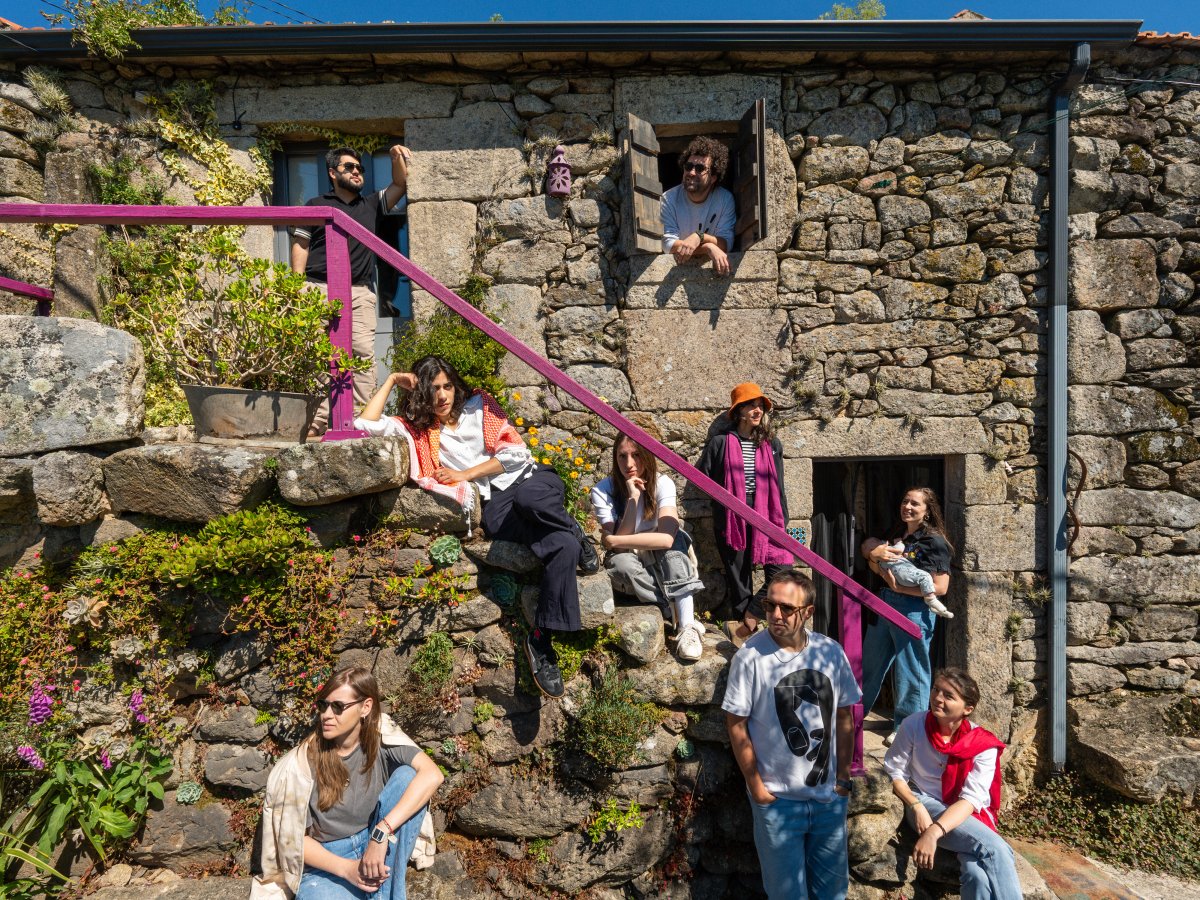
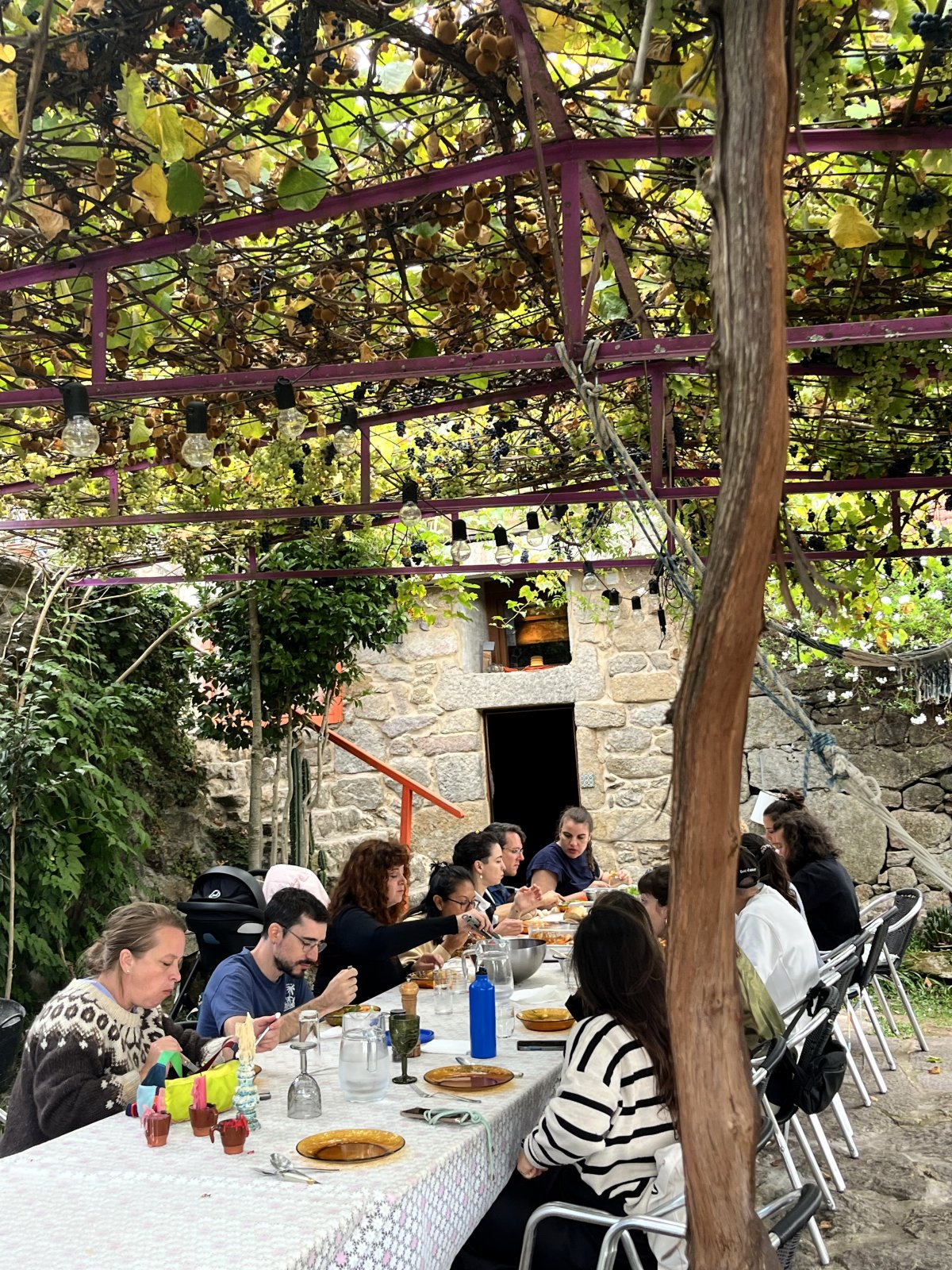
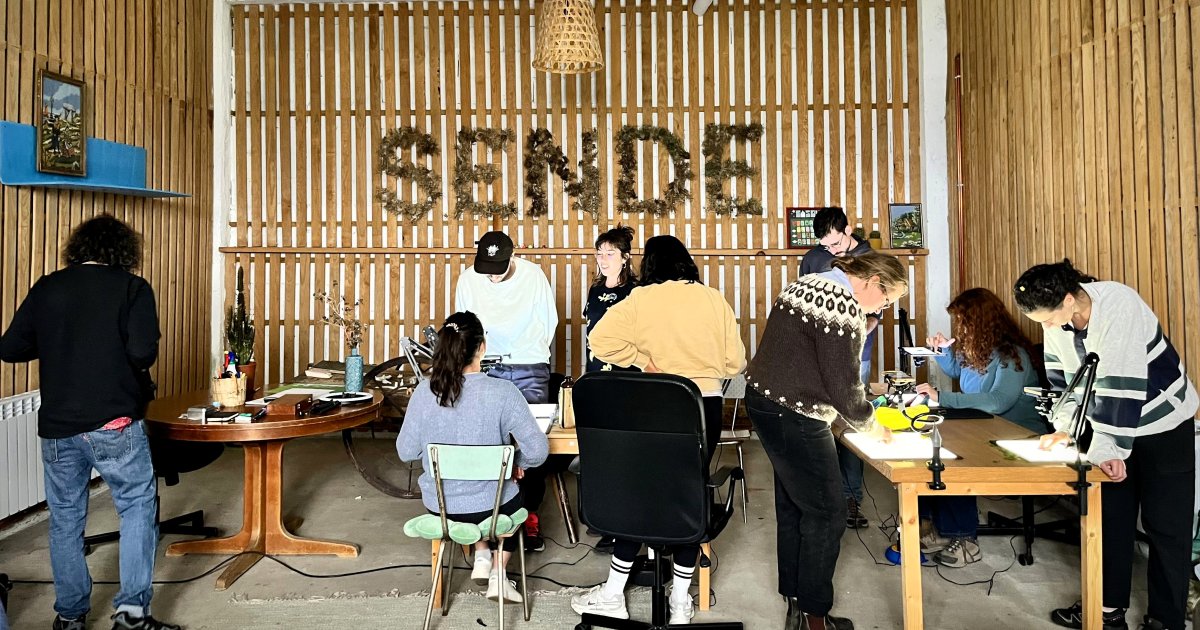
Instead, she was welcomed into a shared dinner, only to discover that cooking and eating together is a central practice at Sende, functioning as a mechanism of trust-building, breaking down barriers and integrating newcomers into the community. From that moment on, the distinction between visitor and participant disappeared, and Katerina was immersed in the community. Within Sende’s environment, multiple layers of activity unfold simultaneously. Long-term residents live and work alongside visiting creatives and participants of initiatives such as Fixar, which supports young people developing projects in rural Galicia. Activities are not isolated or sequential but overlapping and interconnected.
"The most unexpected aspect, compared to my initial expectations," Katerina says, "was how seamlessly Sende integrates coliving and coworking with a vibrant cultural programme."
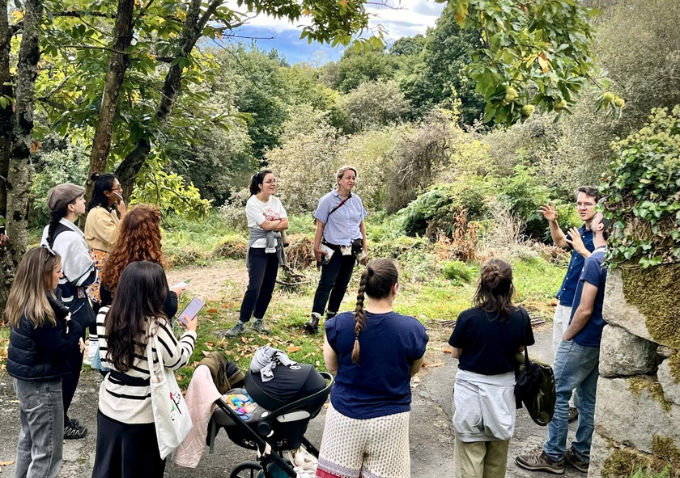
A workshop on wild herbs becomes both an ecological learning experience and a creative exercise. A walk through the village introduces local history while fostering social exchange. Informal presentation formats invite dialogue and reflection rather than one-directional communication. Even moments of rest or leisure become opportunities for connection. What might externally appear as a curated cultural programme is, in practice, a continuously evolving ecosystem shaped by interaction.
"It was deeply encouraging to discover that across Europe there are multiple cultural centres founded on principles similar to ours — centres that build community, strive for sustainability, operate on a participatory and community-based model, and integrate elements of creative education," says Katerina. For organisations that often work in relative isolation, not quite legible to mainstream cultural funding structures, that recognition carries real weight. The particular texture of how Sende held all of that together — its overlapping programmes and its mix of different people and projects running simultaneously — had produced a coherence that Katerihna wanted to understand.
For Katerina Fojtíková and Cultural Centre Schule, the visit to Asociación Cultural Sende provided a set of practices that directly address the challenges of operating a rural cultural space. The two centres share significant common ground: mountainous rural landscapes, local community involvement, a commitment to authenticity and a wariness of commercialisation. Schule operates in a remote setting and faces challenges common to many rural cultural initiatives across Europe: limited access to resources, the need to balance local engagement with broader visibility, and the difficulty of sustaining long-term activity without losing its core identity.
Facing questions of how to expand internationally without losing local identity, how to deepen community engagement beyond structured events, and how to sustain activity with limited resources, Schule identified key transferable approaches from Sende: using shared routines such as meals as tools for integration and trust-building; creating overlapping, multi-layered programmes that encourage continuous exchange; and embedding participation into everyday life rather than limiting it to formal activities.
These insights are now informing Schule’s next steps, including the development of international residency formats, stronger translocal collaborations and a shift towards a more relationship-based model of cultural production, where long-term interaction and community become the primary drivers of sustainability.
"My participation in the AmbGP programme, particularly the visit to Sende, inspired a significant shift in my thinking about the future direction of our cultural centre. The central idea that emerged was the ambition to expand our scope internationally while maintaining the principles of sustainability that define our current operations."
Schule is now developing plans to introduce artist residencies for international guests — a direct response to what Katerina observed at Sende. These residencies would create opportunities for intercultural exchange, shared learning, and collaboration between visiting artists and residents. Both organisations are exploring potential collaboration in music and audiovisual production; plus, a return visit is already planned. These are, in the logic of both organisations, the right scale to begin with.
But Sende, too, reconnected with some of its own principles and practices. “Katerina’s visit helped us put words to things that usually stay invisible in our work - how openness and living together became some of our main tools for building community. Once again, this kind of exchange made us realise that Sende is not only a physical place, but also an approach and a way of working and thinking. Something that can be translated to other contexts; adapted to other realities, communities, and cultural landscapes. A nice reminder of why we chose this unconventional path, and why we still value this slow, sometimes unpredictable work of building and shaping a small, remote creative space in the Galician mountains,” said the Sende team, evaluating the visit afterwards.
Key Takeaways

Asociación Cultural Sende Senderiz, in Lobeira, Galicia, Spain, has spent the past decade transforming a largely abandoned 20-inhabitant mountain village in Galicia into a working coliving and creative hub for artists, educators and social entrepreneurs. Its model combines residential programmes, community events, and initiatives such as Fixar — a programme supporting young rural creatives across Galicia — within a philosophy that treats openness, improvisation and shared daily life as professional tools. The organisation hosted the Ambassadors of Good Practice exchange in October 2025.
--
Katerina Fojtíková leads Cultural Centre Schule (kulturní centrum SCHULE), a rural cultural organisation based in Sediviny in the Czech Republic. The centre operates on participatory and community-based principles, integrating creative education, local cultural heritage and international exchange within a mountainous rural landscape. Fojtíková participated in the Ambassadors of Good Practice programme as a visitor in October 2025.