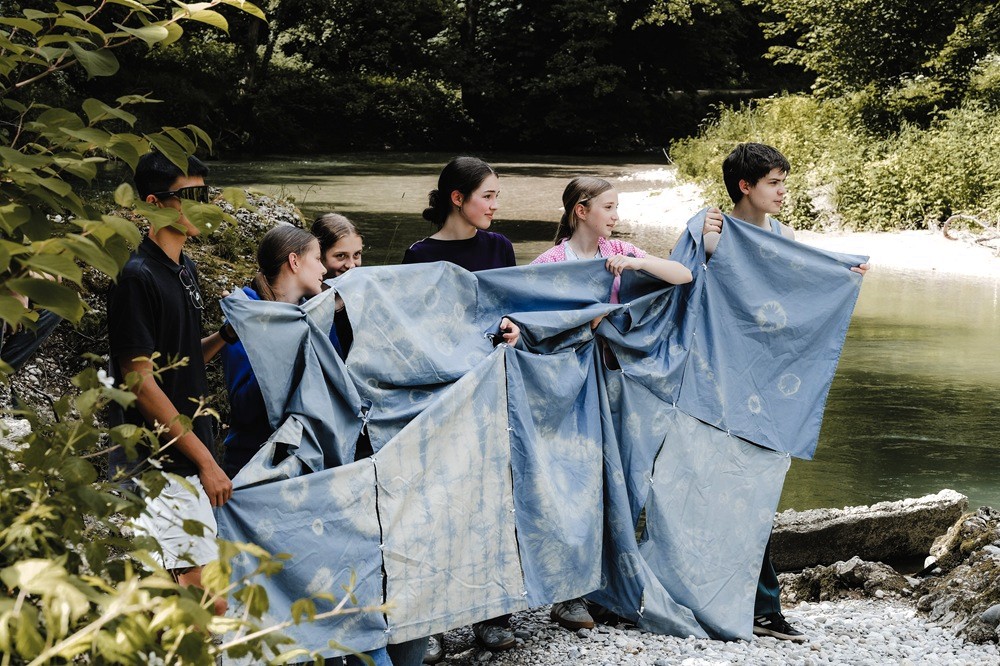



The Learning Lab Rewoven Realities, designed and implemented by Carnica Institut as part of Creative FLIP’s Learning Lab programme, involved a class of 14-15-year-olds from Janez Puhar Elementary School in Kanj, Slovenia. They explored the intersection of fashion, textile art, performance, and sustainability, culminating in a public performance at the BIEN Textile Art Biennial 2025.
By Goethe-Institut Brussels
Rewoven Realities is a creative Learning Lab engaging 14–15-year-old students in sustainable fashion through design, upcycling, and performance. Students transformed garments, learned traditional dyeing, and co-created a public performance during the BIEN Textile Art Biennial 2025, turning Kranj’s streets into a living catwalk. Guided by the theme NEWSTALGIA IN THE AIR, they explored textile heritage, embodied storytelling, and the meaning of fabric as memory and responsibility. This travelling performance, Young Flocks, marked the culmination of weeks of making, learning, and reflection—empowering students to express ideas through movement, sound, and fabric.
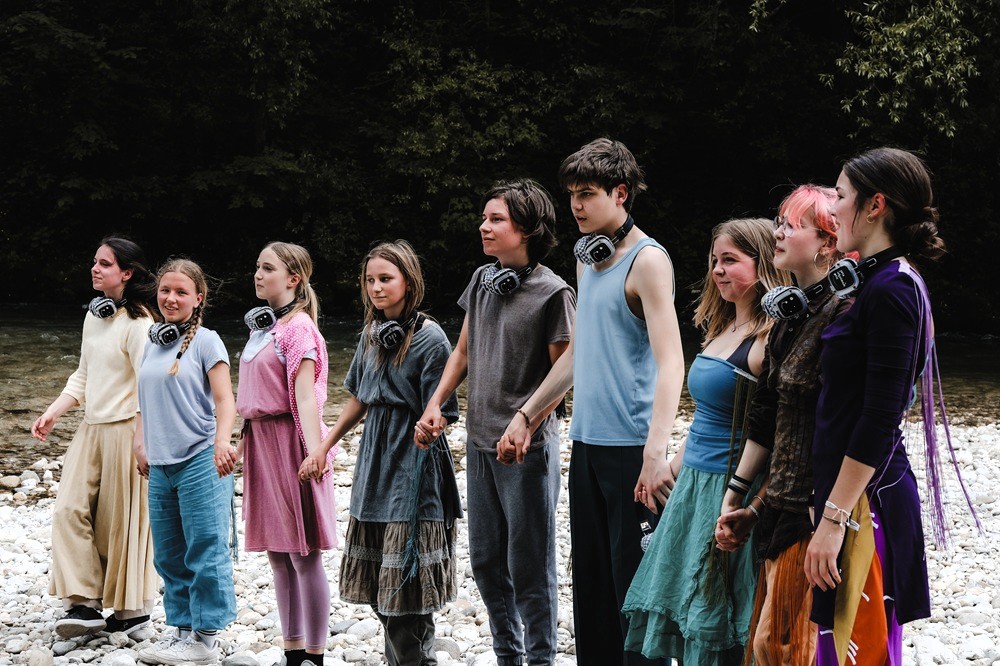
At the end of May 2025, the city of Kranj transformed into a stage for textile art, heritage and social impact. From the quiet greenery of Vovk Garden to the Kokra Canyon, students from Janez Puhar Primary School co-created a travelling performance with young dancers, wearing garments they had designed, dyed, and upcycled themselves.
This was Young Flocks, the culmination of weeks of learning, making, and reflecting. Guided by the theme NEWSTALGIA IN THE AIR, the choreography brought together personal expression, recycled sound from recorded reflections on fashion’s impact, and textile storytelling floated through the streets, merging with movement and music. This showcasing event marked the final chapter of a Learning Lab journey where learning took shape in fabric, movement, sound, and air.
The Learning Lab Rewoven Realities was designed as a creative, interdisciplinary experience combining hands-on design and creative transversal skills with critical thinking. Through workshops, students explored themes like sustainability, intellectual property, and slow fashion, while critically analysing the narratives around these issues, such as labour conditions, waste, and creative ownership. They created upcycled garments and a communal shibori flag by experimenting with traditional dyeing techniques. The final public performance, part of BIEN Art Biennial 2025, transformed Kranj’s old town into a living catwalk where students adapted the concept of the runway to their own styles and stories.
Working with 14- and 15-year-olds proved more challenging than expected. “Their energy levels and short attention spans required constant adjustments to my teaching approach,” admitted one facilitator. For the students, traditional lectures felt too much like school. Instead, hands-on activities—like dyeing, sketching, and garment transformation—sparked curiosity and engagement. “The biggest lesson learnt is that this age group responds best to playful, interactive, and action-based formats,” the facilitator reflected. “Theory-heavy parts—especially around sustainability policies or intellectual property rights—were difficult for them to fully engage with. But we managed.”
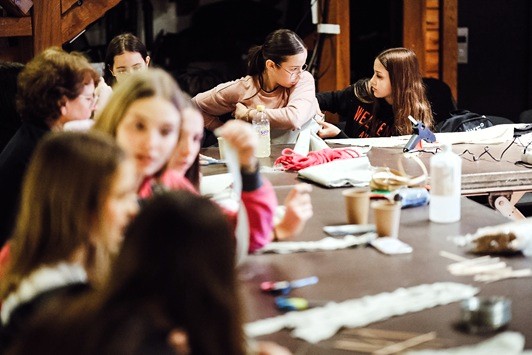
One student, after a design sketching session, asked, “So if I draw it first, it’s mine forever? ”— a moment that opened up a lively discussion on intellectual property. Another group, inspired by Pinterest, explored the boundaries between inspiration, originality and giving credit to creators, leading to a deeper understanding of creative ownership.
The Learning Lab also revealed surprising insights for the creative facilitators. “I was shocked to learn that many of them saw second-hand shops as strange, smelly places,” the facilitator said. “But during our visit to Made in Anselma, a local sustainable fashion brand, they were genuinely excited about the designs made from deadstock materials.”
Another important insight was the value of showing behind-the-scenes moments, bridging the gap between theory and relevance. “Showing them what I do professionally also made a huge impact,” the facilitator Lovro Ivančić shared. “Slovenia’s Got Talent is very popular with this age group, so referencing my work on the show became a great entry point for discussing personal style.”
At the start of the Learning Lab, students’ understanding of fashion, sustainability, and ownership was basic, focused mostly on personal appearance, social status, and simple definitions like “clothes” or “what looks good.” Sustainability was associated with product quality or second-hand shopping, often seen as inconvenient or “smelly”. Ownership was simply “it’s mine and not anyone else’s.”
By the end of the project, there was a noticeable shift. Students talking about fashion began to include terms like zero waste, slow fashion, local production, and self-expression. Some students started seeing fashion as linked to consumerism, material origins, and global production chains. Their language around sustainability grew more nuanced: greenwashing, child labour, working conditions, water consumption, and waste ending up in the sea entered the conversation. They began questioning eco-labels and recognising that not everything that looks sustainable actually is.
Ownership evolved too. The idea of creative ownership, design theft, and crediting your source of inspiration became part of their vocabulary. Concepts like copyright, protected design, and even big brands stealing from small designers surfaced in their responses.
“Was the transformation radical? No. But was there progress? Definitely,” the facilitator said and highlighted: “Most importantly, every single one of them has now heard these words and stories at least once. Somewhere, in the back of their minds, a small drawer has been filled with new information—waiting for the right moment to open again.”
Rewoven Realities was more than a series of workshops on sustainable fashion—it was a platform for young people to explore identity, sustainability, and creativity in a way that was both personal and public. By blending textile art, performance, and critical reflection, the Learning Lab empowered students to become storytellers, designers, and changemakers. For Carnica Institut, the project was a valuable pilot for working with a younger audience.
One student concluded, “Working with fabric was more fun than listening.” And sometimes, that’s exactly where the learning begins.
Image: Maša Pirc
This Case Study was created under Creative FLIP, an EU co-funded project aimed at further increasing the long-term resilience of the CCSI in key areas such as Finance, Finance, Learning, Working Conditions, Innovation & Intellectual Property Rights.
Key Takeaways

1)Carnica Institut is a cultural non-governmental organisation managing public infrastructure, organising events, and fostering collaborations between communities, cultural operators, and local government in Kranj, Slovenia. Initially an art hub, it evolved in 2017 into a regional centre supporting NGOs and individuals in culture, creativity, civil society, and environmental initiatives.
2)OŠ Janez Puhar Kranj – Center is an educational institution that provides quality education for children and young people. Its vision is to nurture primary students into independent, responsible, and creative individuals who develop in all areas. Group of 14-15 year old students participated in the project.