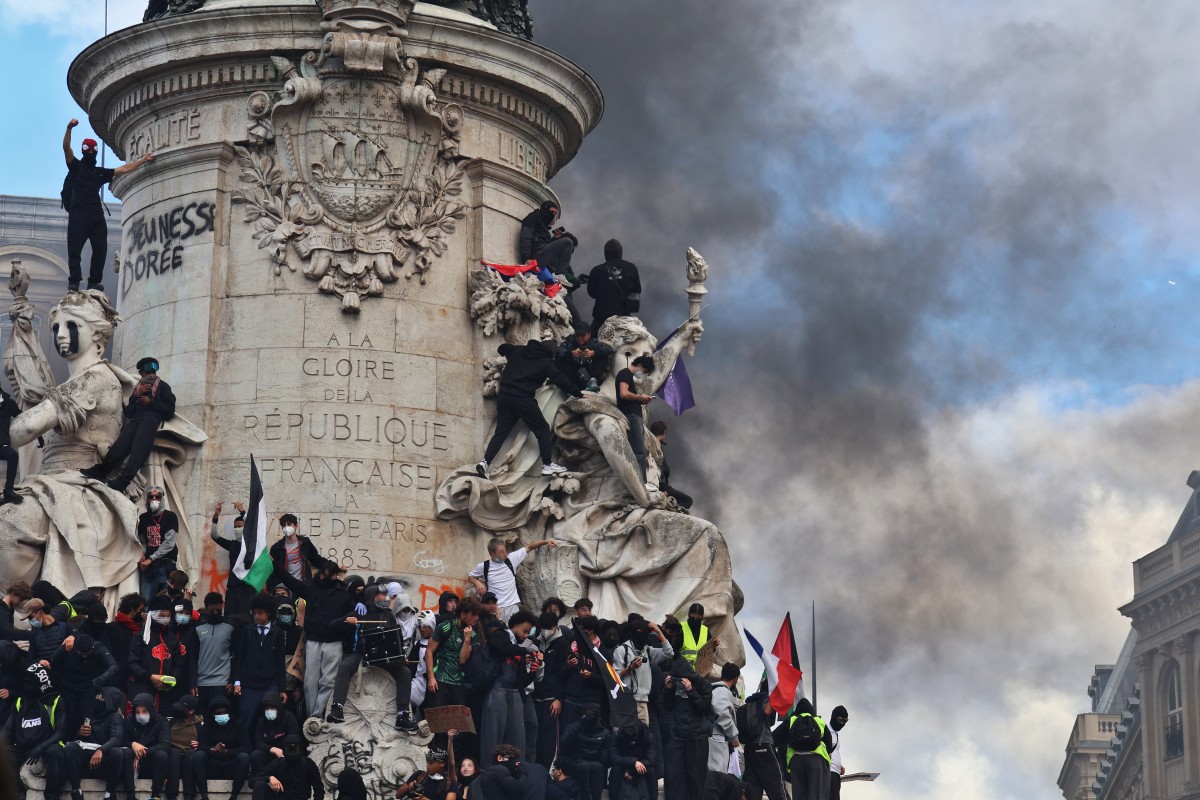
Reinterpreting punk’s "no future" as an urgent call to action, cultural journalist Aïnhoa Jean-Calmettes argues that art reclaims the present by grounding political struggle, collective affect, and history’s unrealised possibilities in the here and now. This Op-Ed is part of CU's Going Beyond End Times Narratives special feature
By Op-EdBy Aïnhoa Jean-Calmettes*
I recently realised there might be a completely different way to interpret the most iconic punk motto. I was writing a profile of the Greek choreographer Katerina Andreou for the French newspaper Libération. Her work led me to think that « no future » could mean something other than a nihilistic declaration – « enjoy now, tomorrow might bring nuclear apocalypse » – namely, more or less the opposite: « Stop putting everything off until tomorrow with all your questions and procrastination. Make your move now. Now is what matters. » By bringing us back down to earth, to the here and now and the actions we can take in it, however insignificant they may seem, Punk invites us to rearticulate a sense of time we seem to have lost.
First hypothesis: what if punk was less about « no future » than something more simple and yet forgotten: « No future without now »? Or to quote a placard seen in the recent French demonstrations, « No tomorrow without today »?
The radical subversive nature of punk might lay there even more than in the social criticism it embodies. Punk reminds us that Western modernity can only think about time by cancelling it out: it reduces the present to isolated experiences, increasingly monetised by late capitalism; it turns the past into an inexorable force; and it erases the future by picturing it as an amorphous and relentless forward rush that we call the future.
Let’s then return to the question that concern us in a punk spirit by taking it somewhat crudely at face value. What if « Go beyond end-time narrative » was not an invitation to imagine a brighter future by replacing omnipresent apocalyptic narratives with utopian counter-narratives? What if it was an invitation to put an end to the cancellation of time produced by Western modernity? Or, to quote another placard that has been flying over French demonstrations in the form of a giant red flag: an invitation to « Leave the Contemporary Era »?
How can culture help to make this shift? As a journalist and theatre critic, I have spent more than a decade exploring the connections between art and politics and the dialogue between performing arts and humanities. The only thing I have learned is that these encounters play out differently every time, as if for the first time. The political efficacy of a piece of art can never be taken for granted. Consuming fictions depicting radiant futures will never be enough to make us believe that they could become true or that we should fight to make them. We shouldn’t be sad about it: narratives conceived to produce specific political or emotional effects are closer to propaganda and advertising than to art.
This would be my second hypothesis: the political power of art may have nothing to do with content or the so-called and very popular « renewal of our imaginative perspectives ». When it comes to the issues that concern us here, the two most compelling theatre works I can think of are La parabole du seum by Rebecca Chaillon and Farm Fatale by Philippe Quesne. Two post-apocalyptic fictions, a genre generally regarded as politically disarming. They have in common the end with the formation of small armies of wonderful weirdos and the sparks of a revolt. These plays do not call for revolution, nor do they aestheticise uprisings. They remind us, again, that the future is invented here, now, and collectively. By bringing anger, hope, a sense of belonging, agency and the urge to organise, they remind us that the political power of the arts is also a matter of affect.
These two plays can be read as early symptoms of a paradigm shift in how we approach the ecological crisis. Could the framework of the Anthropocene, along with the idea of re-enchanting our relationship with the « more than human », be losing its grip? Third hypothesis: as ecological theory has been moving towards a more materialist approach, theatre has begun to do the same. Questions of struggle, class and production antagonisms are coming back to the forefront. Not just on stage, but behind the scenes as well. Some artists, such as Gabriela Carneiro da Cunha and Milo Rau, think politically the very conditions under which their work is produced, maline artistic production itself, are part of struggles rooted in particular places.
This brings us up against another obstacle: the persistent belief that political struggles have, for a few decades, been doomed to fail. Political decisions are no longer in the hands of elected representatives but those of economic powers; police and judicial repression are too violent; we fight, yet nothing changes. This is the place we need new narratives: in the stories we tell ourselves collectively, not just in books, stages or movie theatres. Fourth hypothesis: since the dialogue between humanities and arts works in both directions, the ways we write past and present struggles are also undergoing a profound transformation.
Methods and ways of thinking long associated with artistic practice are finding their way into the humanities laboratory. The range of questions possible to ask and the ways in which we can address them have broadened. For example: What are the dramaturgies, rhythms, temporalities and offstage spaces of revolts? By learning to look differently, filling in the silences - through critical fabulation, if necessary - broadening the frame, and attending to the long stretches of dogged struggle rather than focusing on the revolutionary event, the humanities are reinventing the past, transforming it from an inexorable fate into something else entirely: unrealised possibilities that can still be reactivated.
The fifth hypothesis, the sum of all the others: going beyond end-time narratives has nothing to do with the future but everything to do with the past and the present. Let’s be punk.
Aïnhoa Jean-Calmettes is a journalist specialising in culture and ideas. She writes for Libération and CND Magazine and coordinates the humanities sections of Mouvement. She hosts talks at the Institut du monde arabe, the Manufacture d’idées festival, and the Maison de la poésie and regularly collaborates with Villa Gillet, the Maison des écritures contemporaines de Lyon.
During the Bautopia festival in Athens, Creatives Unite presented a panel discussion titled 'How do we go beyond End-Times Narratives?' Thinkers, academics and artists Igor Šimić, Thanassis Moutsopoulos, Angeliki Poulou and Ainhoa Jean-Calmettes took part in an open discussion about the role of arts and culture in the current Gen Z protests around the world concerning the climate crisis, peace and democracy. Read more here
Op-Ed
The opinions expressed in this Op-Ed are those of the author. They do not purport to reflect the opinions or views of the Creatives Unite editorial team