

On the last day of the Bautopia festival in Athens, Creatives Unite hosts a panel discussion on a relevant and up-to-date topic at the intersection of culture and politics: end-times narratives and what culture's role may be in a future that is described as bleak, between climate catastrophe and AI takeover of agency. At Romantso Creative Hub in Athens at 16:00
By Matthaios TsimitakisMore than thirty years ago, we were told by liberal thinkers like Francis Fukuyama that history had ended. Mark Fisher gave a name to what followed: capitalist realism. As the future is cancelled, he argued, it is easier to imagine the end of the world than the end of capitalism. The problem, in that picture, was a failure of imagination of the future.
Today the problem has shifted. In End Times Fascism, Naomi Klein and Astra Taylor describe how tech billionaires, religious fundamentalists and ethno-nationalists have imagined the end in vivid detail: fortified enclaves, escape from the planet. A disaster movie with a VIP section. They have made peace with the ending (once again), on one condition: that they write the story.
Amitav Ghosh, in The Great Derangement, argued that climate change is a crisis of culture before anything else: our stories were built for a stable world. 'What stories can we say in an unstable world?' he wondered in 2016.
Art historian T. J. Demos has spent years asking what art does once the world’s end is already on the screen. He is describing our times as an endgame — for liberalism, for the climate, for the world as we've known it — and asking whether the imagination itself survives.
And we all know who has grown up inside this. Gen Z has never known a world without a crisis. A 2021 survey of ten thousand young people in ten countries, published in The Lancet Planetary Health, found that more than half said humanity is doomed.
What stood out is that their distress tracked their sense that governments were failing to act. Doom, in other words, is not only a story people absorb. It is also a response to institutions that don’t answer. Resignation is the corrosive result. It undercuts the will to act, and it closes off the very stories we need. So we’re opening the debate in the field of culture, the place where a society practises imagining and forms futures.
Who gets to tell the story of the future? What does a story look like that isn’t surrender? And what can culture actually do?
Thanasis Moutsopoulos, Associate Professor, Cultural Analyst at the National Technical University of Athens, will talk about the idea of novelty or authenticity, which seems to have all but disappeared. Is that notion an afterthought of the postmodern condition or a by-product of the invasion of AI programmes at all levels of creativity?
Aïnhoa Jean-Calmettes, journalist and editor for the ideas section at Mouvement Magazine and theatre critic at Liberation, will bring to the table the debate from the academic field, how materialist approaches have grown in influence, challenging the narratives associated with anthropocene or collapse theory
Igor Simic, Creative Director at Demagog Studio, will explain how by turning all cultural production into content, everything becomes disposable, fleeting, extractivist, and irrelevant, but it also gains the potential to be flatter, more heterarchical, intertwined, and free.
Last but not least Angeliki Poulou, Assistant Professor, Department of Digital Arts & Cinema, National and Kapodistrian University of Athens and member of Medea Electronique Art Collective will examine the ways in which contemporary and digital art respond to the ecological and planetary crisis, and question what happens when artistic engagement with catastrophe stops at awareness.
The panel discussion will be open to the audience for questions and comments, as we don't expect definite and concrete answers but rather the start of a debate that is relevant, up-to-date and long due indeed.
Bautopia festival at Romantso Creative Hub in Athens at 16:00
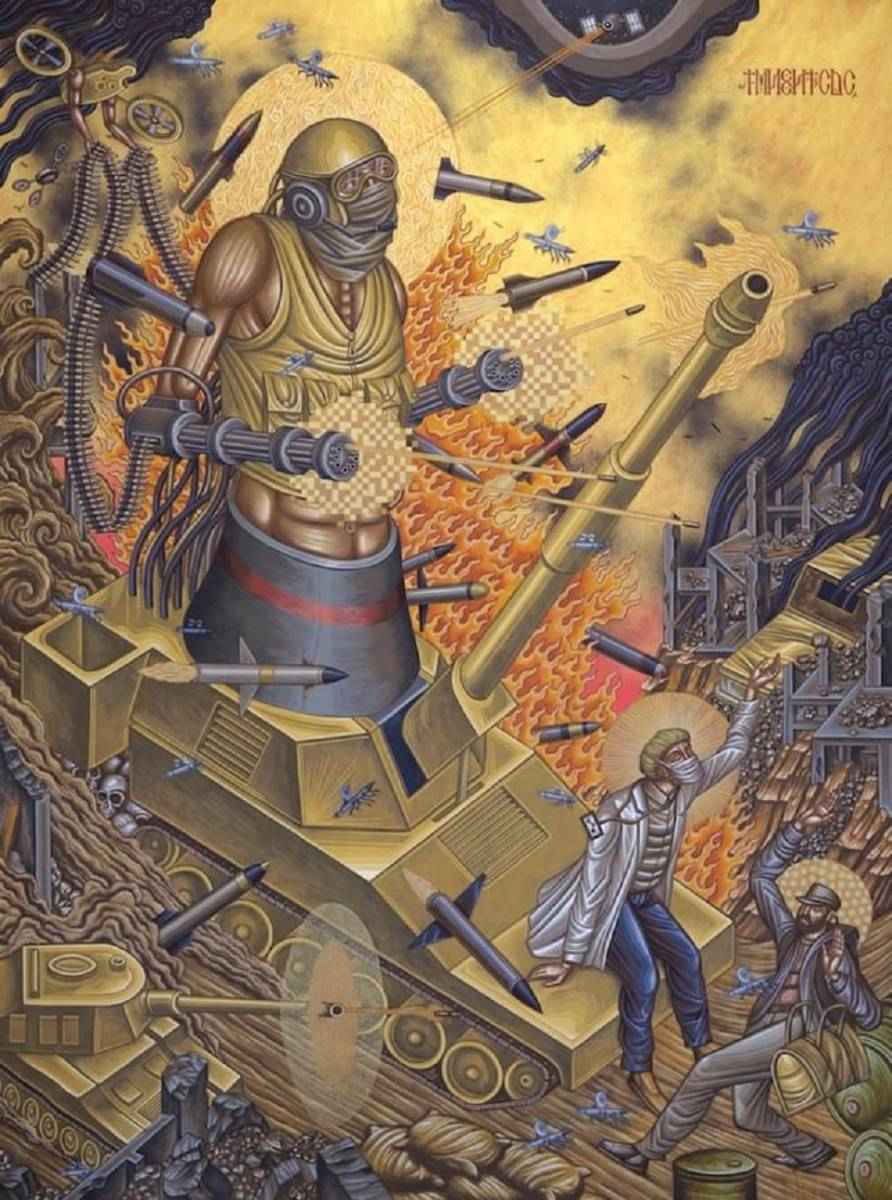
Image: Stelios Faitakis, Fortunately Absurdity is Lost (Part II: Not quite dead)