

Annick Jehanne, president of Fashion Green Hub, founded the organisation in 2015 in Roubaix—once one of France's great textile capitals—with the conviction that sustainability, innovation and job creation were not competing priorities but a single argument waiting to be made.
By ECHN for Creative FLIP
In 2015, Annick Jehanne and two colleagues founded an association in Roubaix, a northern French city still marked by the shells of its former textile industry — a thousand brick factories with tall chimneys, most of them silent. Their goal was specific and, at the time, largely uncontested terrain: to bring fashion and textile companies together to work on sustainability. "At the time," Jehanne says, "nobody worked on it."
Ten years later, Fashion Green Hub is a national organisation with 450 member companies, two Plateau Fertile hubs — Roubaix and Paris — a third planned for Lyon, and a research finding that its most distinctive quality is not its infrastructure, its training programmes, or its digital fabric platform but trust. The journey from fifty people in a disused factory to a nationally recognised model for sustainable textile innovation is not a story about rapid scaling. It is a story about what happens when you refuse to move faster than the ecosystem around you is ready to go.
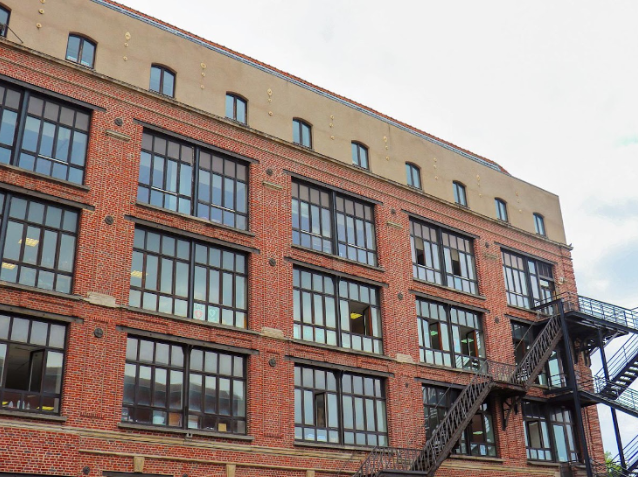
Roubaix was the right place to begin. A weaving city that had produced wool, cotton and linen at an industrial scale, it still housed significant numbers of textile companies—large retailers beginning to grapple seriously with sustainability—even as its manufacturing base had contracted. The choice of a historic brick factory building for the first Plateau Fertile was not incidental. It embedded the initiative physically in the city's industrial memory while signalling something about its intentions: this was not a clean-room startup. It was a continuation, on different terms, of something that already existed.
The founding insight of Fashion Green Hub was structural. Jehanne and her colleagues understood quickly that sustainability in fashion could not be addressed by working with one part of the supply chain at a time. "From the beginning we thought we had to work on it on the whole value chain, not only distributors, manufacturers or designers, in order to put everyone together so that people could move, find solutions and do more projects together as well." Schools were not talking to manufacturers. Designers were not talking to industrial distributors. Nobody, in Jehanne's account, was talking to anybody. The first task was simply to put them in the same room.
Plateau Fertile Roubaix became that room – and considerably more than a room. It is a prototyping space with printing machines, rotary machines and the full range of equipment that small companies and young designers need to test ideas without committing to production runs. It is a training centre, running programmes for people who have been unemployed for more than five years and teaching them upcycling manufacturing skills that connect directly to the manufacturers in the network. It is home to an on-demand factory. And it runs its own digital platform through which designers can browse and order existing fabric stocks – a direct expression of Jehanne's core sustainability principle: "Sustainability to us means to use existing fabric first. We have some swatches of existing stock of fabric, stored nearby, so that designers can come and see what's in stock."
The result, across a decade, is that 2,200 companies have forged new working relationships through Fashion Green Hub's structures—relationships that, by Jehanne's account, simply did not exist before. The association also now runs Fashion Green Days, a B2B event series on sustainability and innovation held three times a year in different parts of France – the only event of its kind when it launched and now a fixed point in the sector's calendar.
What Fashion Green Hub was doing was also, from the beginning, an argument. In a northern French city where the conversation about economic regeneration was dominated by technology startups—AI, robotics, and advanced manufacturing—Jehanne was making a different case. "We showed that sustainability was creating jobs. This is what we wanted to show in this area: that working on the subject was innovative because there are a lot of startups working on artificial intelligence or robotics, manufacturing, and very innovative things. So we wanted to show that sustainability, innovation and jobs were connected, and we could manage to create activities and jobs in the process of sustainability."
That argument has been recognised formally. Plateau Fertile Roubaix is one of the first twenty French third places to receive the Proximity Manufactures label, awarded through France's national recovery plan – an acknowledgement that the model has something to say not just to the textile sector but to the broader question of how post-industrial territories rebuild economic and cultural life.
The expansion to Paris in November 2022 tested how transferable the model was. The answer was 'transferable, but not identical'. The Paris hub occupies a contemporary glass building by a noted architect — entirely different in character from the Roubaix factory and better suited to the particular qualities of light that textile and creative work demand in that context. The differences are deliberate. Fashion Green Hub does not replicate; it adapts to what already exists in each place.
The Lyon hub, planned for the near future, follows the same logic. And Jehanne is unambiguous about the pace at which that logic will be applied. "We never do a Plateau Fertile if we don't already have a big enough community in that area. We are quite slow; we don't want to rush. We are a small team, about 20 people only. So we go step by step, we take time, and we talk to all the ecosystem actors before we launch anything. It's a slow process, but that's not a problem. It comes when it's ready. We are not a financial company. So we have no shareholders to please. We do whatever we decide to do."
That independence—from investor pressure, from the logic of growth for its own sake—turns out to be structurally connected to the quality that a researcher from the Catholic University of Lille identified after spending four years embedded with the organisation. His conclusion, following interviews with members and partners across the network, was that Fashion Green Hub's most distinctive asset was trust: that people entering the association knew they would not be taken advantage of, that respect and openness were the operative norms, and that this quality — rare enough in any industry, rarer still in one as competitive as fashion — was what made genuine collaboration possible.
Key Takeaways

Annick Jehanne, President, Fashion Green Hub — Roubaix, France
Annick Jehanne co-founded Fashion Green Hub in 2015 with two colleagues in Roubaix, northern France, with the aim of bringing fashion, textile, art, design and cultural professionals together around a shared sustainability agenda. Under her leadership, the organisation has grown from a local association of fifty people to a national network of 450 companies, with Plateau Fertile hubs in Roubaix and Paris and a third in development in Lyon. Jehanne is a recognised advocate for the connection between sustainability, innovation and job creation in the textile and fashion sectors.