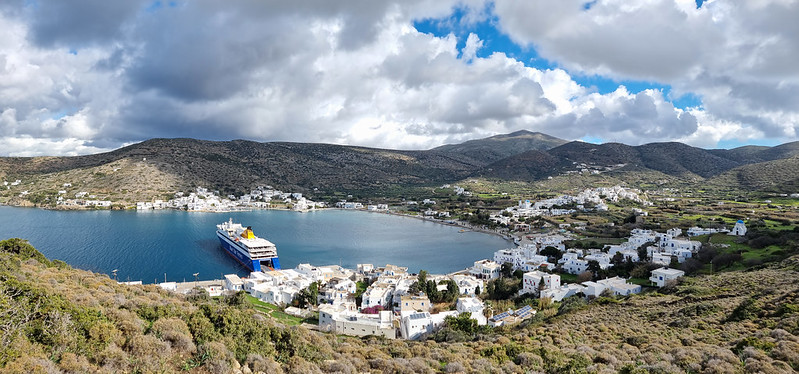



On a small Greek island in the Aegean, a village and ancient city that have existed in harmony for millennia are facing a threat that could arrive with alarming speed. In Hungary, an 18th-century watermill—one of only 300 surviving from a network that once numbered 17,000—is quietly rotting from the inside out. And in Portugal, a late-19th-century gunpowder factory, one of Europe's most complete and preserved industrial sites, is deteriorating under vandalism and invasive vegetation, risking the loss of a dual industrial and ecological legacy.
On Thursday, in partnership with the European Investment Bank Institute and supported by the European Commission through the Creative Europe Programme, Europa Nostra revealed Europe's 7 Most Endangered heritage sites for 2026. The annual programme, running since 2013, functions as both a warning system and a lifeline — a way of saying, loudly and internationally, that time is running out.
The stakes differ by site, but the underlying tension is consistent: development pressure, neglect, and the slow erosion of political will to protect places that don't generate obvious economic returns. For Guy Clausse, Vice-President of Europa Nostra, the answer is to reframe the question entirely. "Cultural and natural heritage must be recognised as a living force driving growth, sustainability and cohesion," he said at Thursday's announcement, "and therefore be put at the core of European strategies, policies and budgets."
That argument — heritage not as nostalgia but as infrastructure — is increasingly the one conservationists are making. Evidence proves that a mediaeval watermill anchors regional tourism or that an intact Aegean village is an irreplaceable economic and cultural asset.
Selected from 14 shortlisted candidates, each of the seven winning sites receives €10,000 in grant funding and hands-on technical support. But the real prize, advocates say, is the international spotlight—the kind that has, in past years, unlocked millions in additional funding and prompted meaningful policy changes across the continent. Greece's Monemvasia Castle, featured on the 2025 list, is one example of how the programme can catalyse action that local advocates alone could not achieve.
The programme's value is perhaps clearest when you return to the three sites where it could matter most this year.
In Katapola, on the island of Amorgos in the Cyclades, no formal construction approvals have yet been granted for the large-scale port development threatening the ancient city of Minoa. The window for intervention is still open. Local citizens have already slowed the urban planning process through sustained mobilisation, and Europa Nostra's Advisory Panel believes the site has the potential to become a blueprint for sustainable heritage protection across small Mediterranean islands facing similar pressures. International attention, arriving now, could tip the balance before irreversible construction begins.
For the Fábri Watermill near Feked, the need is different but equally urgent. The community's commitment to saving the mill is not in question — what's missing is the specialised expertise required to restore an 18th-century milling structure authentically. Inclusion on the list is designed to provide exactly that, linking local champions with technical guidance they cannot access on their own.
And at the Vale de Milhaços Gunpowder Factory in Seixal, where the remains of one of Europe's most preserved industrial sites risk disappearing into disrepair, the programme offers something harder to quantify: the insistence that even industrial histories deserve to be preserved, not because they are comfortable, but because forgetting them carries its own cost.
The list of the 7 Most Endangered Heritage Sites in Europe for 2026:
Katapola Village and Ancient City of Minoa, GREECE
Fábri Watermill, Feked, HUNGARY
Blower Hall, Esch-sur-Alzette, LUXEMBOURG
British Barracks at Fort Chambray, Gozo, MALTA
Vale de Milhaços Gunpowder Factory, Seixal, PORTUGAL
Reformed Church of Sântămăria Orlea, ROMANIA
Weifert’s Brewery, Pančevo, SERBIA
Expert teams will be dispatched to each site over the next two years.