Seventy-six years ago on this date, a Luxembourger in the service of France stood before journalists and diplomats in the Salon de l'Horloge of the Quai d'Orsay in Paris and read a short text that would, within a generation, transform Western Europe from a charnel house of rivalries into the most ambitious peace project in history. The occasion is now commemorated annually as Europe Day, falling this year on Saturday, May 9, 2026.
Robert Schuman, French foreign minister, proposed on May 9, 1950, that France and West Germany — nations which had fought three devastating wars between 1870 and 1945 — should place their coal and steel industries under a single supranational authority open to any European nation willing to join. The logic was as bold as it was simple: coal and steel were the essential materials of warfare. Remove exclusive national control of them, and the next Franco-German war would become, in his now-famous phrase, "not merely unthinkable, but materially impossible".
The declaration was in fact drafted not by Schuman but by Jean Monnet, France's First Planning Commissioner, widely regarded as the intellectual architect of European integration. Monnet had spent weeks preparing the text in secrecy; Schuman, who had grown up in the borderlands between France and Germany and served under three flags in his lifetime, gave it both credibility and urgency. West German Chancellor Konrad Adenauer, who had been briefed in advance, agreed to the plan in principle — a crucial act of statesmanship that gave the proposal immediate political weight.
In 1950, Europe was five years clear of the most destructive war in its history, its cities still rebuilding and its populations still counting their dead. The Cold War was hardening the continent's divisions. France, mindful of German industrial revival, faced a dilemma that had no purely national answer. Schuman's proposal — inspired by his official foundation notes, by Monnet's persistent advocacy — resolved it by making France and Germany inseparable economic partners rather than perpetual adversaries.
The contested Saar and Ruhr regions, mineral-rich territories that had been flashpoints in every Franco-German confrontation since 1870, were central to the design. By placing their output under joint high authority, neither nation could arm for war against the other without the other's participation. The proposal was, in its own way, a masterstroke of coercive interdependence.
By June 3, 1950 — less than a month after Schuman's declaration — six countries had agreed to open negotiations: France, West Germany, Italy, the Netherlands, Belgium and Luxembourg. Their motivations were mixed. Italy and the Benelux states faced their own energy pressures in a globalising economy; none wished to find themselves excluded from a new continental architecture. The result was the European Coal and Steel Community, founded in 1951, the first truly supranational institution in European history and the direct institutional ancestor of today's European Union.
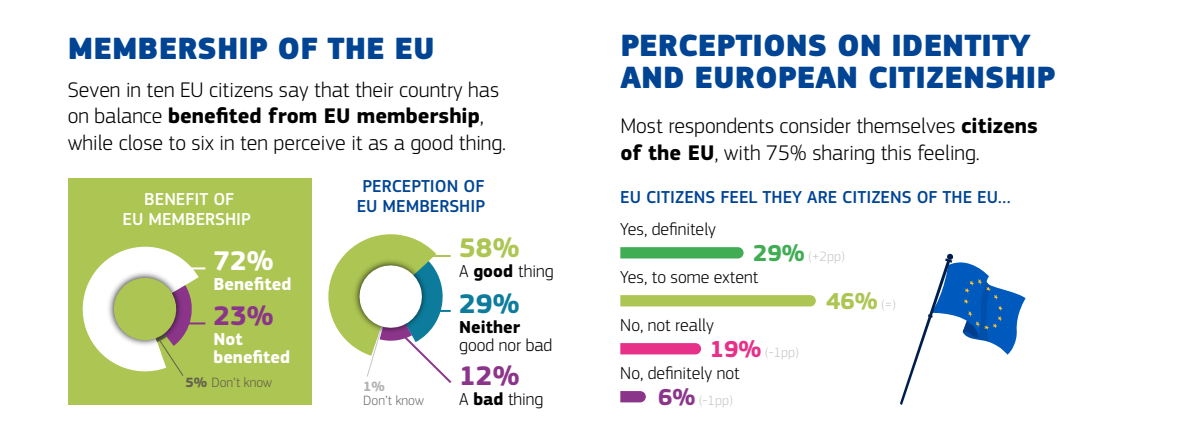
 Nearly three-quarters (72%) believe their country has benefited on balance from being a member of the EU. Nearly three-quarters of Europeans (73%) agree that the EU is a place of stability in a troubled world, and support for stronger cooperation in defence remains at the highest level ever recorded, with 81% backing a common defence and security policy among member states. 76% of European respondents agree that Russia’s invasion of Ukraine is a threat to the security of the EU, and support for the EU’s response to Russia’s invasion of Ukraine remains strong, with 55% satisfied with the EU’s response to the Russian invasion of Ukraine.
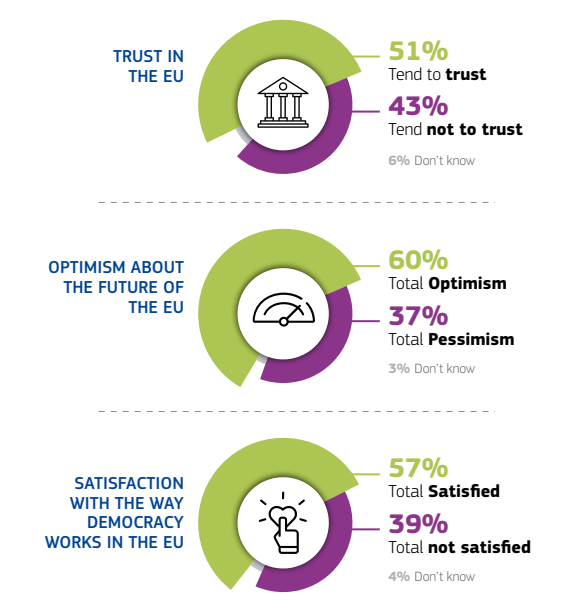
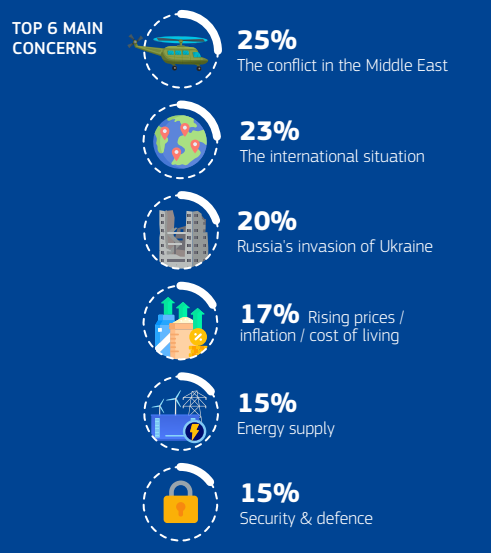
Overall, 76% agree that the EU should continue supporting Ukraine until a just and lasting peace is achieved. A majority of Europeans (51%) trust the EU, representing an increase of 3 percentage points since autumn 2025. Six out of ten Europeans say they are optimistic about the future of the EU. More than half (57%) of EU citizens are satisfied with the way democracy works in the EU. At the EU level, the conflict in the Middle East is now the top concern (25%), ahead of the broader international situation (23%) and Russia’s war against Ukraine (20%).
(click image to enlarge)
 At the same time, the cost of living remains the dominant concern at the national and personal levels, with 36% and 52%, respectively. Support for the euro in the EU remains at 74%, maintaining the highest level since the introduction in January 2002. More than eight in ten interviewees (82%) express support for the common currency in the euro area. At the same time, perceptions of the economic situation have weakened slightly, with 44% of interviewed Europeans considering the EU economy to be good. A relative majority of citizens (42%) think the European economic situation will remain the same in the next 12 months, vs 36% who think it will be worse, and 15% who think it will be better.
Saturday's celebrations stretch from Athens to Antwerp. In Brussels, the principal EU institutions — the European Commission, the European Parliament, the European External Action Service, and the European Economic and Social Committee — open their doors to the public from 10:00 to 18:00 Central European Summer Time, offering tours and activities for visitors of all ages at the Berlaymont headquarters and beyond. A festive march departs the European Quarter at 4:45 pm, arriving at the Grand-Place, where a large EU flag is draped across the square's baroque façade, and speeches are delivered before an open-air dance floor is established on the Place des Palais.
--Here is a list of events organised by official EU institutions--
In Luxembourg, the principal commemorations take place across two days: events in Luxembourg City on May 9 and a larger Europe Day festival in the town of Wiltz on May 10, with a particular focus on cross-border cooperation and the fortieth anniversary of Portugal's and Spain's accession to the European Community. In Prague, an open-air festival on Střelecký ostrov — the island in the Vltava — brings together theatre and musical acts from Sweden, the Netherlands, the United Kingdom, Croatia and Czechia alongside public debates on geopolitics, disinformation and the war in Ukraine.
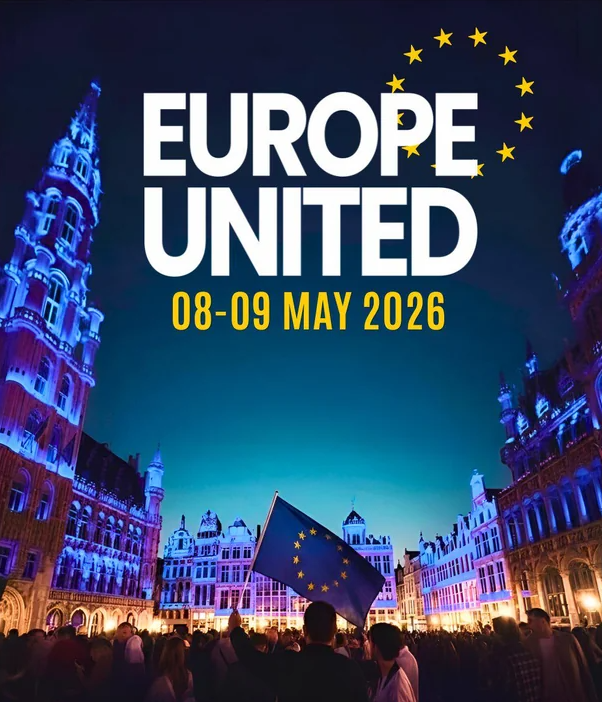
Across the continent, the European Cultural Foundation is curating a shared European agenda of locally organised concerts, debates, exhibitions and workshops. The Europe United gathering at the Grand-Place on May 8–9 brings citizens, policymakers, artists and students together to reflect on the values Schuman and Monnet staked their careers upon.
(click image to enlarge.)
The Schuman Declaration is widely considered the founding act of European integration — a new federal model, as scholars have described it, representing a union of states and peoples rather than merely a trading arrangement. That legacy is now, as it has periodically been throughout the Union's history, subject to intense debate about where the boundaries of solidarity lie and whether the original ambition retains its force. Seventy-six years on, the EU remains the largest voluntary union of sovereign nations on earth.