


Commission’s summary of 450 reactions on the ongoing review of the DMA showed broad support for the “landmark” legislation, of major impact on books, music, video games, GLAMs and academic research. Creatives called for measures on definition gaps, transparency and interoperability among others, to address “Amazon’s monopoly” and big techs’ “unfair practices”, growing at the expense of end users and a truly free market.
By Eirini PolydorouThe European Commission published the summary and responses to the public consultation on the ongoing review of the Digital Markets Act (DMA).
Respondents generally supported the importance of the DMA in ensuring the development of fair and contestable markets. Concerns included the dual role of major platforms such as Amazon, functioning as both intermediaries (covered in DMA) and retailers (not covered in DMA). They urged for addressing unfair practices linked with self-preferencing, data-sharing obligations, cloud markets and advertising markets. They argued on blocked interoperability and focused on lack of transparency, due to big techs’ taking advantage of current DMA definition gaps.
Particularly ebooks, video games engines, social media video sharing, retail activity, research publishers and all kinds of cultural institutions should be included under the DMA scope, said the respondets. They called for extending the definition beyond current financial criteria, so that the DMA truly covers for all digital services provided by gatekeepers or actors of such power, while future-proofing on AI implications. There were also calls for preserving the DMA’s political independence.
Against calls to expand the DMA’s scope particularly in relation to AI and cloud services, gatekeepers’ representatives commented on risks of stifling innovation, market distortion and administrative overload. Gatekeepers and affiliated entities called for caution in prematurely intervening in the AI sector, characterised by strong competition.
The 450 contributions gathered, included a total of 319 contributions to the consultation, 63 responses to the call for evidence and 96 to the consultation on AI, representing a wide range of actors, including business users, SMEs, trade associations, civil society organisations, academics, consumer groups and individual citizens, among others.
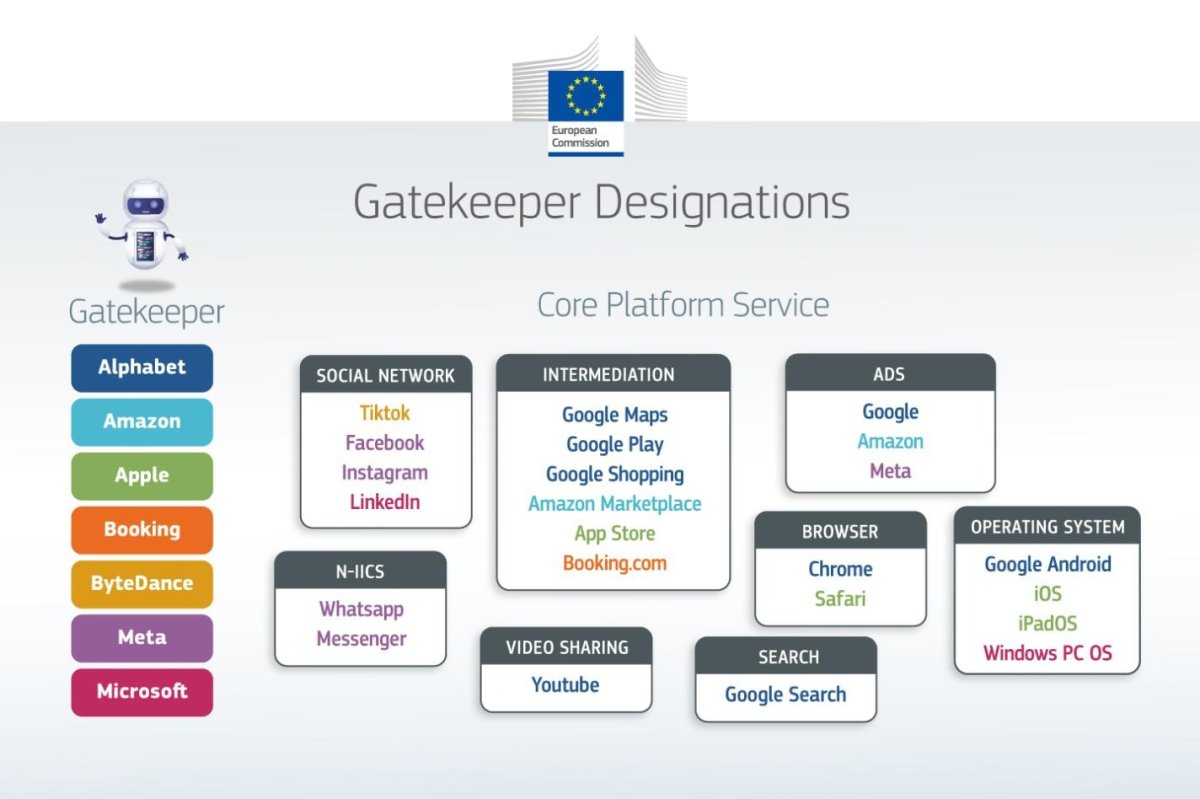
All DMA’s designated gatekeepers but one, as responses were submitted by Alphabet, Amazon, Apple, Booking, Meta, and ByteDance, while Microsoft did not submit a response (click on image to enlarge).
European and International Booksellers Federation (EIBF) called for DMA enforcement to not “fall prey to geopolitical tensions with the U.S.A” and for the Commission to “not hold back when it comes to fining gatekeepers in case of non-compliance”, keep moving forward with a “brave” enforcement approach against “this aggressive stance against the EU and its digital regulation” and towards reducing “our dependence on their services and increase resilience in the face of external shocks”.
European Games Developer Federation (EGDF) also welcomed DMA progress and suggested that “in the long run, the EU should build a global digital single market area with like-minded countries”, while noting that “the EU must be careful not to fall behind the regulatory development in other markets” and consider updating of the DMA “to ensure that European game developers enjoy similar conditions in their home markets as they currently do in the USA”, especially since “Unfortunately, gatekeeper platforms have so far refused to fully implement DMA obligations”.
“The DMA must consider how gatekeepers are embedding generative AI into core services”, because “unless addressed, the separation of the DMA from the AI Act may allow new forms of dominance to emerge, unrestrained by current obligations”, noted SAVIESA. Bringing the example of Microsoft and Google already integrating AI assistants into search, cloud, and productivity suites, SAVIESA called for DMA enforcement to explicitly address AI-powered services functioning as de facto gatekeepers.
AI-related threats are rising also in the academic journals field as emphasized by the International Federation of Library Associations and Institutions (IFLA). Noting “efforts to develop proprietary downstream AI-based services, drawing on their [major scholarly publishers] exclusive access to content”, IFLA expressed concerns “about the transparency of the results of AI-based and other search tools provided by the platforms often applied without clear information to users or the possibility to opt out”.
 Image by OpenClipart-Vectors from Pixabay
- DMA should protect booksellers and video games developers
“Amazon’s growing monopoly is affecting the whole book ecosystem” stressed the European and International Booksellers Federation (EIBF) and called to add "retail and distribution" to the definition of the services covered by the DMA in order to cover to both roles that giant techs play in the ecosystem. They argued on “ the unfair practices and damages created by most gatekeepers’ deriving from their dual role as “the gatekeeper provides an intermediation service which falls under the DMA scope (e.g. to a bookseller selling books as a third party through the marketplace) and acts at the same time as a retailer itself, which does not fall under the DMA scope (i.e. selling books directly) on the same consumer-facing platform”.
This dual role has led to practices “representing self-preferencing and a lack of transparency, in breach of DMA”, such as in the case of bookselling pre-order restrictions. For instance, though "not clearly stated in Amazon’s terms and conditions, but identified through observation by business users", from the moment a -highly anticipated- title is announced, end-users can pre-order it directly by Amazon, but not from other vendors during the same period, since “competing sellers are limited to a 30-day advance window for pre-orders, significantly reducing their sales opportunities” as said by EIBF.
Video game engines should also be included in the definition of DMA, said European Games Developer Federation (EGDF). As “video game engines are becoming key gatekeepers of European cultural and creative sectors”, the DMA scope on core platform services “should ideally be widened to encompass all digital services provided by companies belonging to a gatekeeper digital corporate group”, to ensure a future-proof approach where “European SMEs are aware of and can exercise their rights correctly”.
 Image by DAVECTOR from Pixabay
- DMA should protect all cultural content
Schools, cultural organisations, and non-profits should be “explicitly recognised” as business users under the DMA, according to SAVIESA in order to address current challenges for artists and cultural organisations regarding “attribution, provenance, and visibility on dominant platforms”. DMA transparency obligations should extend to to cover attribution and provenance of cultural content, currently challenging artists and cultural organisations. For DMA to protect “cultural dignity” the definition must be extended in order to enable transparency obligations and relevant contestability. Providing evidence from research SAVIESA argued that this is about “protecting Europe’s cultural diversity and creative rights”, on top of price or access, since “Spotify and YouTube recommendation systems shows how algorithms dictate visibility, while EU copyright debates have underlined the fragility of metadata and authorship online.”
 Image by Mohamed Hassan from Pixabay
- To cover for GLAMs, DMA should protect all cultural and research organisations, beyond financial criteria
Access to research, education and culture for all is also hindered by the multiple roles played by major players also in the academic publishers sector, as emphasized by the International Federation of Library Associations and Institutions (IFLA) and the Coalition for Creativity (C4C). Respondents expressed how the combination of a high market concentration along with pressure imposed from the “prestige economy” pushing researchers to achieve certain publication levels, eventually enables actors which currently do not fulfil the DMA financial requirements to still play a gatekeeper role in the sectors. The scholarly journals field is characterised by a notable tendency towards consolidation, where a “small number of very profitable multi-billion-Euro players” “act as platforms, interacting both with researchers (as authors, taking their work for free or even against payment), and with readers (through selling subscriptions)”.
Major publishers such as RELX/Elsevier and Springer Nature currently control “every part of the process” through vertically integrated digital ecosystems that are “particularly detrimental to Galleries, Libraries, Archives, and Museums (GLAMs)” and “indispensable for researchers, academic institutions, and the public”. For example, through strategic acquisitions "a single publisher like Elsevier owns platforms for search (Scopus), reference management (Mendeley), research analytics (SciVal), and institutional repositories (Pure)”. At the same time, "they collect vast quantities of granular user data, including search queries, downloaded articles, IP addresses, and peer review activity", building a surveillance infrastructure "on the back of publicly funded research", posing "a significant threat to academic freedom" and creating "an insurmountable competitive advantage", argued Coalition 4 Creativity.
 Image by OpenClipart-Vectors from Pixabay
What is Interoperability and how is it blocked?
In a nutshell, “Consumers should be able to switch ecosystems and choose alternative services through which to access their content, without being locked into digital ecosystems and formats provided by a gatekeeper”, as said by EIBF in their contribution. As they explain, currently, Amazon’s flagship product Kindle uses for e-books a proprietary file format (AZW) that cannot be transferred to or opened on competing devices, such as Kobo or Tolino. Conversely, Kindle devices do not support the widely adopted EPUB format used by most other e-book providers. A similar situation applies to audiobooks purchased via Amazon’s Audible platform, which are also locked to Amazon’s ecosystem.
In this respect they call to broaden the scope of DMA obligations, so that on top of messaging services or social networks, it includes ebooks and a wider range of digital services, formats, software and hardware, currently used by digital gatekeepers to “bind consumers to them”, such as in the case of Amazon’s Kindle.
 Image by Stefan Schweihofer from Pixabay
Lack of Transparency and Power Imbalance hinders DMA enforcement
Overall, respondents noted that their attempts to report non-compliance and secure injunctive relief failed due to the difficulty of collecting sufficient evidence.
For instance, “it is still unclear whether Amazon prevents users from offering better prices or commercial conditions on other platforms (MFN) – in breach of DMA - due to lack of transparency in their terms and conditions and algorithmic displaying system”, as said by EIBF. Multiple booksellers-users of the Amazon Marketplace claimed that in various cases their offers were no longer featured in the Amazon Marketplace as they should, following DMA’s buy box algorithm, intended to alternate fairly between different sellers offering the same product. They stated that this constituted DMA breach and led to a loss of 80–90% of their turnover. At the same time, EIBF also reported that booksellers tended to refrain from reporting incidents of DMA non-compliance for fear or retaliation measures, since especially booksellers "rely heavily on services such as the Amazon Marketplace".
 Image by OpenClipart-Vectors from Pixabay
- DMA to empower music rightsholders facing imbalance of power
According to their empirical evidence, there are systemic advantages such as the frequent imposition of standard terms of service among others enjoyed by UGC platforms, granting them “extensive rights to exploit copyright-protected content or the lack of transparency as regards revenues from advertising linked to music content”, which may hinder ‘fair compensation and limit the agency of music creators in securing equitable remuneration for their works”.
Fair MusE participants called for transparency measures ensuring clarification and enabling music rightholders to resist bundled licensing terms and to request access to platforms in exchange for remuneration that more accurately reflects the value their music generates for the platform. They also proposed to include video-sharing in the DMA scope, “so that music rights-holders could also benefit from FRAND (fair, reasonable and non-discriminatory) access to this critical service for music exploitation and visibility”.
To address power imbalances and to ensure transparency compliance, respondents called for the Commission to set specific minimum reporting standards and require the establishment of independent dispute mechanisms, not controlled by the internal processes of big techs, among others.
 Image by marlon rondal from Pixabay
Background and next steps
The Commission's review report, based on the assessment of these contributions, is planned to be presented by 3 May 2026 to the European Parliament, the Council, and the European Economic and Social Committee.
The public consultation was launched on 3 July 2025 as part of the ongoing review, to be conducted every three years according to DMA requirements. A call for evidence and a dedicated questionnaire on Artificial Intelligence (AI), were published on 26 August 2025, as part of the consultation.
Find more here
Image at the header by Gerd Altmann from Pixabay