
On April 9, the European Commission published what may be the most consequential transparency tool in the history of EU cultural funding: an open-access, interactive dashboard that lets anyone — journalists, researchers, arts organisations, governments — drill into the full project-level data of the Creative Europe programme (2014–2027), the EU's primary instrument for supporting cultural and creative sectors across 41 countries.
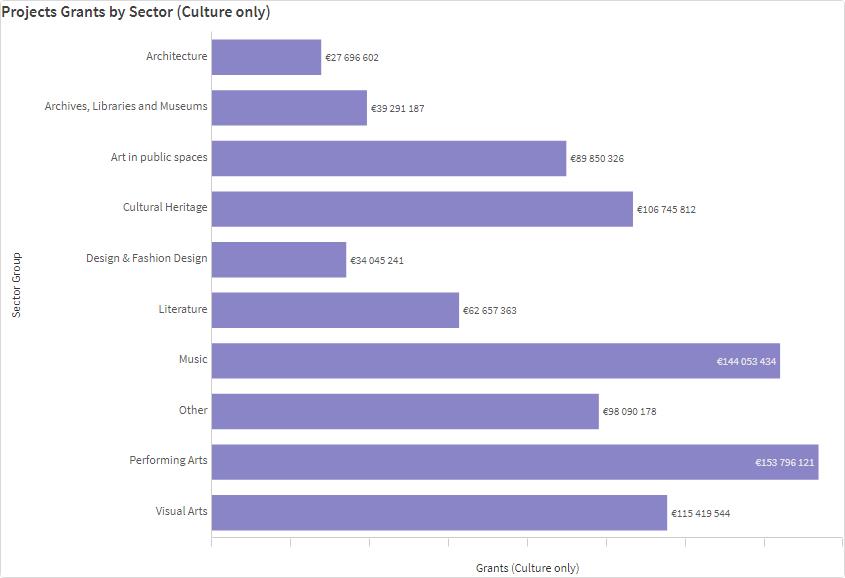
The dashboard, published via the Commission's refreshed culture.ec.europa.eu portal and branded as "Creative Europe in numbers", aggregates grants, partner data, country coverage, and thematic priorities across the programme's three strands: Culture, MEDIA, and Cross-Sectoral. It includes interactive maps, downloadable datasets, and statistics on budget allocation, number of projects, and sectoral distribution across film, music, heritage, performing arts, and publishing.
Budget split by strand — 2021–2027
Geographic concentration, however, remains a persistent challenge. France, Germany, Italy, Belgium, and the Netherlands absorb the largest absolute volumes of funding. The Decade of Creative Europe evaluation found that collaborations between low- and high-capacity countries rose from under 5% to roughly 30% — progress, but not equity. Countries in the Western Balkans and smaller EU markets remain under-represented in absolute terms.
Achievements and what comes next
The dominance of the MEDIA strand is structural: the programme's legal framework mandates minimum allocations, meaning film and audiovisual consistently receive nearly twice the budget of all other cultural sectors combined. The MEDIA strand has strengthened the transnational circulation of European films and series "in a sector that is fragmented along national borders", as the 10-year evaluation report says. On average, four EU films and series supported by MEDIA could be viewed by audiences in more EU countries across TV, cinema and video-on-demand, than before the MEDIA funding. It is estimated that MEDIA-supported EU films and series attracted at least 241 million additional admissions in EU countries outside their home countries compared to those which did not receive MEDIA support.
The dashboard launch arrives as the Commission has conducted a 10-year-long evaluation of Creative Europe that will directly inform the shape of whatever replaces it after 2027. Commissioner Micallef has been tasked with developing a "Culture Compass for Europe"—a strategic policy framework that would address the programme's known structural tensions: the tilt toward MEDIA, the geographic concentration in western EU hubs, and the persistent barriers that prevent smaller organisations in lower-capacity countries from competing on equal terms.
Practical guide for cultural operators
How to use the dashboard — and what to do
1. Access the dashboard. Go to culture.ec.europa.eu/creative-europe → "Creative Europe in Numbers". Publicly accessible, no login required. Filter by country, strand, year, and sector.
2 Identify your strand. Cultural and Creative sectors cover heritage, performing arts, music, literature, visual arts and much more. MEDIA covers film and audiovisual. Cross-sectoral coverage includes media literacy and innovation. Each has distinct eligibility criteria and budget envelopes.
3. Benchmark your geography. Use the map to see your country's funded projects. If under-represented, that works in your favour — geographic equity is a scoring criterion. Frame your application accordingly.
4. Build your consortium early. Creative Europe requires transnational partnerships. The 2024 cooperation call distributed €59.7m to 160 projects; the networks' call gave €44.3m to 39 networks. Aim for partners from 3+ countries, ideally including one lower-capacity EU or partner state.
5. Contact your national desk. Each country has a Creative Europe desk offering free support and partner matching. Find yours at culture.ec.europa.eu/resources/creative-europe-desks.
6. Watch the 2026 cooperation call. The Culture strand's flagship call has a €60 million budget for 2026, open to small and medium-scale projects. Track open calls at the EACEA portal.
7 Align with 2026 priorities. The Work Programme explicitly prioritises democracy, social resilience, digital transition, and improved working conditions for artists. Heritages with reconciliation dimensions and inclusion-focused work score higher this cycle.
Organisations that can document their outcomes, such as audience reach, cross-border partnerships, professional training, and community impact, will be better positioned both for current calls and for the post-2027 framework.