Within dominant artistic responses to the Anthropocene, a sense of apocalyptic collapse prevails. Contemporary art maps ecological destruction, archives disappearing environments, visualises climate change, and simulates future disasters. Yet these practices can also turn catastrophe into an aesthetic experience, making destruction visible without necessarily challenging the systems that produce it. Writes Angeliki Poulou
By Op-EdBy Angeliki Poulou*
Within dominant artistic responses to the Anthropocene—or, more precisely, the Capitalocene—a sense of apocalyptic collapse prevails. Contemporary art maps ecological destruction, archives disappearing environments, visualises climate change, and simulates future disasters. Yet these practices can also turn catastrophe into an aesthetic experience, making destruction visible without necessarily challenging the systems that produce it. We sound the alarm, speak on behalf of the Earth, and call for awareness, participation, resilience, and social impact. But how often do we name the political and economic system at the root of the crisis: capitalism?
The claim that “everything is political” risks becoming politically empty when it no longer distinguishes between the forces that reproduce the existing order and those that challenge it. According to Olivier Neveux, the question is not simply whether everything is political, but how and under what conditions something becomes politicised.
This brings me to Ann Laura Stoler, Jonas Tinius and the distinction between ruins and ruination. They propose shifting our attention from ruins to ruination: from the representation of destruction to the processes that produce it. Ruination foregrounds destruction as an ongoing socio-historical process shaped by extraction, accumulation, abandonment, and dispossession. It asks us to look beyond what remains after catastrophe and examine the infrastructures and power relations that make it possible. To move from ruins to ruination is to recognise that catastrophe has a history. But if destruction is historically produced, can the future also be understood as something other than an inevitable outcome?
We once turned to gods, religions, and oracles to ask what the future might bring. Today, we increasingly turn to computational systems to predict, calculate, optimise, and recommend possible futures through data. Can AI be understood as a contemporary oracle?
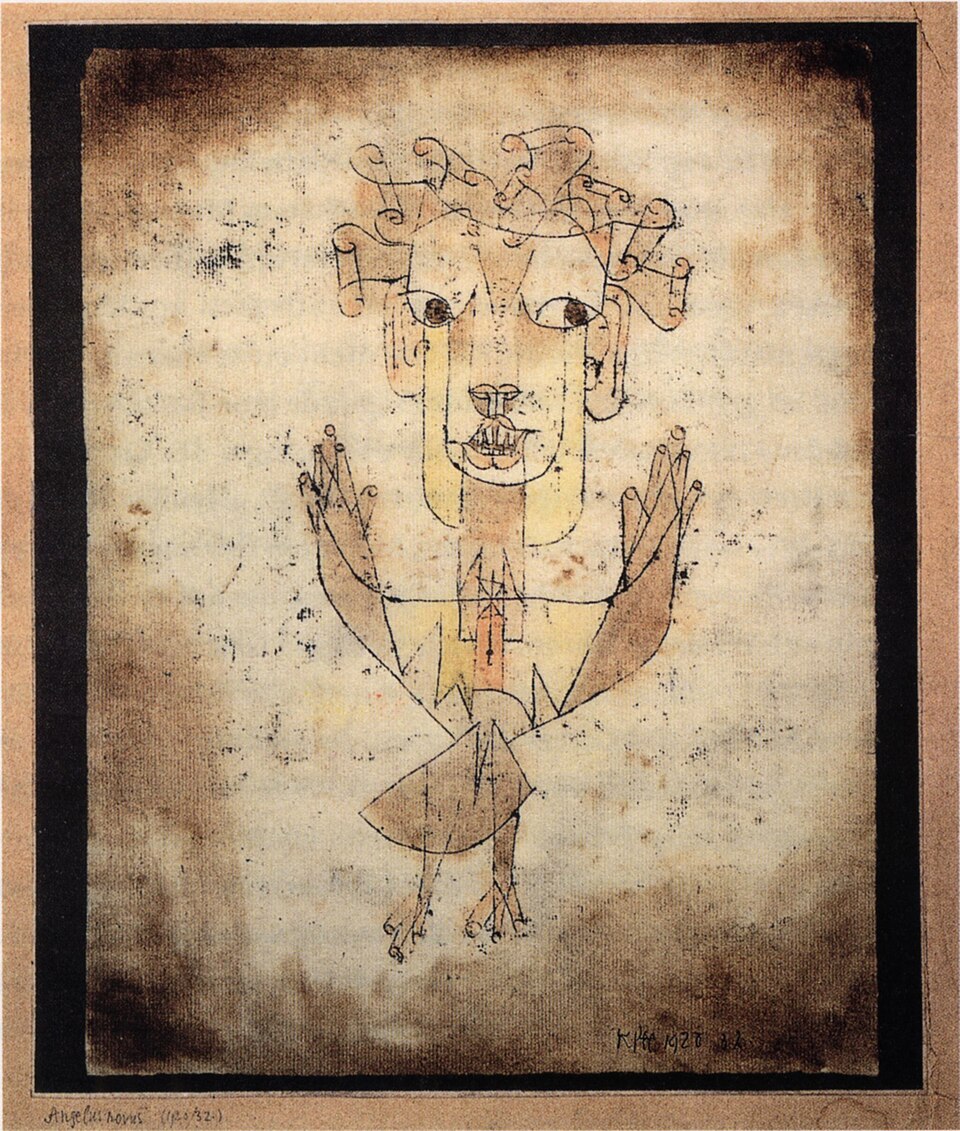
Walter Benjamin's Angel of History looks back at the accumulating wreckage of the past while being propelled forward by the storm of what is called progress. Today, we seem increasingly trapped within the accumulation of destruction itself, as though catastrophe had become not an interruption of history but its horizon.
Ancient Greek tragedy offers a different relationship to narratives of inevitable endings. Catastrophe unfolds through actions, decisions, conflicts, and relations of power. Even when tragedy offers no resolution, it opens a space in which responsibility and the possibility of another order can be contested.
This tension emerges in AI Oracle by the notopia collective, presented at Ars Electronica in 2021. Visitors enter an immersive capsule, are symbolically scanned, and receive a machine-generated prophecy about their professional future. Like the ancient oracle, the machine remains largely invisible. What visitors encounter is a voice, an atmosphere, and a pronouncement. The work invites us to consider how computational systems acquire the authority to speak about our futures. These systems do more than anticipate what might happen. By determining what counts as probable, desirable, or optimisable, they also shape the horizons within which the future can be imagined.
The dominance of dystopian and apocalyptic narratives surrounding AI may therefore reveal less about technology itself than about a crisis of political imagination. While contemporary debates often focus on humanising machines, earlier artistic avant-gardes explored how machines might produce new futures, social relations, and forms of collective life.
As Mark Fisher and Franco Berardi have argued in different ways, our capacity to imagine radically different futures has become increasingly constrained. The future is now treated as something to be predicted: calculated from data, modelled, and optimised. It becomes an outcome to be managed rather than a collective horizon to be transformed.
Who decides the future? Who creates history? What happens when the construction of the future is delegated to systems of prediction rather than understood as a collective responsibility?
I want to propose a shift: from the future as prediction to the future as a collective process of fabrication. A radically different response to catastrophe emerges in Orestis Karamanlis's TEMPI: 57 Heartbeats & Electronics, presented at the Athens Epidaurus Festival in 2026. Referring to the 57 people who lost their lives in the Tempi train disaster of February 2023, the art project connects 57 people through cables and contact microphones, transforming their heartbeats in real time into a collective soundscape. Here, mourning becomes a collective practice of listening and remembrance. Individual heartbeats enter a shared sonic space, bringing bodies together through a fragile relation between presence, absence, and memory. Rather than representing catastrophe from a distance, TEMPI performance poses a question: how can we inhabit a shared world after catastrophe? Where the AI oracle individualises the future as a prediction addressed to a single subject, TEMPI makes collective presence the medium through which another future might be imagined. Its political potential lies in creating a space where memory, mourning, and collective responsibility can be reassembled.
A further example is Survival Apparatus: The City as a Post-Digital Ruin, an audiovisual installation by Medea Electronique. Through collective games and processes of positioning, participating artists generate perspectives, encounters, and relations that are transformed into audiovisual material. The work becomes a laboratory for producing a shared gaze: a way of collectively asking how we see, experience, and imagine the city. The city is no longer simply a ruin to be observed. It becomes a space of relationships and possible configurations, collectively reimagined through the process of making the work.
These examples suggest two interconnected shifts. The first is from ruins to ruination: from the image of destruction to the historical and political processes that produce it. The second is from prediction to collective fabrication: from the future as a calculable outcome to the future as a field of collective action.
Art cannot stop climate change on its own, dismantle capitalism by itself, or repair damaged ecosystems. Its political potential lies elsewhere: in making the infrastructures of destruction visible, questioning the apparent inevitability of the existing order, and creating conditions in which different ways of inhabiting the world can be explored.
The artistic practices discussed here are mostly small in scale. They offer neither ready-made futures nor guarantees of transformation. Instead, they experiment with ways of assembling bodies, memories, perspectives, and forms of collective attention. To move from ruins to ruination is to recognise that catastrophe has a history. To move from prediction to collective fabrication is to recognise that the future has a politics.
 Angeliki Poulou is an assistant professor in the Department of Digital Arts and Cinema at the National and Kapodistrian University of Athens, specialising in ‘History and Theory of Contemporary Art and New Media’. Her theoretical and curatorial work lies at the intersection of contemporary art, art/technology theory and new forms of performance. She has been a member of the Medea Electronique art collective since 2011, where she acts as a curator and dramaturg.
During the Bautopia festival in Athens, Creatives Unite presented a panel discussion titled 'How do we go beyond End-Times Narratives?' Thinkers, academics and artists Igor Šimić, Thanassis Moutsopoulos, Angeliki Poulou and Ainhoa Jean-Calmettes took part in an open discussion about the role of arts and culture in the current Gen Z protests around the world concerning the climate crisis, peace and democracy. Read more here
Op-Ed
The opinions expressed in this Op-Ed are those of the author. They do not purport to reflect the opinions or views of the Creatives Unite editorial team