CYANOTYPES is an EU-funded (2022-2026) cross-sectoral initiative aiming at breaking down sectoral silos in CCSI education. It promotes visibility and understanding of the CCSI as vital force for driving the sustainable transformation of societies. That means that education and training in the digital and AI fields are crucial. The project highlights that for successful AI adoption it takes more than technical skills, but also critical thinking, ethical judgement, creativity, systems thinking, collaboration and the ability to act under uncertainty.
Critical and analytical thinking are at the core of cultural and creative education, and exactly the same skills we need for an ethical, sustainable and just transformation in times of AI. CYANOTYPES approaches AI not only as a technological challenge but also as a cultural, educational and societal one. The project highlights that successful AI adoption depends not only on technical skills, but also on competences such as critical thinking, creativity, systems thinking, and the ability to act under uncertainty.
The vision of the project is to provide feasible pathways for a greater cooperation among CCSI stakeholders to increase their positive impact on Europe’s major societal and economic transformations through (formal) education and training (VET). The project brings forward a holistic education approach, where individual and collective learning paths are embedded. Rather than positioning the CCSI as passive recipients of technological change, the project demonstrates how their strengths can actively contribute to shaping human-centred and democratic digital futures.
Barbara Revelli, Head of Programmes at ELIA – Network of Higher Arts Education & Cyanotypes partner: “Core competences for Europe’s future with AI are critical and analytical thinking, as highlighted at the World Economic Forum. The cultural and creative sectors are core players and competence owners in this context.”
In order to advance these agendas in the European context, the project breaks out of the sectoral and geographical silos that exist in education and training. The CYANOTYPES consortium and work plan are strictly cross-sectoral. They bring together partners from diverse working environments: education, VET, SMEs, as well as network and intermediary organisations. The moderated process of developing common understanding of lifelong learning needs is based on co-creation activities. Through moderated co-creative processes, a common understanding of lifelong learning needs is created.
A co-developed competence framework and toolkit for the AI era
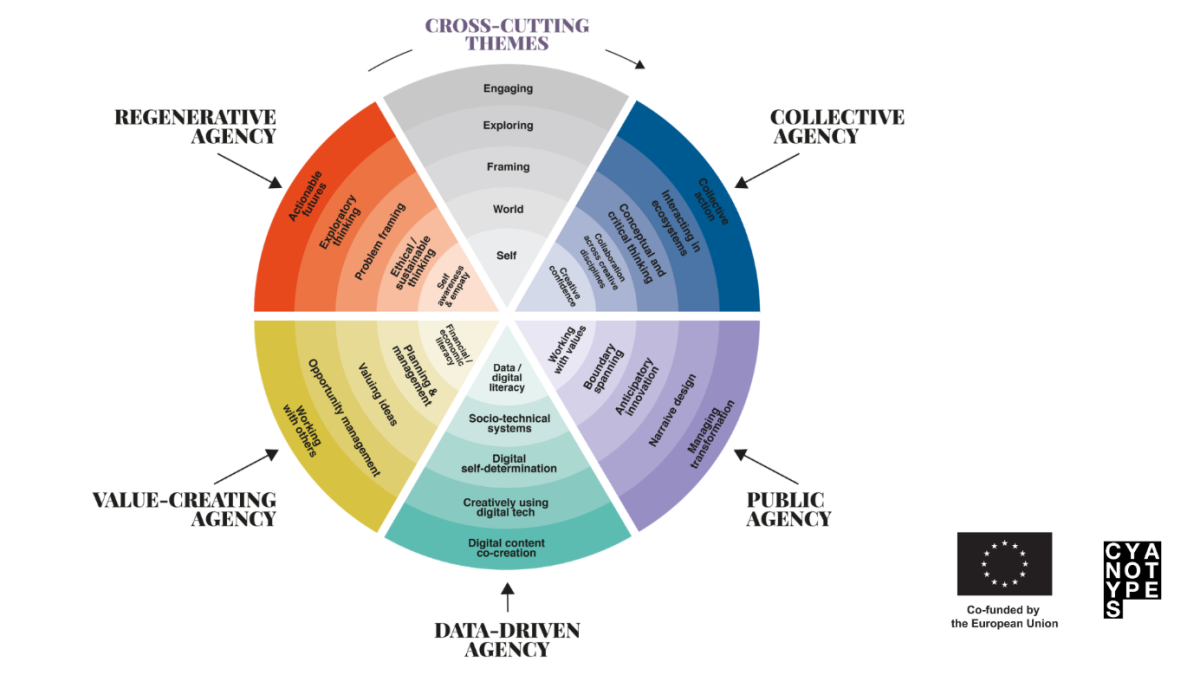
The project has translated a complex and fragmented landscape of cultural, educational and training actors into a shared
Competence Framework that is accessible to diverse stakeholders and applicable across different contexts.
Beyond the Competence Framework, the
CYANOTYPES Toolkit is one of the project’s key outcomes. It complements the Competence Framework with practical resources: guidebooks, self-assessment tools, Train-the-Trainer materials, learning plans, pilot methodologies, and implementation guidance tailored to different stakeholder groups to translate future competences into training pathways.
Learning by Doing: Pilot Activities Across Europe
Through pilot activities across Europe, CYANOTYPES has supported curriculum innovation, trainer development, organisational learning, entrepreneurial skills, and AI literacy initiatives.
CYANOTYPES has built a growing ecosystem of around 70 pilot initiatives – roughly 30 partner-led pilots, and more than 40 open pilots developed by organisations outside the consortium, across Europe and beyond. Several of these pilots focus specifically on digital transformation and AI literacy, exploring topics such as creative agency, ethical AI adoption, digital self-determination and future-oriented learning.
Educational institutions have applied the framework to curriculum development and institutional reflection, while cultural organisations and intermediaries have used it to strengthen learning pathways and organisational capacity.
The pilots show that the framework works both as a strategic reflection tool and as a practical instrument for educational and organisational innovation. For example, the University of Applied Arts in Vienna has used the framework to support curriculum innovation and the development of new learning formats, including a dedicated summer school.
Building cross-sectoral communities to develop and discuss transformational competences
Building communities across educational, cultural, policy and business sectors has been a central achievement of CYANOTYPES. The project has created a shared language for discussing future competences and has fostered dialogue across Europe.
The project has also contributed to policy dialogue and stakeholder engagement through consultations, recommendations and long-term strategic reflections on future skills, AI readiness and lifelong learning in the sector.
A key action in that respect is the annual
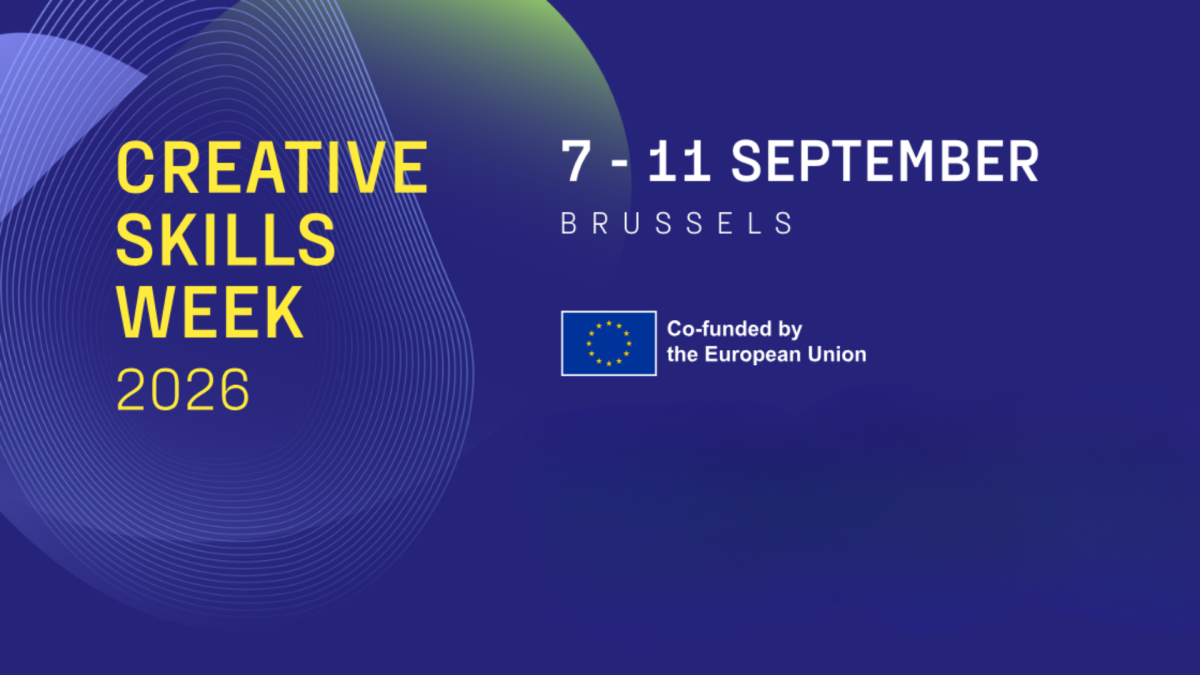
Creative Skills Week, organised by the project and its partners. Creative Skills Week has emerged as a flagship European platform for dialogue, collaboration and advocacy around the future of the cultural and creative sectors and industries. The event has two main goals: (1) encouraging cross-sectoral exchange with the different CCS stakeholders that keep competences up to date and (2) position the CCS as crucial partner in European (digital, AI) futures.
Barbara Revelli, Head of Programmes at ELIA – Network of Higher Arts Education & Cyanotypes partner: “With Cyanotypes, we help the CCS to gain back agency. With Creative Skills Week, we empower the CCS stakeholders to build community for sustainable futures”
Under the 2026 theme The Difference that Makes the Difference, Creative Skills Week highlights the role of creative skills in strengthening Europe’s capacity to navigate technological transformation, democratic challenges and societal change.
For CYANOTYPES, Creative Skills Week represents an important pathway towards long-term impact beyond the project’s lifetime. It provides a platform for sharing pilot experiences, advancing recommendations and supporting the broader adoption of competence-based approaches that strengthen resilience, creative confidence, and lifelong learning across Europe.
*CYANOTYPES is part of Alliances for Sectoral Cooperation on Skills funded by the European Commission Erasmus+ Programme.
This Case Study was created under Creative FLIP, an EU co-funded project aimed at further increasing the long-term resilience of the CCSI in key areas such as Finance, Learning, Working Conditions, Innovation & Intellectual Property Rights.
Key Takeaways
- Digital and AI transformations require more than technical skills. CYANOTYPES and the tools developed demonstrates how human-centred approaches to AI literacy can help learners, educators, organisations and policymakers engage with technological change responsibly, creatively and critically.
- Cross-sectoral approaches to skills development are essential. Breaking down silos in education and training helps Europe’s creative sectors address emerging challenges related to digitalisation, AI, sustainability and resilience. The cultural and creative sectors and industries already hold many of the competences needed, including creative agency, critical thinking, ethical judgement, collaboration and systems thinking.
- Cross-sectoral communities of learners and practitioners have significant potential to strengthen innovation, lifelong learning and policy development. Europe-wide initiatives such as Creative Skills Week provide important opportunities to connect stakeholders, share practices and build future-oriented learning ecosystems.
Interviewee

Barbara Revelli is Head of Programmes at ELIA, the globally connected European network of higher arts education institutions. With over 15 years of experience in international cultural collaboration, she leads ELIA’s knowledge exchange and programme curation across its community and major European initiatives. Her work focuses on educational innovation, collaboration with the cultural and creative Industries (CCI), cross-sectoral innovation, and the triple transition (societal–digital–green).
She leads the programme development of Creative Skills Week, a European platform that builds partnerships across the knowledge triangle - higher education, vocational education, and industry & SMEs – to strengthen collaboration and knowledge exchange in the CCI. She is ELIA’s lead for CYANOTYPES, the Erasmus+ Blueprint project for the cultural and creative industries and contributes to advocacy initiatives, including the Pact for Skills, skills ecosystems partnerships, AI & Ethics, and micro-credential implementation.
Previously, she worked in various cultural organisations at the intersection of design, media, fashion and eco-sustainability. She studied Arts and Cinema in Italy and Paris.
Related articles