
Economist Heritiana Ranaivoson argues that generative AI—trained on creators’ work without consent—should be treated as a public resource, urging Europe to strengthen regulation and industrial policy at the same time to protect its cultural and creative sectors.
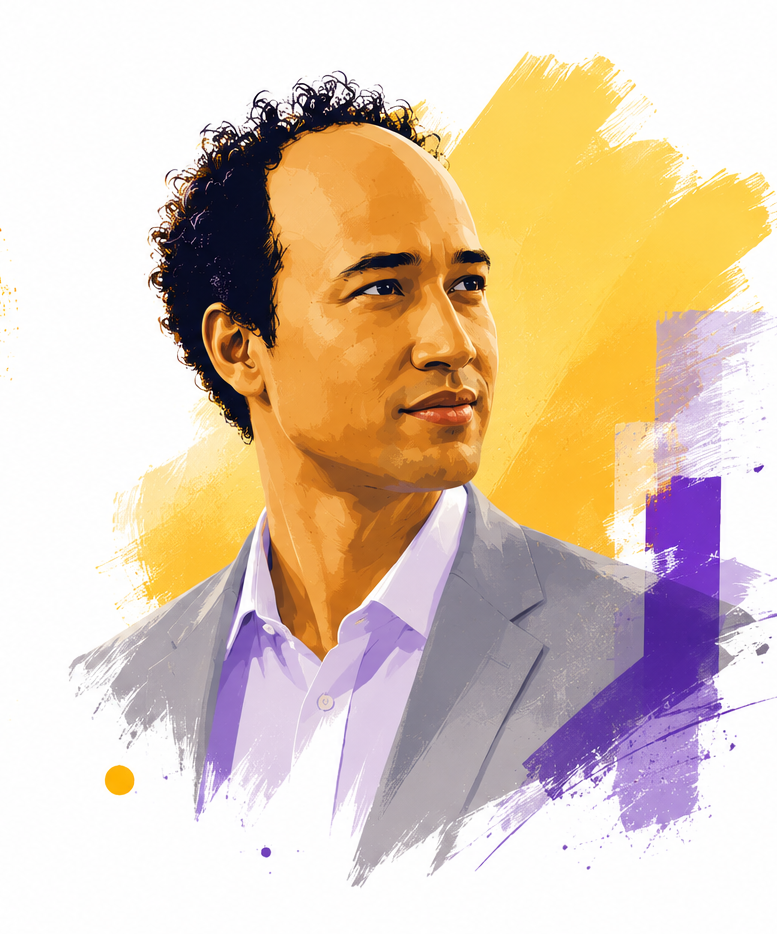
By Matthaios TsimitakisThree interconnected debates are heating up in Brussels: the 2026 review of the Audiovisual Media Services Directive (AVMSD), the phased enforcement of the EU AI Act, and escalating tensions over copyright rules for generative AI training data. Dr Heritiana Ranaivoson has been a research professor at imec-SMIT, Vrije Universiteit Brussel, in the Media Economics & Policy unit since 2023. He has worked at SMIT since 2010.
An economist by training (Ecole Normale Supérieure de Cachan; PhD, Université Paris 1 Panthéon-Sorbonne), he has spent the past decade studying how digital platforms and, more recently, generative artificial intelligence reshape the creative industries – from music streaming recommender systems to the discoverability of European film and television.
He sits on UNESCO's reflection group on the diversity of cultural expressions in the digital environment, set up under the 2005 convention, and was a contributing author to the fourth edition of the Re|Shaping Policies for Creativity report, with a chapter on digital technologies. He spoke to Creatives Unite, for the cultural and creative sectors, at VUB's campus on Boulevard de la Plaine in Brussels.
The conversation ranged from the economics of generative AI and the deepfaking of public figures to copyright law, Europe's stalled industrial policy, and a transatlantic debate – sharpened that same week by Senator Bernie Sanders' bill to give the American public a 50 per cent stake in big AI firms – over who should own the technology in the first place.
The transcript below has been edited for length and clarity.
Creatives Unite: We're entering the era of AI. It feels to me like a continuation of the platform era rather than something genuinely new.
Heritiana Ranaivoson: To some extent, yes — it's a prolongation of having new intermediaries. At the start of the internet, there was an idea that we'd get rid of intermediaries altogether: everyone in forums, on their own websites. What we quickly realised, especially with social media, was that we'd simply created new, powerful intermediaries. AI is a continuation of that. The names aren't necessarily the same — though Google and Microsoft are already very strong — but there's a similar risk of homogenisation.
Creatives Unite: What is that risk for the creative sectors specifically?
Ranaivoson: AI can help creators and professionals across every sector, but it can also replace them. So it will become harder to begin a career, compounded by the fact that the technology is trained on what creators have already produced — on their works — without their consent. So the creative sectors risk losing what they have already made and face a threat to what's still to come: new works that don't find their audience.
AI is being used now to create content — text, sound, images, video, and even video games — and that causes another problem: distinguishing what's true from what's fake. AI-generated imagery is starting to appear in documentaries in place of archive footage. It looks impressive, but it isn't accurate — you're pretending it's a photograph from fifty years ago when it isn't, and anyone who knows the period can tell.
Another threat is people losing control of their own image: a singer's voice or an actor's face can be imitated. If you're an actress and it gets harder to find work as you get older, there will be a 20-year-old version of you in films, using your fame but taking your place. That's a risk for anyone with a public profile.
Creatives Unite: Manipulating images isn't new, of course — think of the Soviet practice of airbrushing purged officials out of official photographs under Stalin.
Ranaivoson: Yes, it's a good example because it shows that this existed before, too, like most of the problems we are going to see, but now it's industrialised.
Creatives Unite: So what kind of world does that produce? Can we regulate it or will we end up with a libertarian world where anyone with their own platform does as they please?
Ranaivoson: That's the most pressing question — how do we regulate this? We're now in a context, pushed hard by the United States, of a huge competition to build as much capacity as possible — data centres everywhere — and the environmental impact is, in the medium term, terrible.
Creatives Unite: Europe seems to be caught behind America and China, racing to get there first.
Ranaivoson: The more sensible position, in my view, for Europe is it isn't enough to refuse the technology — you need to understand how it works. In a European context, "not adopting AI" tends to mean not that Europe avoids the technology, but that Europe adopts technology built by others. There's "nothing" European at most layers of the stack: the companies don't belong to Europe, the data centres don't belong to European companies, and the content running through it is more American than European. I think it's good that Europe has a strong regulatory tradition — but that alone isn't enough. Europe also needs to be strong somewhere in the production layer — I say "one layer" because we need to start somewhere.
Creatives Unite: There's good research on the discoverability of European artists on digital platforms — the broader pattern of internet political economy concentrating power at the top, into a handful of American companies.
Ranaivoson: The cultural sectors have always been quite concentrated, but this certainly doesn't improve things. It's a further loss of control, because these companies aren't based in Europe, which makes them harder to regulate — even for the European Commission, let alone national governments.
Creatives Unite: Isn't that a historical paradox — that open systems meant to "socialise" the media ended up doing the opposite?
Ranaivoson: It does look like a paradox. The Internet’s original intent was to empower everyday users. Instead, it's empowered a small number of companies at others' expense. With social media platforms, the work users put in — posting and commenting — generated advertising revenue that went to Meta, not to them. Now, with generative AI, the platforms feed even more directly on content created by professional creators and by all of us, which makes those AI platforms more powerful still.

Creatives Unite: Who, in your research, is leading the way on regulating this well?
Ranaivoson: Europe as a whole is trying, but it's harder because there are real discrepancies between member states — I'm not sure how many are genuinely engaged with the creative sectors as opposed to a narrower, heritage-protection view: defending cultural identity without really asking what to do about the platforms and technologies themselves and how creators and cultural institutions can actually thrive alongside them.
Creatives Unite: Can there be a genuine balance between innovation and a cultural policy that protects producers while remaining open to experimentation?
Ranaivoson: We can no longer treat innovation and regulation as a false dichotomy — they need to go together. You can have innovation without sovereignty of various kinds, whether beneficial or harmful. But you can't have regulation without sovereignty – and if you want innovation that benefits everyone, not just a few companies, you need regulation too.
Creatives Unite: But sovereignty raises the question of who, exactly, is sovereign. The EU isn't simply an alliance of states — it exercises power.
Ranaivoson: The European Union remains, in important respects, not very democratic: most power sits with the Commission, which isn't elected. Governments hold power too but have to negotiate and agree; the Parliament has gained more power but still far less than the Commission, even though it's the body people actually vote for. That weakens public trust in the EU — I'm French myself, and the EU's image in a big member state like France is still fairly poor — which, in turn, weakens its legitimacy to intervene in culture and media, areas people often feel should stay local or national.
Creatives unite: France's protective cultural policy — quotas and support for cinema, the French language, and television — has paid off over the past century, hasn't it? It became something of a model for other countries.
Ranaivoson: For many cases, yes, it's had good effects — cinema especially. It needs adapting, but it has worked, partly thanks to EU-level regulation too, like the Audiovisual Media Services Directive, which governs how video streaming services are regulated and has shaped how much French content appears on platforms like Netflix.
Creatives Unite: So, where should Europe start — regulating content, or regulating the technology itself?
Ranaivoson: Given the current direction of policy, I think the most important thing now is making sure they're actually implemented and enforced – the AI Act, the Digital Services Act, and the Digital Markets Act – because the Digital Omnibus, the Commission's package to simplify digital legislation, risks watering some of them down. That pressure is partly coming from the US, too. It's more a question of building on the rules we have in place and having the sectors adapt them. The AI Act, for instance, is an interesting piece of legislation, but outside of its copyright provisions, it doesn't really address media or the cultural sectors at all.
Creatives Unite: Even within copyright — what happens to people whose work is effectively training the algorithms that may replace them?
Ranaivoson: The Audiovisual Media Services Directive is currently under discussion at the EU level; I believe a fresh round of discussion is expected to start early next year, looking at how to take AI into account. Other sectors are under real pressure and far less protected — music, for instance, would benefit from more regulation; otherwise, it's left to the major companies. Universal Music, for example, now has agreements with several AI companies, including a settlement and licensing partnership with Udio and a separate alliance with Stability AI.
Creatives Unite: And what about algorithmically generated music already charting?
Ranaivoson: It's difficult. But I feel that overall AI technology isn't particularly liked — including among young people. If you're in a student working group and one person is visibly leaning on AI for everything, the others tend to see that as a problem, someone who doesn't really know their own work because they just typed a prompt.
Creatives Unite: Even so, won't AI end up dictating taste – the synthetic becoming the norm and the "authentic" the premium exception?
Ranaivoson: I don't believe the synthetic will dominate everything. Talk to people who genuinely love music, and they'll tell you they'll never listen to AI-made music — I feel the same. But if you're doing your grocery shopping and there's AI-generated background music playing, you won't mind. The question is how much of it there will be and whether we can make sure it isn't simply treated as "free music" or gain an unfair advantage.
Creatives Unite: Some people argue that, given that generative AI is trained on humanity's collective creative output without consent or compensation, it should effectively be made a public resource.
Ranaivoson: If AI is here — and it is — then yes, it should be nationalised or at least treated as a public resource. That way, decisions about what's acceptable aren't left to a handful of companies alone.