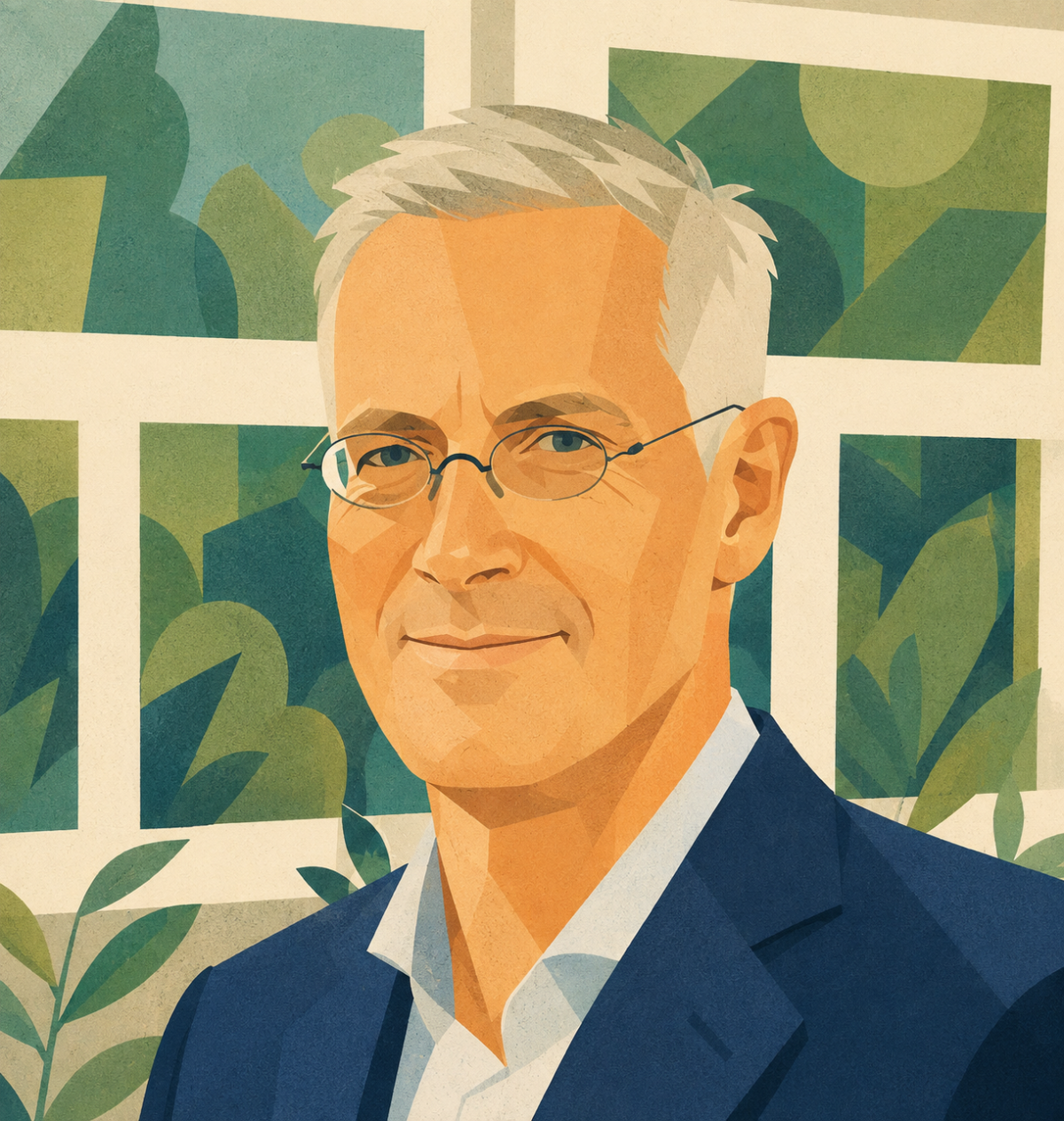

Media theorist Sönke Zehle on why Europe's creative sector should stop battling AI platforms and start building workable alternatives — cooperative data models, a renewed case for public value, and why despair, not automation, is the real threat to young creatives.
By Matthaios TsimitakisEurope's creative sector is having an identity crisis, and Sönke Zehle thinks that's not entirely a bad thing. As generative AI forces art schools to rethink teaching from first principles, and platform monopolies tighten their grip on digital infrastructure, the media theorist argues that resistance is the wrong instinct. Better, he says, to build alternatives good enough that nobody needs to fight for them — a philosophy he sums up as "bypass, not battle".
Zehle is a lecturer in media theory at the Academy of Fine Arts Saar (HBKsaar) in Saarbrücken, where he directs the academy's xm:lab and co-directs K8 Institut für strategische Ästhetik, its institute for generative research and regenerative design. He is also an affiliate researcher at the German Research Centre for Artificial Intelligence (DFKI). Within CYANOTYPES, the Erasmus+-funded, HKU-coordinated skills alliance for Europe's creative and cultural sector, he has co-led two pilots at HBKsaar — the Generative Arts and Design Lab and the Regenerative Economy Lab — built around what he calls triple-loop learning: a framework for creative work at the level of the individual, the context around them, and the wider ecosystem.
Creatives Unite spoke to Zehle shortly after the two pilots were formally evaluated, in a conversation that quickly moved well past them: why generative AI is forcing art schools to rebuild the creative process from first principles, what a renaissance of cooperativism could offer a data-driven economy, and what he would tell a European policymaker about the psychosocial toll AI is taking on young creatives — and about the risk of a sector convinced it's the only creative one in the room.
---
Creatives Unite: You've coined the phrase "bypass, not battle". What does that look like in practice?
Sönke Zehle: The European approach to the extractivism of the creative work by platform monopolies is to slap them with a fine every now and then, but that doesn't build anything. We could frame everything we do as resistance to monopolies, but then few people can sustain that resistance. Most systems change happens because someone demonstrates a plan B – people are not invested in the status quo; they just don't know an alternative exists. So we have to build alternatives, and they have to be workable and able to slot into an existing workflow, not manifestos—because people still have deadlines and still need to work in the same way as before. That's where media theory starts to look more like anthropology: you have to understand what someone's actual workflow looks like before you can say where a better system could replace it. Interface design matters enormously, too. Nobody I know wants to use Teams. They use it because it's what they're given. But take, for example, the alternative. Nextcloud: it was a tragedy of good intentions and bad UX — a real problem. We'd be far more sovereign if our open tools simply worked as well as the platforms they're meant to replace.
Creatives Unite: How do media theorists in the arts navigate the tension between media’s horizontal reach and the arts sector’s vertical structure? And what has changed with the introduction of AI?
Sönke Zehle: It's practice-facing in a way university media theory doesn't have to be. AI first came in through generative conversation — we can outsource part of our workflow to these machines, so we need to understand where they sit in it, which means describing the workflow differently. So we've put students to work building tools for a process-based understanding of creative work, from ideation to business-model development. We look pragmatically at node-based tools like ComfyUI, and what we learn is that a process we thought was holistic actually breaks down into distinct stages, each with its own logic. Once you can describe your work as something you do repeatedly, you're halfway to an algorithmic understanding of it — an algorithm is basically a recipe, a set of instructions someone else can repeat. Critical reflection on technology doesn't begin with the technology; it begins with looking at the process. And we're not starting from zero: two decades of the platform economy took us from lifetime software licences to subscriptions, and now to a token economy, where you buy machine cognition time without knowing how complex a task is until you run out.
Creatives Unite: What do you expect students to walk away from the school, questioning?
Sönke Zehle: First, I would tell them not to be depressed. If AI can do all this, why spend years on a creative degree? Our answer is that AI isn't a tool; it's a dialogic kind of other, and we still have to work out what role it can play. We can't teach from a position of knowing any more — the field moves too fast — so we teach from a position of experimenting and exploring. We frame it as a lab situation: not just a room or a set of technologies, but a set of cultural techniques – how we handle data, authorship, process, and collective agency. That last one is difficult in an art context: the moment you walk through the door of an art academy, you're told you're unique, singular – which breeds suspicion of collective work. So the commons has to be on the agenda. Elinor Ostrom won a Nobel Prize for showing that the "tragedy of the commons" only holds for an unmanaged commons — the real history of the commons is a history of managed ones.
Creatives Unite: You've talked about European technological sovereignty and federated systems. Where does that fit in?
Sönke Zehle: We engage with the conversation on a tech stack Europe can actually control – federated infrastructure like Gaia-X, not one hyperscaler trying to rival the Chinese or US players but something closer to the Fediverse answer we've already seen in social media. I think of CYANOTYPES as a triple loop: the first loop is about us as individuals, the second is the context we're in and how it shapes what we can do, and the third is the ecosystem. We haven't spent enough time on that second loop — can we shape the context so it empowers us? That's where the older conversation about the commons meets agential AI. We're teaching students to build multi-agent systems, and a new issue is already on the horizon: if a bunch of agents are doing your work, who coordinates them? In the past, that happened inside the creative suite. Now the tool itself is distributed, so we have to govern that distribution — which is why the real question isn't DaVinci versus Midjourney, it's whether there's an interoperability standard, like MCP, so agents from different platforms can work together.
Creatives Unite: Is Europe's creative sector lagging behind the US on AI, or further ahead than we assume?
Sönke Zehle: Only a few years ago, German users were among the most critical of Google's dominance and turned out to be its most loyal — adoption was highest in Germany, while other countries did far more through their everyday choices to keep the digital ecosystem diverse. So the first question is whether we're aware of the power we already have through the tools we choose every day. Dominance can be challenged from the top, with a better product, or from the bottom: we go somewhere else.
Creatives Unite: You've written extensively on cooperativism. How does that idea evolve in the age of AI?
Sönke Zehle: The cooperative tradition is the sharing economy before we had the term – farmers have shared equipment for over a hundred years in Germany. We're actively exploring how it applies to new contexts. In a healthcare-and-AI network we co-initiated, we looked at the cooperative less as a model of economic democracy and more as infrastructure for a self-determined data ecosystem. In Germany, the law makes the legal relationships inside a cooperative simpler than those outside it, so it becomes an instrument for simplifying value creation in a data-driven economy — data marketplaces run entirely by their members. That's a function we haven't begun to maximise. During the brief Web3 moment we had a knowledge explosion, then a co-creation explosion, but never really finished thinking through alternative arrangements of property. That's the unfinished work ahead of us.
Creatives Unite: What would you tell a policymaker at the European level right now?
Sönke Zehle: Whenever people from the creative sector talk to people outside it, there's a question of self-definition — "So you're creative; what does that mean?" — which makes things harder: engineers say, Well, we're creative too, so what makes you special? The honest message is to stop claiming to be the only creative sector. We've actually been quite successful at making other sectors more interested in aesthetics, design, communication, and user orientation — we can take pride in that. And the opening message shouldn't be "everyone else is rich; we're precarious. Help us." It should start on a positive note: this isn't an industry in the traditional sense; it's a large network of freelance and micro-enterprise structures, but it is one in the sense that it shares a value-creation logic that has spread across other sectors for decades. Then the real move is we're not the only creative people in the room, but we may be the only ones who have organised our entire professional lives around the principle of creativity. That's a harder claim to dismiss.
Creatives Unite: You've also spoken about the psychological toll AI is taking on younger creatives. How does that connect to resilience?
Sönke Zehle: Start on a positive note, because there is so much despair across the sector right now. Younger people especially aren't just using AI; they're integrating with it — agents have become their best friends, and studies show people increasingly turn to chat platforms for health and therapy. I think that should be read symptomatically: there's a conversation about our collective psychosocial fragility that we're not having with each other, so people are having it with machines instead – and the creative sector, of all sectors, knows something about fragility and precarity. If we have the resilience, we can turn that negative energy into something creative, but that resilience has to come from somewhere. It's not just that we need money—we need the resources to turn a crisis into something worthwhile. And don't send us off to read a competitiveness report that mentions culture only under "agriculture". We need what the economist Mariana Mazzucato calls public value — value that exists where markets can't operate. Tell me one crisis right now that market forces alone can solve.