
Scholars announced on Thursday, 25 June the most significant recovery of ancient text since the Herculaneum scrolls were first excavated more than two centuries ago, after a combination of synchrotron X-ray imaging and machine learning enabled researchers to read, in full, a carbonised papyrus that had been sealed inside a lump of volcanic debris since AD 79.
The announcement, made at the Biblioteca Nazionale di Napoli Vittorio Emanuele III on 25 June, marks a decisive turning point for the Vesuvius Challenge — an open-science competition founded in 2023 to read the Herculaneum papyri without physically opening them. For the first time in nearly two millennia, an entire Herculaneum scroll has been read from beginning to end without ever being touched.
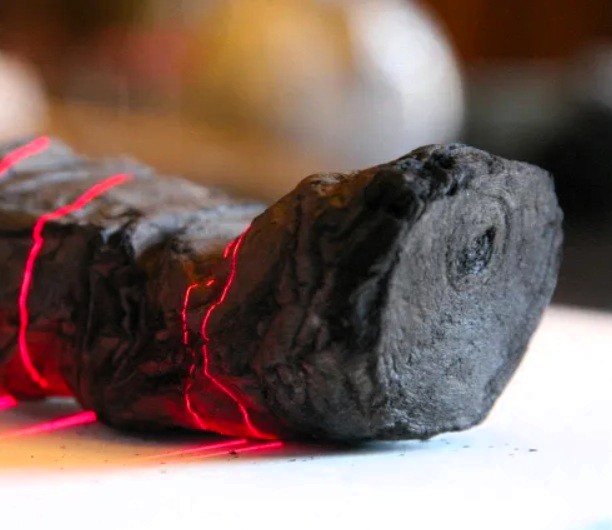
The scroll, catalogued as PHerc. 1667— the standard shorthand for the Herculaneum papyri collection, with "Paris" variants denoting scrolls held at the Bibliothèque nationale de France since the Napoleonic period. It is a philosophical treatise on ethics that the evidence suggests is a Stoic work dating to the second century BC. Its final preserved column names Aristocreon — nephew and disciple of Chrysippus, one of the most influential thinkers of the early Stoic school, of whose written output almost nothing otherwise survives. "For nearly two millennia, many of these texts have been physically preserved but intellectually inaccessible," said Brent Seales, principal investigator of EduceLab and the Stanley and Karen Pigman Professor of Heritage Science at the University of Kentucky, who co-founded the project. "Today we are finally able to read them."
The Herculaneum papyri are the hundreds of scrolls and papyrus fragments recovered from the Villa of the Papyri during 18th-century excavations of the Roman town of Herculaneum. They constitute the only library from the ancient world to have survived physically intact in its original location. The scrolls were carbonised when the pyroclastic surge from Vesuvius swept through the town in AD 79, preserving them while rendering them impossible to study by conventional means: any attempt to unroll them by hand destroyed much of the material. Around 300 intact scrolls remain sealed and unread.
PHerc. 1667 embodies the problem in miniature. Earlier attempts to open it — in the nineteenth century, and again in 1969 and the 1980s — progressively destroyed its outer layers and reduced it to a compressed inner core roughly 8 centimetres tall and 2 centimetres in diameter, less than half the height of an intact Herculaneum roll. Archivists assigned it a readability score of zero. It was, in effect, given up.
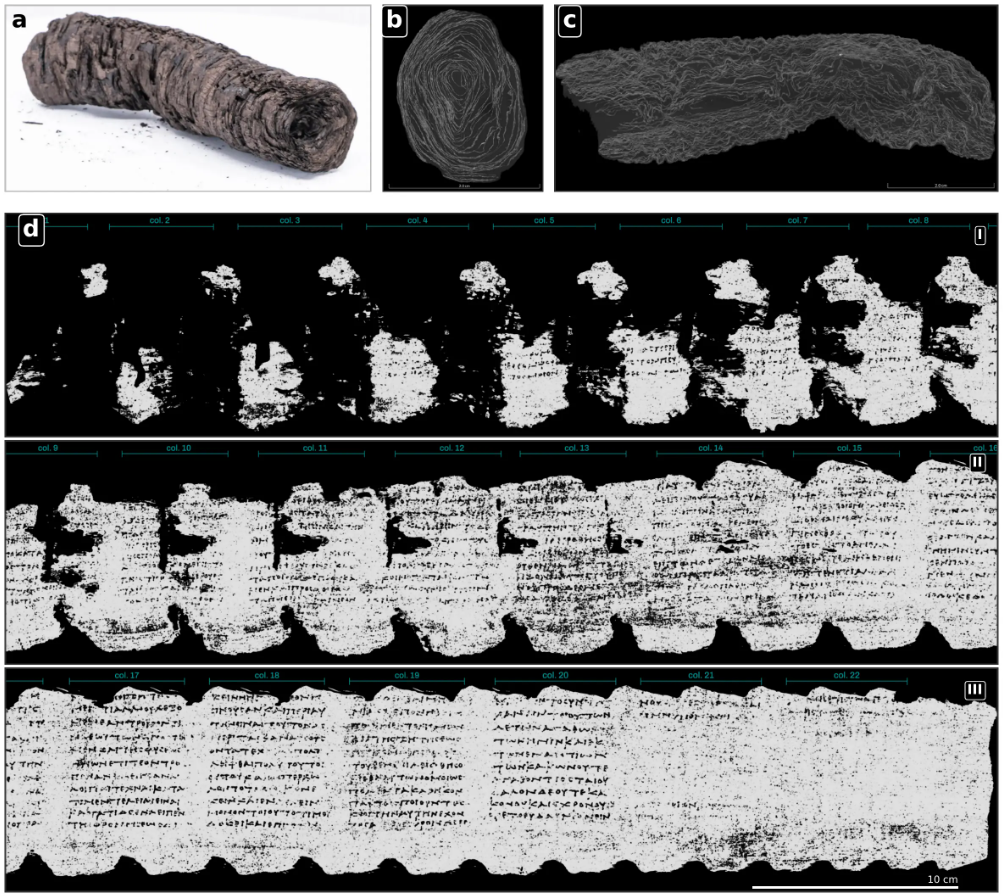
The scans underpinning the June 2026 results were acquired using high-resolution phase-contrast X-ray microtomography at the European Synchrotron Radiation Facility (ESRF) in Grenoble — a scanning technique capable of resolving the individual layers inside a sealed, carbonised roll without disturbing it. From those volumetric data, the research team reconstructed the scroll's internal geometry, traced and flattened its layered surface into a readable sheet, and trained machine learning models to detect traces of carbon-based ink against the equally dark carbonised papyrus — a distinction invisible to the naked eye. Each reading was then examined and transcribed by papyrologists. The entire pipeline was conducted without the scroll ever being physically opened.
All data, code and transcriptions from the project are released openly under a Creative Commons licence at scrollprize.org/data, with the full methodology set out in a preprint published simultaneously with the Naples announcement.
The technique of virtual unwrapping was pioneered by Seales at EduceLab, who spent years developing non-invasive imaging methods for ancient manuscripts. The Vesuvius Challenge was launched in March 2023 — co-founded by Seales alongside Silicon Valley technology entrepreneurs Nat Friedman and Daniel Gross — as an open competition to accelerate progress. The initiative, donation-funded and entirely open-source, has attracted more than 1,000 competing teams and has distributed more than $1.8 million in prizes.
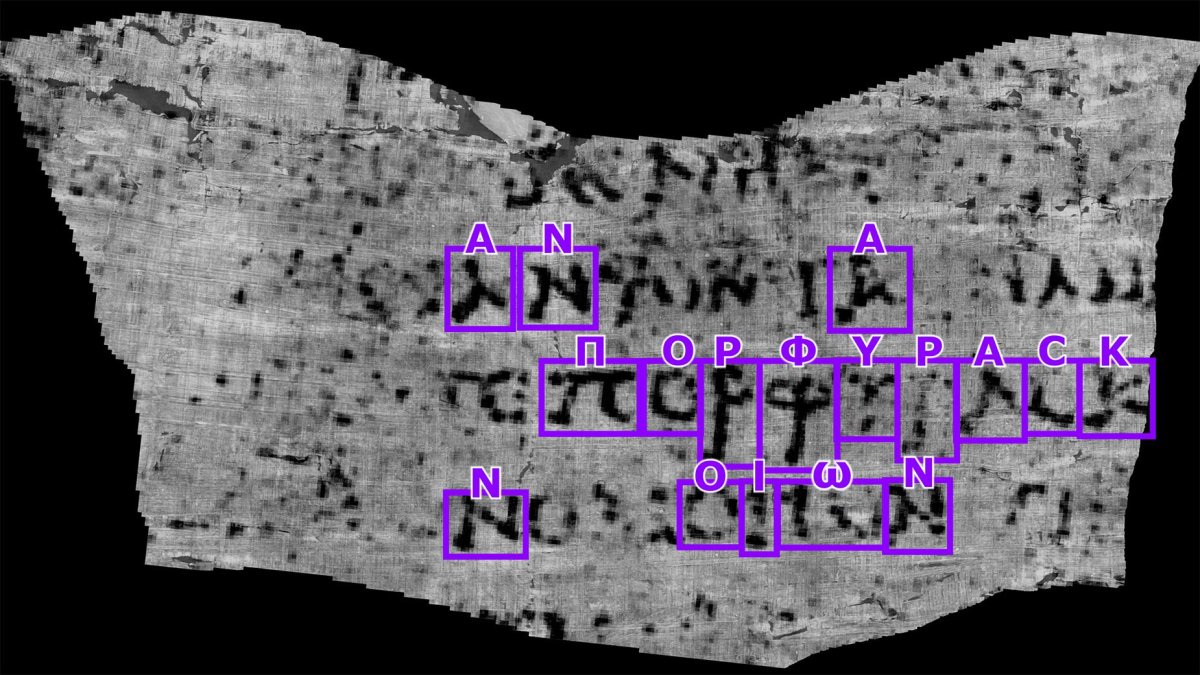
The first competitive milestone came in October 2023, when the first letters and lines of Greek text were detected from a sealed scroll. The initial word was recovered by Luke Farritor, then an undergraduate at the University of Nebraska, whose machine-learning model trained iteratively on ink-signal patterns in the scan data, eventually resolving the first word ever recovered non-invasively from a Herculaneum scroll: ΠΟΡΦΥΡΑϹ — purple.
In February 2024, Farritor, Youssef Nader and Julian Schilliger were awarded the $700,000 Grand Prize after their combined models recovered more than 2,000 characters across 15 full columns from a sealed scroll identified as PHerc. Paris 4. The text, attributed to the Epicurean philosopher Philodemus of Gadara, is a previously unread tract on pleasure, in which the author — using food as an illustration — argues that scarcity does not in itself make a thing more enjoyable than abundance.
The June 2026 results advance the project simultaneously on three fronts, as set out in the Vesuvius Challenge's formal announcement and the University of Kentucky press release issued on the same day.
The primary achievement is the complete reading of PHerc. 1667 — roughly 1.4 metres of papyrus across around 22 columns of Greek, recovered continuously, end-to-end, for the first time in its surviving history. The text engages with themes of human nature, impulse and moral progress consistent with Stoic philosophy, and the naming of Aristocreon in its final preserved column allows scholars to date the work to the second century BC, making it the oldest text yet identified in the collection. Passages read for the first time in two thousand years include "...we will inquire into something, but we will not grasp it, if in some way we depart from ourselves and from our own nature..." and "...such being the goods for us, even from the opposite evils there will be neither anything good — let alone beautiful — nor anything bad — let alone ugly — nor happiness..."
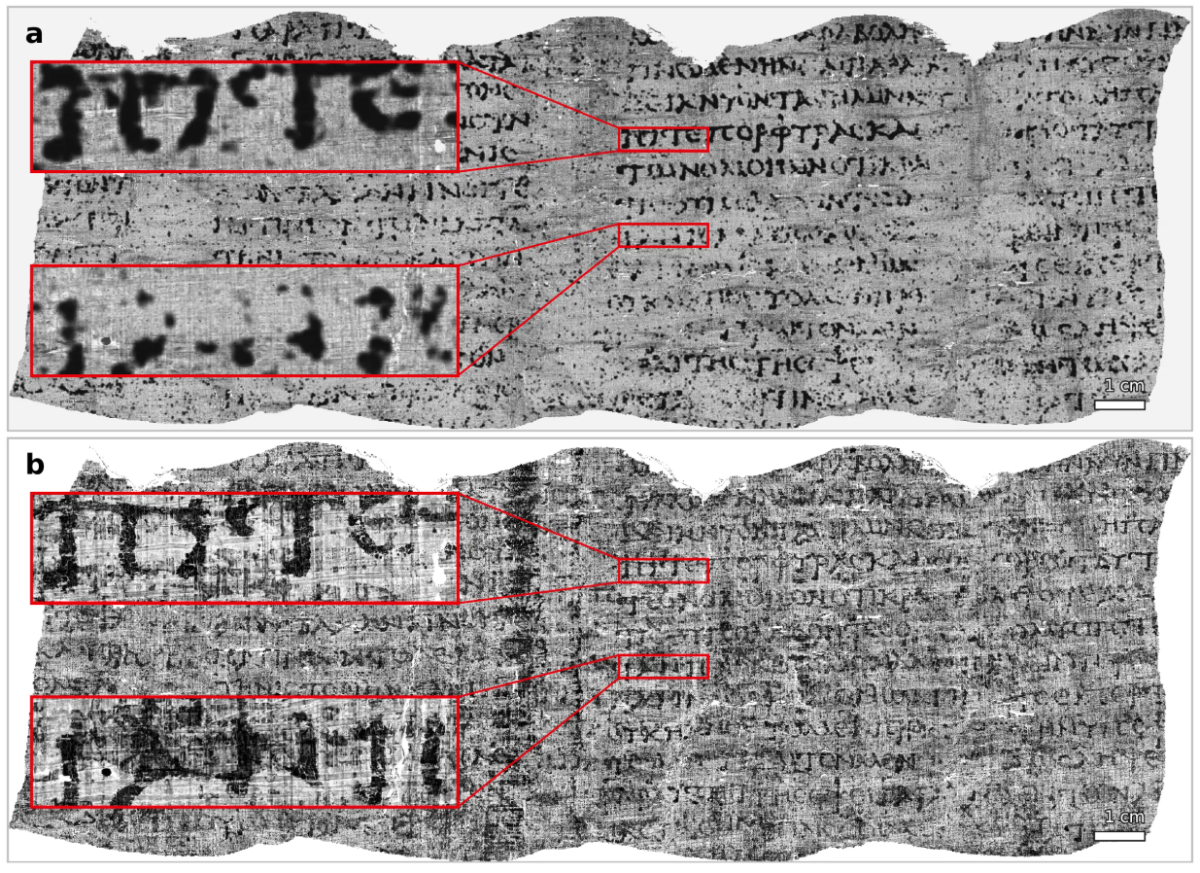
The second milestone concerns PHerc. Paris 4, the scroll used for the 2023 Grand Prize. A higher-resolution synchrotron scan of the same roll now makes the ink directly visible within the three-dimensional X-ray data — an independent confirmation, from superior instrumentation, that the 2023 reading was accurate letter for letter.
The third milestone is the identification of the title region of PHerc. 139, which yields the attribution Philodemus, On Gods, Book 8. The discovery establishes for the first time that Philodemus's On Gods was a multi-volume work extending to at least eight books; until now, only the first volume had been known. Separate from the preprint, the Naples ceremony also confirmed the recovery of more than 70 columns of text from PHerc. 172, housed at Oxford's Bodleian Library and identified as Philodemus's On Vices, Book 1.
Federica Nicolardi, assistant professor of papyrology at the Università degli Studi di Napoli Federico II and lead papyrologist of the Vesuvius Challenge, said of PHerc. 1667: "While a few isolated letters were visible, overlapping layers obscured the writing, and the scroll was assigned a readability score of zero. But now, with virtual unwrapping, we can follow sustained arguments across multiple columns. That is a transformational shift."
Around 300 intact Herculaneum scrolls remain sealed. A Vesuvius Challenge Master Plan, published in July 2025, outlines a programme of work intended to reduce the manual labour currently required for each scroll – through improved surface extraction, deeper automation and tools designed to cut human intervention at every stage of the pipeline. At current processing rates, experts estimate that completing the full library would take several years; the master plan is designed to compress that timeline considerably.
Whether the main library of the Villa of the Papyri has ever been found at all remains a matter of scholarly dispute. Some researchers believe the excavated collection represents only a secondary library and that a far larger archive may still lie beneath unexcavated levels of the site. The machine-learning techniques developed for Herculaneum could also, in principle, be applied to other categories of concealed ancient texts, including cartonnage—recycled papyrus used in antiquity to wrap Egyptian mummies, which often preserves fragments of earlier texts within its layers.
As the Vesuvius Challenge puts it in its own announcement: the thoughts of the ancient world, sealed in darkness for two millennia, are coming back into the light — a whole scroll at a time.