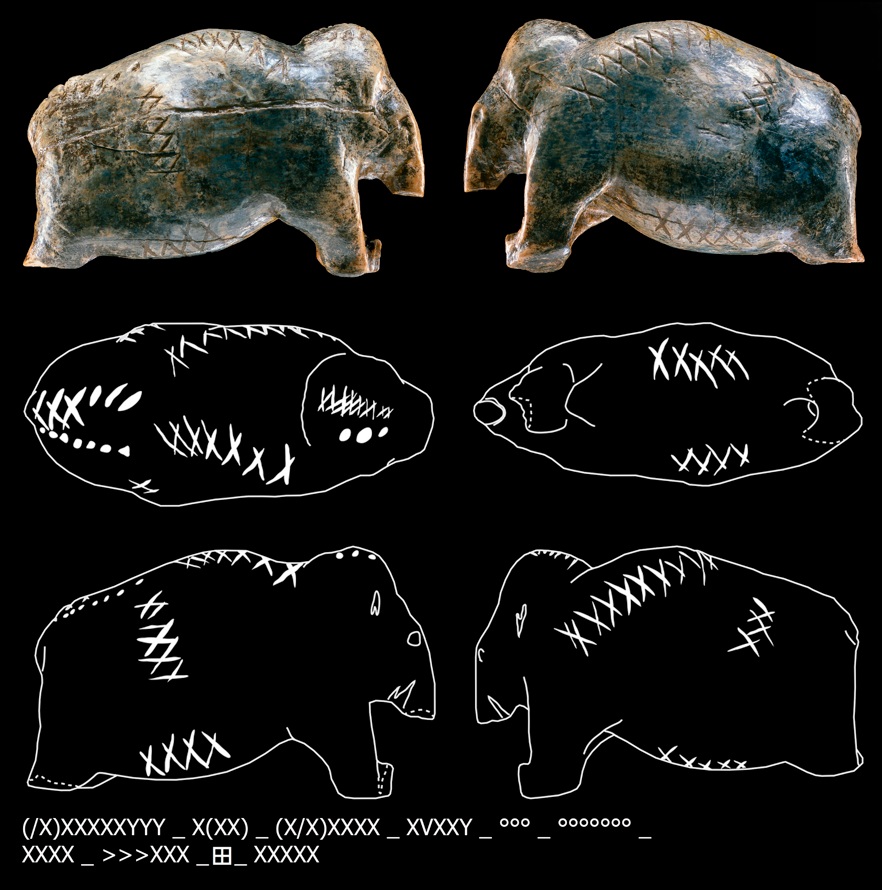



The *Adorant* figurine — a piece of mammoth ivory no larger than a matchbox, carved into a lion-human hybrid form — was found at Geissenklösterle Cave in Baden-Württemberg in 1979. It bears a sequence of notches and dots that, alongside similar marks found on more than 200 other artefacts from the same era, has now been subjected to rigorous computational analysis, Reuters reports.
The findings, published this week in the *Proceedings of the National Academy of Sciences*, stop short of classifying the marks as written language. However, researchers found that their sequential use displayed information density properties strikingly similar to proto-cuneiform — the earliest known precursor to cuneiform writing, which appeared in ancient Mesopotamia around 3300 BC.
The artefacts date from approximately 43,000 to 34,000 years ago and are associated with the Aurignacian culture — among the first anatomically modern humans to establish a distinct cultural identity in Europe. Having migrated out of Africa and across the continent as hunter-gatherer bands, these early Europeans encountered Neanderthals along the way and left behind some of the oldest known figurative art on record.
The signs identified by researchers include notches, dots, lines, crosses and star shapes. Notably, crosses appeared exclusively on tools and animal figurines — never on human ones — pointing to a system of conventions rather than individual artistic choice.
The artefacts analysed — drawn from four cave sites in southwestern Germany — were made primarily from mammoth ivory, though some were crafted from animal bones and antlers. Among them were animal figurines, hybrid human-animal figures, personal ornaments, and musical instruments in the form of flutes.
While the Aurignacian sign sequences share informational properties with proto-cuneiform, researchers noted that key features of true writing remain absent — most critically, a demonstrable link to spoken language structures.
The meaning of the signs themselves has not been deciphered and may never be. What the research does establish, however, is that the cognitive capacity for structured symbolic communication existed far earlier than previously demonstrated — and that somewhere in the caves of Ice Age Europe, people were already finding ways to make marks that meant something to others.