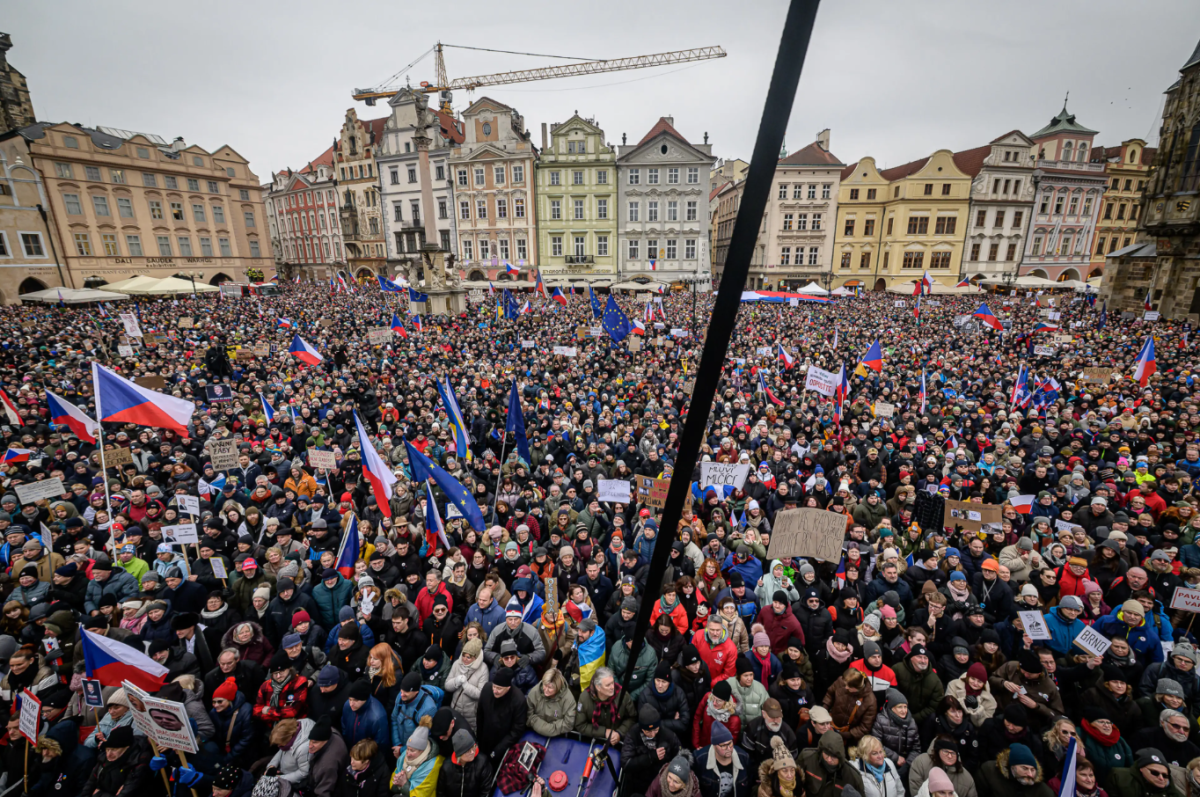
On Sunday an estimated 400,000 people gathered on Prague's Letná plain to protest the Czech government's plan to scrap the licence fee for its public broadcasters. The government's bill would abolish the 205-crown (about €8) monthly household fee and fund Czech Television and Czech Radio from the state budget.
Czech households pay 205 crowns (about €8) a month to fund public broadcasting: 150 for television and 55 for radio. Larger firms pay multiples of that. The government's bill abolishes the fee and has the state budget pay Czech Television (ČT) and Czech Radio (ČRo) instead.
For 2027 it sets about 5.74bn crowns for ČT and 2.07bn for ČRo. Media-freedom groups say that amounts to a cut of about 15%, or 1.4bn crowns a year. The broadcasters have estimated it could cost up to 700 jobs, according to a newsletter report that I could not confirm against a broadcaster statement.
Prime Minister Andrej Babiš says abolishing the fee was in the coalition's manifesto and eases the burden on households. He argues the licence-fee model is outdated and that other European countries are moving away from it. He and his allies insist that nobody wants to control public media and that the bill changes only how the money reaches the broadcasters.
Critics fear a government could later cut or threaten funding to pressure coverage and undermine independence and impartiality of reporting. A fee set by law and collected separately gives more distance. Civil society groups say a 15% reduction threatens the broadcasters' ability to fulfil their public-service remit.
"An elected government has the right to govern but it does not have the right to do whatever it wants and to dismantle democratic institutions," said Mikulas Minar, chairman of the civic group Milion Chvilek (A Million Moments) that organised Sunday's protest and estimated some 400,000 attended, according to Reuters. "Show that your aim is not to take control of them and let experts propose genuine safeguards for their independence from political power."
The European Broadcasting Union and other groups argue that the EU's European Media Freedom Act requires public-media funding to be adequate, predictable and set by transparent criteria in advance. Some of those groups do not say state funding is wrong in itself. Their position is that a change on this scale needs binding safeguards, such as multi-year funding the government cannot trim at will and legal guarantees of editorial independence.
Opponents also say there was no proper consultation with the broadcasters and little time for scrutiny. Mr Babiš has himself admitted the vote did not go well. In the early hours of Saturday, 24 October, the Chamber of Deputies rejected opposition motions to throw the bill out.
Under the Chamber's guide to the legislative process, the bill must pass four stages. It now faces a long road before it can become law. The coalition of ANO, the SPD and the Motorists holds 108 of 200 seats, enough to override both the Senate and a veto. A senior ANO figure, deputy speaker Patrik Nacher, has said he expects the Senate to send the bill back and does not rule out a presidential veto. Mr Babiš has hinted that changes may come at second reading, but the coalition has not agreed on a model yet.
The organiser of the massive rally was the Million Moments for Democracy movement with backing from unions, students, universities, churches, artists, athletes and international media bodies. Public-media staff held a one-day strike on 3 November, and opposition leaders attended the rally, which turned it into a wider protest against Mr Babiš's government.
Critics also point to Slovakia, where the Fico government cut the broadcaster's funding and replaced it with a new institution. Many Czechs read the bill through that example, although the government says the bill only changes the funding method.