At the annual meetings of Creative Europe’s cooperation projects, the conversation gradually matured from how to make culture together to how to make it last. Now the programme that funds them is preparing to give way to AgoraEU, and the sector is fighting to push back pressures. From funding reductions to industry changes due to AI. What will remain and what has to be fought over once again is now an open question
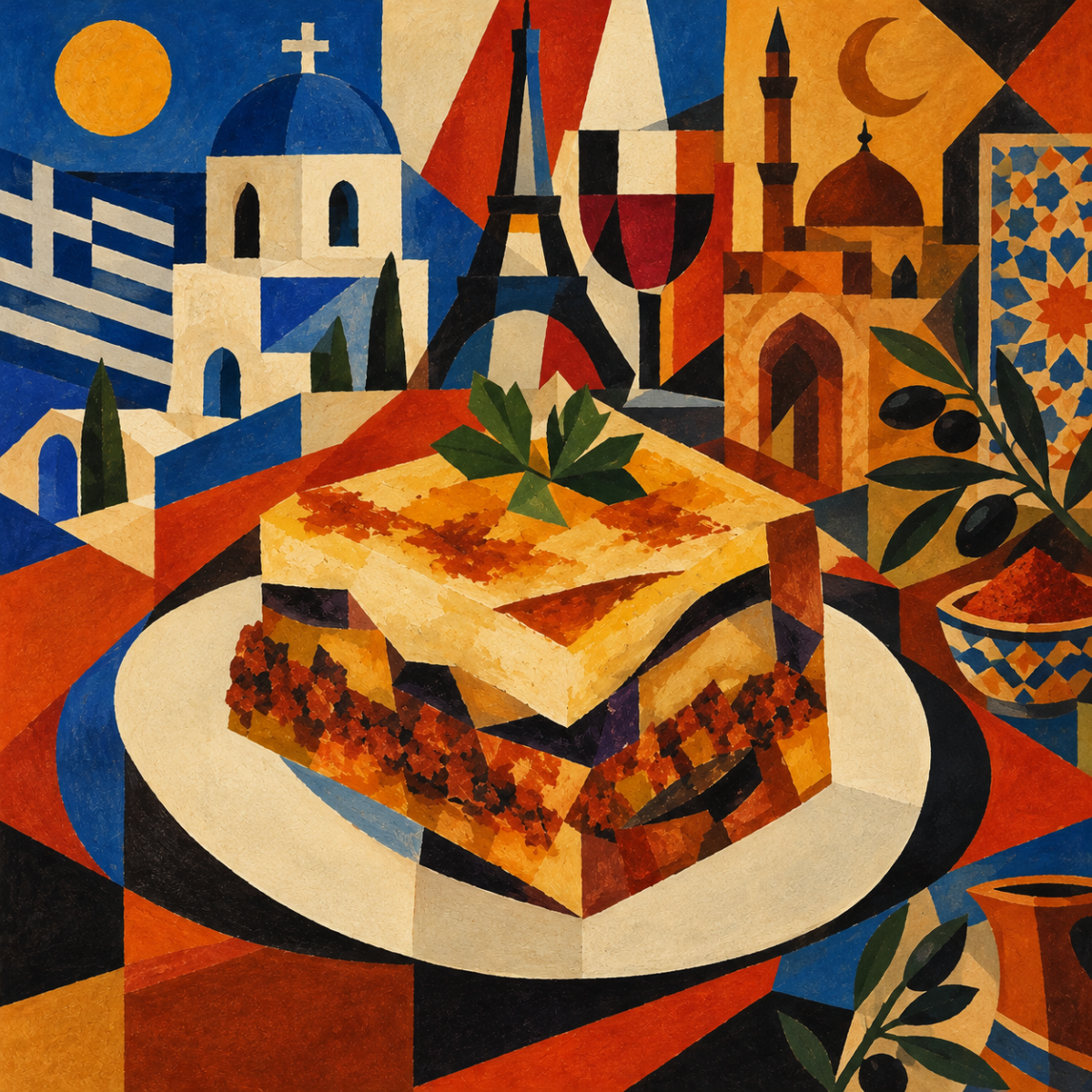
Ask almost anyone to name a Greek dish, and moussaka will be at the top of the list. Many would think it is one of the oldest symbols of Greek identity. Vasilis Charalampidis wanted to complicate that. Speaking in Brussels this June, he told a room of Creative Europe grantees that the moussaka we eat today is not an ancient recipe passed down unchanged. Quite the contrary.
Its modern form, he said, was created in the early twentieth century by a Greek chef, Nikos Tselementes, who had studied cooking in France and came home with new techniques. Tselementes did not copy what he had learned abroad, and he did not preserve local habits exactly as they were. He combined them. A dish found across the Eastern Mediterranean, in which aubergines, minced meat and tomato sauce were cooked together, was reorganised into layers and topped with a béchamel inspired by French cuisine. The result was neither entirely Greek, nor French, nor Middle Eastern. It was “something new”. But over time, that new thing became one of the most recognisable symbols of Greek culture.
Charalampidis, President of the Board of the European Creative Hubs Network (ECHN), was addressing the annual Grant Holders Meeting of Creative Europe’s Cooperation Projects, organised by the European Education and Culture Executive Agency (EACEA). On 10 and 11 June. More than 100 beneficiaries of projects selected in 2025 had gathered at the Arsenal in Brussels, part of a three-day programme that brought more than 170 grantees together. Every cooperation project, Charalampidis suggested, is a little like moussaka: ingredients and methods from different places, brought together with care. Or to leave the culinary metaphor behind, his moral, in other words, was “Cooperation and innovation, when they truly succeed, eventually become tradition.”
It was a pleasing story. It was also a way into something harder, which is the question that ran through the next two days and runs today as we’re moving towards the last year of Creative Europe and the opening of the new cycle, that of Agora. What has Creative Europe left behind as common knowledge, principles and strategies for the new era?
The meeting in June used Open Space Technology, a format in which participants propose and run their own workshops. The topics ranged from accessibility and diversity to artificial intelligence, youth engagement, sustainability, impact, partnerships, artistic practice and community building. Charalampidis, who was asked to write the wrap-up, found that discussions that looked unrelated kept returning to the same words: trust, belonging, participation, care, and long-term impact.
In the diversity workshop, someone put the whole argument in three words: “Give them the key.” In the youth session: “We need to trust young people more.” A participant in a workshop on hope and the future said: “Hope is difficult to find.” Another, describing how many project teams now see their role: “We are facilitators, not providers.” And on the central tension of the whole meeting, one participant offered a formula that may travel well beyond Brussels: “Build projects inside communities. Build communities around projects."
Behind these lines was a structural complaint. Trust takes years to build. Communities form slowly. Cultural change rarely follows a funding calendar, and its effects often become visible long after activities have ended. Several workshops questioned whether cultural cooperation's most meaningful results can be measured within a project's life. But ask any European from the Iberian Peninsula to the Baltics and from the Mediterranean to the Arctic about culture, and, as Eurostat confirms, they will tell you how important culture is for their well-being (even for public health) and how much it shapes the modern European identity.
“We move from projects to ecosystems,” Charalampithis wrote. “We move from outputs to conditions.” And then two more moves: from short-term activities to long-term change, and from delivering culture to enabling participation. In this account, culture is less a sector than infrastructure: for dialogue, participation, democracy, belonging, experimentation, and care. “The real issue”, he wrote, is not what the projects will produce, but “what they will leave behind”. Charalabidis’s reflection was not just his own ideas, but it was echoing the changing beliefs in the field.
In September 2025, Mieke Renders, Managing Director of Trans Europe Halles, had closed the meeting of the cohort selected in 2024 with a list of requests. Fund partnership-building before applications, pilot formats beyond the logical framework, and support residencies through lump sums. Her closing remarks were from Europe to the world, from projects to communities, from output to process, and from sustainability to responsibility. A year later, Charalampidis took a step further: from projects to ecosystems, from outputs to conditions, from short-term activities to long-term change, and from delivering culture to enabling participation.
In 2025, problems were mostly about unclear roles, disengaged partners, and rigid KPIs that, in Renders’s summary, “suffocate creativity”. Its principle was freedom within a fair system. In 2026, the question was how culture can survive by what it builds. Its principle was continuity. Trust shows the shift: in 2026, participants described themselves as “facilitators, not providers".
Creative Europe’s last period runs to 2027. In July 2025, the European Commission proposed AgoraEU for 2028 to 2034, a single programme that merges Creative Europe with the Citizens, Equality, Rights and Values programme. The proposal totals about €8.6 billion, and its culture strand would be about €1.79 billion, compared with €805.9 million in the current period. In May 2026, the Council adopted a partial negotiating position, slashing the budget for culture by 30%. Talks with the European Parliament will follow.
Which lessons from this generation of projects carry across into AgoraEU, and which are lost in the transition? Do lump sums, longer timelines and funded partnership-building survive? “Ecosystem”, “infrastructure” and “conditions” are generous words, born from the sector’s experience and knowledge but questionable how they can be written into the new funding regulation. It is hard to fund trust, but it's what is needed.
Anthropologists talk about invented tradition, the idea that practices were deliberately made to last. What lasts is rarely what is simply produced. It is what someone decides to keep. Creative Europe’s projects knew how to make new things. Their own summaries say the harder task is making sure that something survives the grant, the cohort and the programme. In the next budget cycle, the European institutions will decide which of the practices developed over these years and which principles the sector developed across Europe are worth carrying forward. What is abolished in policy priorities and what remains as our common knowledge, values and tradition.
Read Vassilis Charalampidis' keynote by clicking the image below (PDF)
Image illustration: by Creatives Unite with ChatGPT