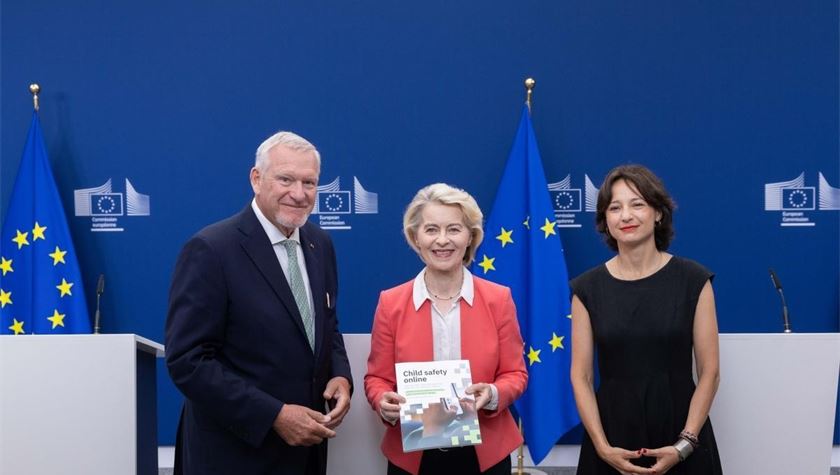



The European Commission is preparing to restrict children's access to social media after a panel of experts convened by Ursula von der Leyen concluded that technology platforms, rather than parents or regulators, should have to prove their services are safe for young users before children are allowed to use them.
Dr Maria Melchior, a director at France's national institute for health and medical research, and Professor Jörg Fegert, a child and adolescent psychiatrist at Ulm University Medical Centre in Germany, handed the final report of the Special Panel on Child Safety Online to the Commission president in Brussels on Monday. The wider panel, included neuroscientists, psychologists, data-protection specialists and two teenagers drawn from the EU's Children's Participation Platform and worked for a year before they concluded.
The group met three times between March and June, taking evidence on internet addiction, cyberbullying, grooming and the effects of what the report calls "social media+" services — platforms whose design features, including infinite scrolling, autoplay and persistent notifications, it regards as unsuitable for children. Its central recommendation is that access to such services should be barred to under-13s until providers can show their products are safe by design, with the door left open to further age-based restrictions for young teenagers.
At a press conference, Mrs von der Leyen said children under three should have no screen exposure at all and argued for a system of "phased and gradual" access as children grow older. She said social media was "not a toy" and drew a comparison with the age limits already set for driving and buying alcohol, arguing that responsibility for safety should sit with the companies that design the products rather than with families.
Her remarks were accompanied by a new Eurobarometer survey showing large majorities of Europeans worried about cyberbullying, grooming and children's exposure to harmful content and roughly two in three wanting the EU to restrict underage access to social media. According to the survey, young people in the EU spend on average 4.5 hours online on school days and more than 6 hours at weekends. Nearly 1 in 3 teenagers say social media leaves them feeling stressed, sad or excluded.
The Commission has not yet published a bill; officials say it will weigh the panel's recommendations before bringing forward proposals, which are expected after the summer. Michael McGrath, the EU's consumer protection commissioner, has indicated the forthcoming law would treat children as "vulnerable consumers" who must be protected by design.
Momentum for a tougher regime was already building in the European Parliament, which voted by 483 to 92 in November to demand a harmonised EU digital minimum age of 16 for social media, video-sharing platforms and AI companion apps, with 13- to 16-year-olds permitted access only with parental consent. MEPs, led by the Danish rapporteur Christel Schaldemose, also called for bans on infinite scroll, autoplay and gambling-style in-game rewards and for senior managers at persistently non-compliant platforms to face personal liability.
Any new law would build on, rather than replace, the bloc's existing Digital Services Act, whose Article 28 already requires large platforms to assess and mitigate risks to minors, bans targeted advertising to under-18s, and requires parental controls and age-assurance tools. The Commission has separately opened a review of the older Audiovisual Media Services Directive, which already restricts harmful content and inappropriate commercial communications aimed at children on video-sharing platforms, as part of a wider "European Democracy Shield" strategy for the media sector.
The push has not gone unchallenged. European Digital Rights group EDRi, a digital-rights network, has criticised the bloc's growing reliance on age-verification tools, describing the approach as a "sledgehammer" that risks data breaches and surveillance without tackling platforms' underlying design. The Electronic Frontier Foundation has separately warned that age-checking systems, especially once linked to digital identity wallets, could erode online anonymity well beyond their stated purpose.
The difficulty of reconciling child protection with digital rights was underlined in the spring, when EU governments and the Parliament failed to agree on extending temporary rules that let platforms voluntarily scan private messages for child sexual abuse material; the arrangement lapsed on April 3, after MEPs rejected renewal partly over its potential reach into encrypted communications.
Any Commission proposal will need the backing of both the Parliament and EU governments. Debate is expected to focus on where to set the minimum age, how widely to define the services covered, and how to verify a child's age without building new tools for mass surveillance.