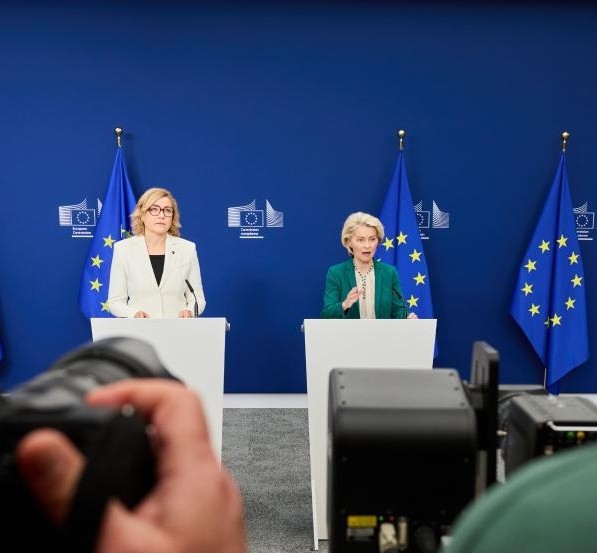



European Commission President Ursula von der Leyen and Executive Vice-President Henna Virkkunen have announced that the European Union’s digital age verification app is now technically ready and will soon be available for citizens to download and use. The app is intended to safeguard children by enabling users to prove they are over a required age before accessing online platforms, mirroring the ID checks carried out in physical shops for age-restricted goods such as alcohol. The solution is built around strict privacy safeguards. It employs zero-knowledge proofs, allowing users to verify their age without revealing any other personal data, such as their exact date of birth. The process is designed to be completely anonymous, with no tracking by platforms or the app itself.
Citizens will download the app, set it up once with their passport or national ID card, and then use it to prove their age when required by online services. The app works on any device — smartphones, tablets or computers — and is fully open-source, enabling anyone to inspect the code. It is designed to integrate seamlessly with national digital ID wallets. France, Denmark, Greece, Italy, Spain, Cyprus and Ireland are described by President von der Leyen as “front-runners” that are planning to incorporate the technology into their national systems. In her remarks, President von der Leyen stressed that platforms would no longer have any excuse for failing to protect children.
“Online platforms can easily rely on our age verification app. So there are no more excuses,” she said. “Europe offers a free and easy-to-use solution that can shield our children from harmful and illegal content.” She added that the app would give parents, teachers and caretakers “a powerful tool to protect children” and emphasised that “we will have zero tolerance for companies that do not respect our children’s rights”. Children’s rights, she said, come before commercial interests.
"This is not the first time the Commission has come forward with an innovative solution to a new problem. We all remember the COVID pandemic. Our world came to a complete standstill. But as we came out of lockdowns and as vaccines were available, the Commission developed the COVID app in record time – three months – to help bring us back to normal life in a safe way. With a scan of our COVID certificates, we could go to a concert or board a plane to travel again, etc., 78 countries across 4 continents were using this app, so it was a huge success. And now we have taken this success and applied it to the age verification app. It follows the same principles, the same model," she underlined.
Executive Vice-President Virkkunen reinforced the privacy credentials of the technology and announced the establishment, this month, of an EU-wide coordination mechanism. The aim is to accredit national solutions and prevent fragmentation, ensuring a single, harmonised approach across the bloc rather than 27 separate systems.
"The message is clear: In Europe, TikTok will have to change its fundamental design. Because we refuse to compromise on our children's well-being. We are taking similar action against Facebook, Instagram, Snapchat and Shein,", Executive Vice-President Henna Virkkunen added. "As platforms do not have proper age verification tools in place, we came up with the solution ourselves."
The blueprint on which the app is based is open-source, and private companies are invited to develop compliant solutions provided they meet the same privacy and interoperability standards.
The announcement builds on a blueprint for an age-verification solution that the Commission first made available in July 2025 and updated in October 2025. It was piloted in several member states and is explicitly linked to the enforcement of the Digital Services Act (DSA), under which the Commission has already taken action against platforms for inadequate age checks and addictive design features.