

Reporters Without Borders' 2026 global index reveals the catastrophic state of an industry under siege, spanning locations from Gaza to Guatemala and from Washington to Warsaw. For the first time in 25 years, half of the world's countries have difficult or very poor conditions for the press.
By Matthaios TsimitakisOn Sunday, governments around the world will mark World Press Freedom Day, the annual occasion proclaimed by the United Nations General Assembly in December 1993 to assess the state of journalism, defend media independence, and pay tribute to reporters who have lost their lives in the course of their work. This year, those tributes will need to be longer than ever.
According to figures published today by Reporters Without Borders (RSF), press freedom has now reached its lowest point in the quarter-century since the organisation began compiling its World Press Freedom Index. The timing is not coincidental: RSF releases its annual rankings to coincide with the day, and the 2026 edition offers little comfort to anyone who believes that the ability to report freely is a precondition of democracy.
The Index, which assesses 180 countries and territories across five indicators — political context, legal framework, economic conditions, social environment, and journalist safety — has recorded a critical moment: for the first time in its 25-year history, more than half of the world's countries now fall into the 'difficult' or 'very serious' categories for press freedom. In 2002, 20 per cent of the global population lived under conditions rated "good". Today, that figure has fallen to fewer than one per cent. Norway holds the top position for the tenth consecutive year. Eritrea is last for the third.
The sharpest single deterioration this year has been in the legal indicator, which measures the legislative and judicial environment in which journalists operate. That score worsened in 110 of the 180 countries surveyed, driven by what RSF describes as the accelerating criminalisation of journalism — the use of national security statutes, emergency legislation, and defamation law as instruments of suppression. In Russia, which ranks 172nd, 48 journalists were behind bars as of this month. In Hong Kong, the publisher Jimmy Lai was recently sentenced to 20 years in prison, the heaviest sentence ever imposed on a journalist in the territory. In El Salvador, a foreign agents law passed in 2025 has forced scores of reporters into exile.
The United States, ranked 64th — a fall of seven places — has also seen significant deterioration. RSF attributes the slide to what it characterises as the Trump administration's systematic hostility towards the press, including the dismantling of the US Agency for Global Media, which led to the closure or severe reduction of Voice of America, Radio Free Europe/Radio Liberty, and Radio Free Asia. The social indicator, which measures the cultural and professional environment for journalists, has fallen sharply as well, driven in part by what the organisation describes as "unprecedented distrust of the media".
World Press Freedom Day 2026 — Key figures
If the index provides the structural diagnosis, the Committee to Protect Journalists (CPJ) has supplied the most harrowing evidence of the human cost. In a report published in February, the New York-based organisation documented a record 129 journalists and media workers killed in 2025 — the highest annual figure since CPJ began collecting data in 1992 and the second consecutive year in which press killings set a new record. The previous record had been set in 2024.
Israel was responsible for two-thirds of those deaths. Israeli fire killed 86 journalists and media workers in 2025, the majority of them Palestinian reporters in Gaza. The figure includes 31 killed in a single Israeli strike on a Houthi media centre in Yemen, which the CPJ described as the second-deadliest single attack it has ever recorded. Israel has stated that its forces target only combatants and has described some of those killed as having links to militant organisations – characterisations that international news organisations have strenuously denied. The CPJ called such claims "deadly smears. " Israel does not permit foreign journalists to enter Gaza; every member of the press killed there was Palestinian.
The CPJ found that at least 104 of the 129 deaths occurred in conflict zones. Beyond the Middle East, Sudan recorded nine journalist deaths in 2025, Mexico six, Ukraine four, and the Philippines three. Drone strikes — a method of killing that CPJ first began documenting in 2023, when two such deaths were recorded — surged to 39 cases in 2025, of which 28 were attributed to the Israeli military in Gaza. Impunity remains endemic: very few of the 47 killings that CPJ classified as deliberate murders — defined under its methodology as intentional targeted killings — have resulted in any transparent investigation or prosecution.
The RSF's own 2026 report adds a further figure: since 7 October 2023, more than 220 Palestinian journalists have been killed by the Israeli army in Gaza, of whom at least 70 were killed in the direct exercise of their journalistic work, making it the deadliest conflict for journalists since modern records began.
World Press Freedom Day 2026 falls on Sunday, 3 May — the 35th anniversary of the Windhoek Declaration, the founding document of the modern press freedom movement. The declaration was adopted on 3 May 1991 at the conclusion of a UNESCO seminar in Windhoek, Namibia, at which 63 participants from 38 countries called for a free, independent, and pluralistic African press. The UN General Assembly, acting on a UNESCO recommendation, proclaimed the day in December 1993.
2025 journalist deaths by country/territory — CPJ data
This year's global conference, held under the theme "Shaping a Future at Peace", will convene on 4 and 5 May at the Mulungushi International Conference Centre in Lusaka, Zambia, co-hosted by UNESCO and the Zambian government. The event will bring together journalists, digital rights advocates, technologists, policymakers, and civil society leaders for sessions on the intersection of press freedom with artificial intelligence, online disinformation, conflict reporting, and the safety of journalists. It has been deliberately scheduled back-to-back with RightsCon 2026, a major global summit on human rights in the digital age, which runs in Lusaka from 5 to 8 May.
On the evening of Sunday 3 May, at a separate ceremony in Lusaka, UNESCO will announce the winner of the Guillermo Cano World Press Freedom Prize, awarded annually to a person or organisation that has made an outstanding contribution to the defence of press freedom in a situation of significant personal risk. The prize is named after the Colombian journalist Guillermo Cano Isaza, who was assassinated in Bogotá in 1986 after years of investigative reporting on drug cartels.
The focus in Lusaka will also fall heavily on the economic fragility of independent journalism. The RSF's 2025 index had already identified the economic indicator as the primary driver of global decline, noting that financial conditions for journalism reached a record low as media outlets were caught between preserving editorial independence and ensuring their survival. The 2026 index confirms that deterioration has continued, with ownership concentration, advertiser pressure, and state control of media financing threatening press independence in countries across every region.
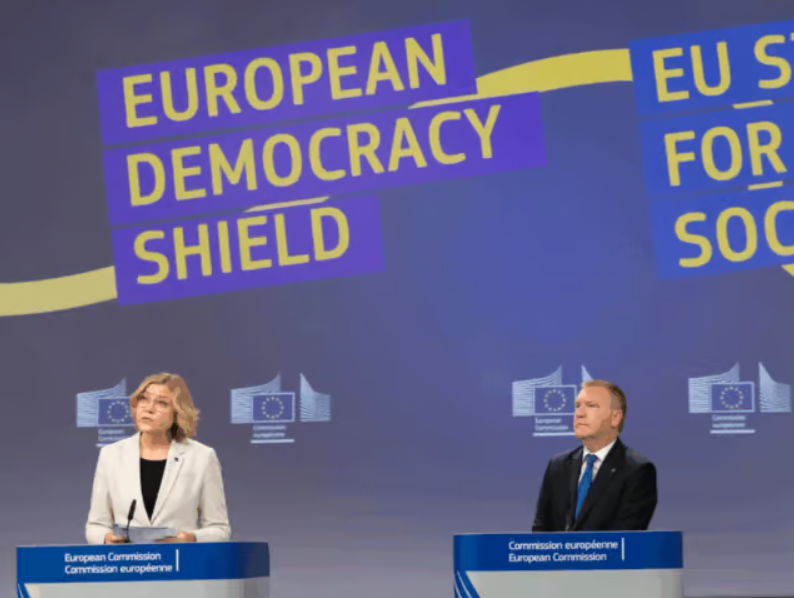 The European Commission marked the eve of World Press Freedom Day with a statement reaffirming its commitment to media freedom ahead of Sunday and pointing to a series of legislative measures it has advanced in recent years. Foremost among them is the European Media Freedom Act, the majority of whose provisions entered into force in 2025. The act is intended to safeguard journalistic sources, protect communications between reporters and their contacts, and insulate editorial decisions from political interference or the use of commercial spyware.
The Commission also cited ongoing enforcement of Digital Services Act provisions designed to prevent the arbitrary removal of journalistic content by online platforms, as well as monitoring of the Anti-SLAPP Directive – legislation intended to shield journalists from the "strategic lawsuits against public participation" that are increasingly used to silence investigative reporting. Executive Vice-President Henna Virkkunen pledged decisive action to strengthen protections and resources for journalists across the bloc. And Michael McGrath, Commissioner for Democracy, Justice, the Rule of Law, and Consumer Protection, reaffirmed the Commission's commitment to upholding the strongest possible safeguards for journalists and independent media.
The RSF data, however, suggests that European legislation, however well-intentioned, has not yet reversed the trend. While EU countries continue to dominate the top of the global rankings — Norway leads, followed by the Netherlands, Estonia, Denmark and Sweden — the 2026 index notes that several EU member states remain in breach of the European Media Freedom Act despite its entry into force. The Media Freedom Rapid Response, a coalition of European journalism organisations, recorded 1,481 press freedom violations across 35 European countries in 2025, including physical attacks, prosecutions under foreign agent laws, and the use of civil litigation to suppress reporting.