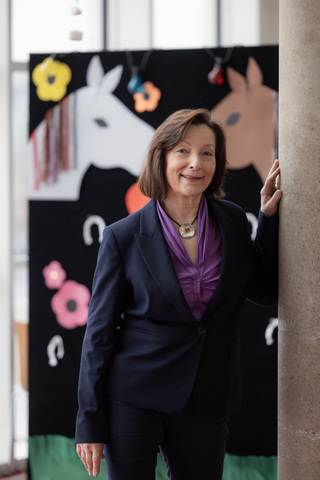


Piia Rantala-Korhonen, CEO of Oulu2026 talked to CU about how to re-invent a tech-city through redefining culture, while promoting sustainability. Piia invites us to a 1 km long table to share local delicacies in a "Summer Night's Dinner" and notes that for a vibrant and attractive city you have to invest in culture, but funding criteria have to not narrow artistic freedom. Read on.
By Eirini Polydorou
Piia Rantala-Korhonen, CEO of the Oulu Cultural Foundation prepared the winning bidbook together with a small team, bearing as a present for Europe the “Layers in the Peace Machine” and including Sámi in the ECoC, Europe’s only indigenous people. Piia is now proud to welcome ECoC enthusiasts throughout the year of Oulu2026 to broaden together the concept of culture, redefine governance as trust and defy -through arts- that we only live once.
CU - We see Culture Climate Change, meaning a permanently richer cultural life, as the goal of Oulu2026. What lies behind this concept? What was the trigger or the need that it responds to?
There are several things. First of all, this has been a really long journey starting in 2017. Oulu2026 Team started to work with the main challenges of the City. We felt the need to bring culture and creativity to our hi-tech city. To go beyond being only a high tech city. Also, a bit before writing the bidding book, there was a study from Turku university. Saying that in Oulu people wouldn’t feel well. . An other study made in Oulu showed that 8% of citizens used 80% of the city’s resources for social and healthcare. So, we wanted to employ culture to make people feel as a more meaningful part of the society. A third challenge was that the whole region has lots of potential in creative industries. We wanted to enable their flourishing. We are not only making a more beautiful city brand, but we really change the city. Culture is a very strong tool when you want to develop a city or region.
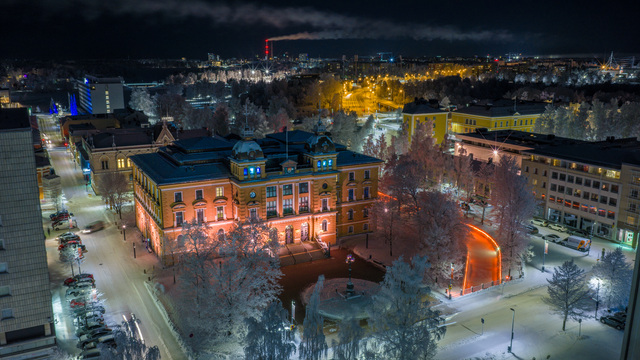 Photo by Tero Suutari - Courtesy of Oulu2026
CU - The opening week has already been a big success, what is the ECoC’s next milestone?
We had 250.000 visits to 200 events in the opening weekend in the city centre of Oulu. There has never been such a record high of visitors in Oulu for any cultural event. Despite this happening in the heart of winter, you could see so many happy faces. We were really hopeful that Oulu would attract a very large number of visitors and this is a big thing for all of us. Let me note that almost everything was offered for free. Some events on photography, exhibition, opera and art museums only had a fee.
CU - Why involve 40 municipalities. Did that offer more challenges or opportunities?
Both. There was a tension between the biggest and growing Oulu and the smaller municipalities. To explain, Oulu is the largest city in northern Europe and smaller municipalities are not happy that most young people go to Oulu to find other young people, study and work. We wanted to collaborate with the municipalities and address the issue of population ageing through the ECoC.
Of course, distance between the municipalities brought transportation and communication challenges. Also, we had to respect the other partner and introduce their background into the ECoC, in an equal dialogue and a meaningful ECoC.
From a view of a manager or a leader it is easy to say to your under. For us - you can’t just say what to do. But you need to explain and inspire people and enable the small municipalities. It’s a whole new way of network leadership, where all governance is built on trust and free will. Beyond this being the only rational choice, you need to build emotional collaborations.
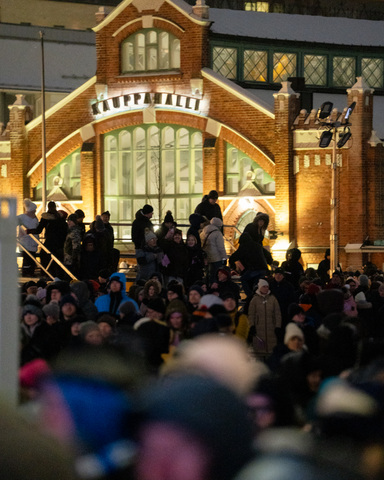 Photo by Linnea Laatikainen - Oulu2026 Opening Festival, Market Square
CU - How does the culture programme of the ECoC reflect the multiple facets of the city? For example, how do you make it possible for Sámi - the European Union’s only indigenous people - to meet with Oulu as a technology city?
We recognised the need to include Sami, early in the process. We collaborated with the Giellagas Instite of University of Oulu. It is the only university in Finland which offers Saami language and cultural studies at the academic level. Sámi people don’t think that the borders of national states are their borders, the borders are new-comers. Despite having several languages. Their dream was to be included in the main events and landmarks of the ECoC. So, we included them and we have a Sami opera and other events featuring them.
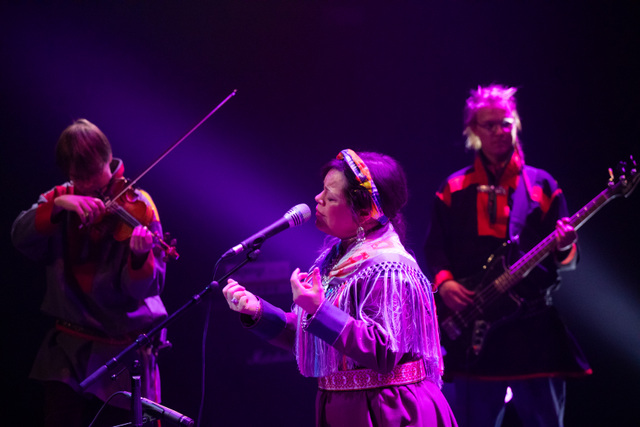 Photo by Sanna Krook - Ulla Pirttijärvi & Ulda performing modern Sami music.
CU - What about languages? For example, what was the impact on the ECoC of Finland as an officially bilingual country?
It doesn’t matter that the Swedish speaking community is small. They have strong establishments, receive public financing and we got extra funding from the Swedish cultural Foundation reaching 200.000 euros to have such programmes. We also have two Swedish speaking trainees in our organization, helping us on that.
In all open calls, there were criteria that you must have some European collaboration. In the beginning there were not so many, but nowadays almost all of them have small associations that have managed to get funded from Creative Europe. We have got such new capacity in terms of legacy.
CU - We see culture and mental health taking a large part of your programming.
Culture brings people together. Thinking that in the pandemic all cultural centres were closed, youngsters had very limited opportunities. Coming together is of major importance to youngsters and culture serves that. Also, culture is something else to offer to youngsters, as an alternative to being isolated through mobile use.
Culture should be present in everyday life. It’s about what it is to be a human being. It should not stay closed in cultural institutions. We only have one life. Through culture we have a view of how it is to have more than one lifes. To broaden your experiences, cultivate empathy and become wiser. This reflects on mental health and also on society.
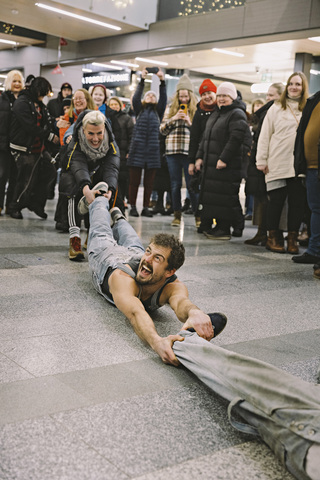 Photo by Henri Luoma - Oulu2026 Opening Festival, Valkea Shopping Centre
CU - We see in the programme activities going beyond the traditional range of arts and culture, including for example food activities, a SmART Hospital or the Hot Sauna Debates. So, everything is culture?
We have been broadening the concept of culture. We want to recognize new phenomena as cultural phenomena, so that they are meaningful for the citizens. We are not the professionals to say what is or what is not culture. It comes from the people.
We have food, science or other projects that broaden the thinking of what is culture. In the beginning of the bidbook, people would say that there is nothing cultural in Oulu. I was very excited to discover all these different cultural phenomena, or ways of living and be proud of our culture in the area. Such as the winter swimming we have. Here in Oulu the sea is still frozen in March - one of the last places given the climate change consequences - and we cherish that.
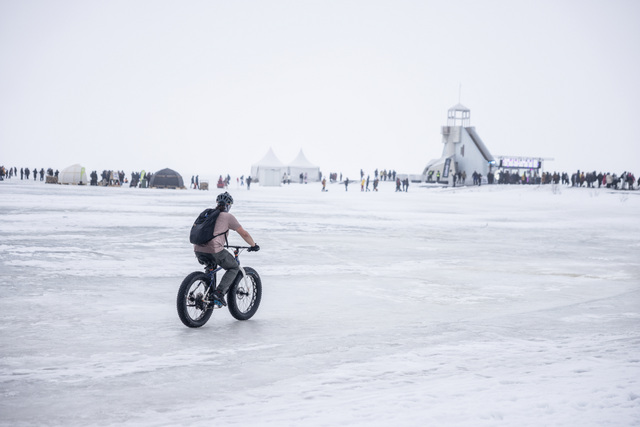 Photo by Harri Tarvainen - Frozen People 2024
Our food programme is very near to my heart. We had also planned to have a foodbook but did not get any finance. So, I decided to write it myself. Now a publishing company is interested, just yesterday I reviewed the manuscript and images and we expect to have it published during April. It features foods as stories of the area. We have a bread culture, mushrooms and berries in the forest, wild fishes and also a hunting culture, very popular in our region. There are stories on all these along with the recipes in the book.
CU - We also see in the ECoC programme many projects on conflict and memory.
I think that maybe the most important gift for Europe on our programme is the “Layers in the Peace Machine”.
It is an immersive installation by Ekho Collective, based on the literary work ”Peace Machine” by late Timo Honkela, saying that AI would help resolve human conflicts.
It is established in our city hall and this is symbolic. It is an experience artwork. You go to the first floor and express memories of peace, then on the second and third floor you experience different interactions with peace. It is really special.
When making this project, we thought of giving it as a gift to Europe that is somehow broken, so we should think of more ways to build up better communication and try to behave as human beings should. But when the Russians attacked Ukraine, we thought that this is not what we meant. The need for a Peace Machine became even stonger.
Once the war burst, we had to cut all the ECoC projects we were planning together with the Russians. Russians’ attack on Ukraine was a really big thing for us because of our national history.Finland has 1340 kilometers of borderlines with Russia, so we thought that we may be the next. This is something that we share with Tartu (Estonia) and Liepaja (Latvia). Oulu has several twin cities in Europe and Odessa, in Ukraine, is one of them. But we heard that the Russians destroyed the historic centre of Odessa. And what was not destroyed, was stolen. Culture and nature are the silent victims in wars.
At those days, two years before the war, when we were preparing the “Layers in the Peace Machine”, we were thinking of hate speech and other dividing behaviors through mobile devices.
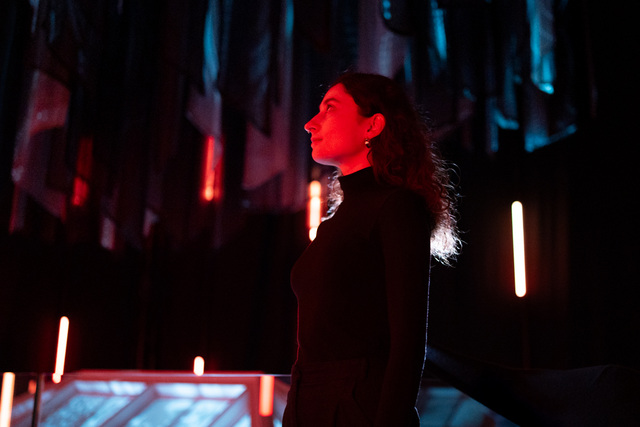 Photo by Linnea Laatikainenredits - Layers in the Peace Machine
CU - How does Oulu2026 respond to the global challenge of environmental sustainability? Is your motto on “Cultural Climate Change” only about culture?
We are aiming at a cultural climate change but the actual climate change is something that connects us with other ECoCs. Sustainability is very important for us. We have a project “The most Sustainable ECoC”, including a toolkit on recycling and other sustainable practices for visitors. Also, when organising the ECoC we tried to use existing infrastructure, such as in the case of a Media Centre. Also, we have a big immersive event in a building that used to be a hyper-market and before the ECoC was empty and abandoned.
CU - Europeans see Finland as a model for gender equality. Is this reflected in the ECoC?
We had a two year long project called Equal Oulu2026. It involved three persons working full-time in projects mostly organising educational activities in all municipalities and stakeholders on how to make cultural events more equal, for example through engaging for equality both audience and creators’ sides.
Also, we discussed a lot of what cultural offerings would be more interesting for men. In Finland, it feels like turning around. Men are more passive in cultural life than women. On the other hand, cultural workers who are not making big salaries are mostly women.
CU - Where do you see the city in 5 years from now? Where do you see yourself in five years from now?
I will be retired in two years. I wish I could be positioned somewhere in the EU, such as a cultural expert.
The politicians should understand that for every 1 euro we spend on culture, it may bring back around 5 to the local economy. If there is no culture, the city is quite a dead place. To have a vibrant and attractive city, means to invest in culture.
I hope the politicians understand this. The municipal boards usually vote every 4 years. This is quite short to ensure a legacy. I hope they also adopt a more long-term approach, by setting not politicians but city-officials on taking such decisions, so we don’t have to start over and over again every time.
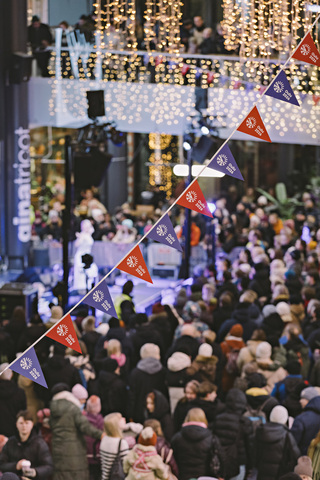 Photo by Henri Luoma - Oulu2026 Opening Festival, Valkea Shopping Centre.
CU - What would be your not-to-be-missed per season proposals in Oulu2026? We see events throughout the year across three chapters: Wild City, Cool Contrasts and Brave Hinterland.
Hard to choose. For Spring, let’s say “Frozen people” about to take place in early March. It is an electronic music festival on the beach, an exotic arctic experience over Oulu’s iconic Nallikari area.
In the summer, I would definitely suggest "Summer Night’s Dinner". This will be a 1 kilometer dining table inviting all of us to experience a diversity of local foods and really get together. The table will be covered with a table cloth made by a collaboration between arts academies in Oulu and China Oulu’s twin city, Hangzhou.
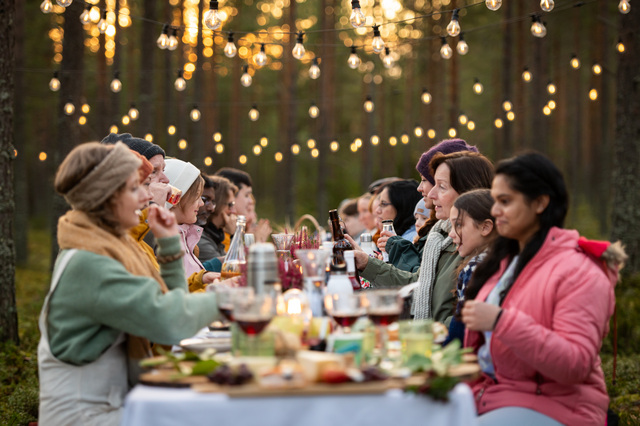 Photo by Lauri Kaikkonenredits - Arctic Food Lab - Summer Night's Dinner
In the autumn, I would say the Lumo - Art & Tech festival to enjoy an impressive variety of events from light art and sound art to diverse forms of digital art.
For winter, I wouldn’t miss the Snowball musical. This will be a Christmas musical for the whole family, where Northern legends and the story of Kaleavala are woven in an exciting story full of magic, mystery and romance.
CU - Does today’s image of the ECoC reflect what you had in mind when designing the bidbook? Is there something that you would do differently, if given the chance to start over?
The biggest challenges are connected to the long timeline. When you create the bidbook in 2021 and you are about to implement the ECoC in 2026, you can’t really see into the future. The bidbook should not be too ready for the implementation.
CU - What would be your advice to a small or big city now preparing a bidbook for the ECoC title?
Start early enough and remember that this is not about making an artistic festival year, but must be done together with the whole community. The more you engage locals, the better. You are building mutual trust. And then you are resilient. And then, you can handle whatever comes into the future. Without mutual trust there is no resilience.
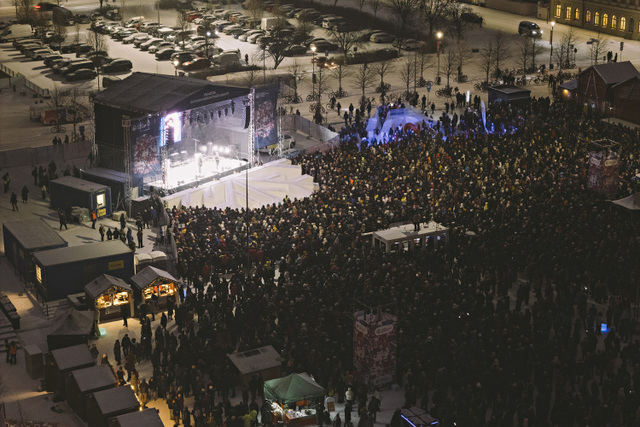 Photo by Henri Luoma - Oulu2026 Opening Festival, Market Square.
CU - What about EU policy on future ECoCs? The Commission is designing the post-2033 ECoC era.
When the EU takes decisions on the ECoC they will listen to the cities that have gone through the process. We have experience and we know what should change to make the capital even better.
The EU should take responsibility for financing the ECoC in the future. Big cities have already held the title. As more and more small and smaller cities join, it is not possible to make it with a budget of 50 millions.
During 2025, together with ECoC colleagues we prepared a Whitebook with our policy suggestions for the ECoC. The Whitebook should be taken under consideration. The timing of the public consultation for the post-2033 ECoCs was not good for us. Last year was the most busy year for the overall process.
CU - What about artistic freedom, rising among the highest priority challenges of culture policy in recent years? Does artistic freedom combine with an instrumental approach of culture policy?
There should be artistic freedom. Funding or other policy programmes should not involve too many criteria that are already making artistic freedom smaller. If you try to solve the EU challenges through culture, artistic freedom will narrow. Not only instrumental use for culture, but also culture for culture’s shake.
Because culture has impact, culture policy is almost always also instrumental. So, politicians should clarify their expected impact, but allow for artistic freedom at the same time.
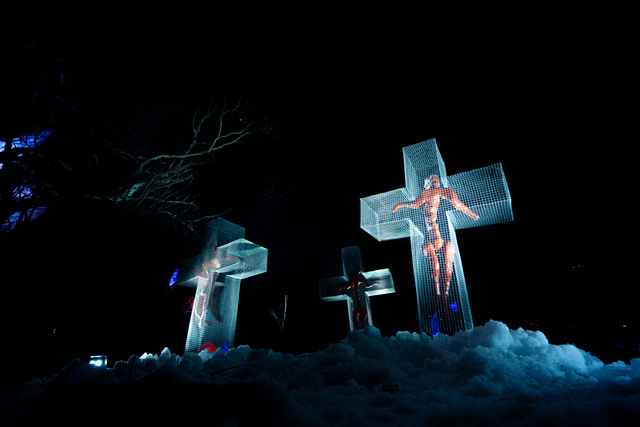 Photo by Vera Lakovaara, Oulu Urban Culture ry - Frozen People music event 2025.
CU - What are your expectations and wishes for 2026?
I hope that people have the opportunity to experience all the interesting events that happen this year in Oulu2026. There are so many interesting events that only happen once. And if they miss them, they will miss it forever.
Piia Rantala-Korhonen is the Chief Executive Director of Oulu Culture Foundation, which delivers the cultural programme and other activities of Oulu2026 European Capital of Culture. She has worked with art and culture in many organizations on national and international level. Rantala-Korhonen was born in Helsinki 1962; she works and lives now in Oulu, Finland. She holds a Master of Science degree from the University of Helsinki. She has made postgraduate studies in Governance, Leadership and Management. Her spare time is filled with literature, cooking and family life with children and grandchildren in Oulu, in Paltamo and in Espoo.
Image at the header by Harri Tarvainen - Courtesy of Oulu2026