More than half of the museums that answered the first UNESCO-ICOM global survey on artificial intelligence are already using it. They also have no internal policy, strategy or guidelines for doing so. The report, published on 17 September 2026, puts numbers on a gap that museum professionals have long described anecdotally: practice is moving faster than the rules meant to guide it.
The survey ran from 21 May to 21 July 2026 and received 466 responses from 90 countries. After removing organisations outside ICOM's definition of a museum, 403 were retained. Of these, 57% said they use AI, but 55% have no AI policy of any kind. Only 7% have a formal strategy or plan in place, 15% rely on informal guidelines or pilot practices, and 22% are onto drafting something. These findings are maybe not representative of the global museum sector, but they give a first glimpse on the situation.
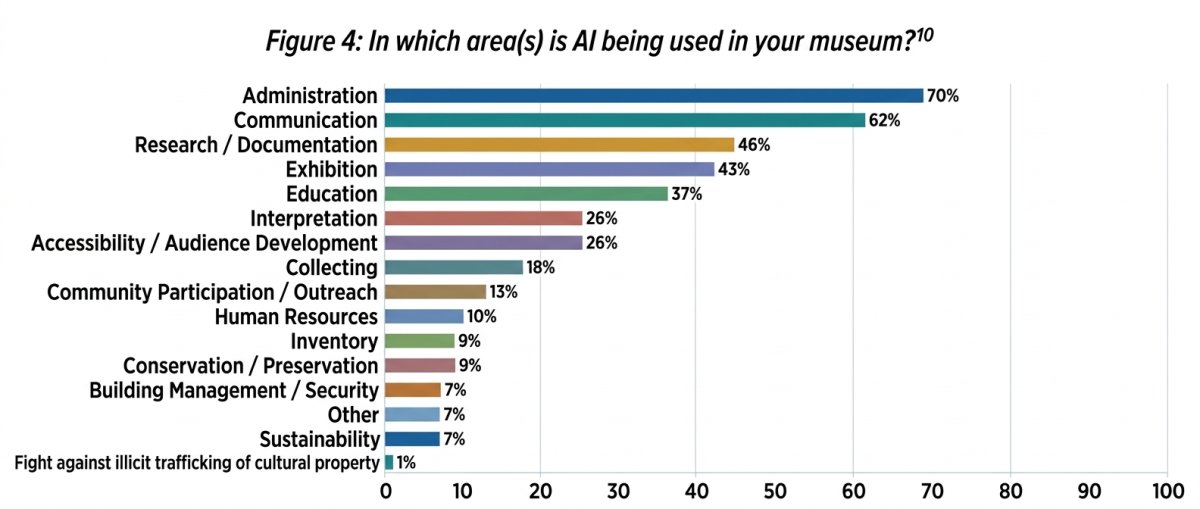
The picture is of a pragmatic, mostly administrative technology. Among museums that use AI, 78% apply it to understanding and analysing text, and the leading areas of use are administration (70%) and communication (62%) as seen in the chart below. Respondents describe drafting, translation, summarising and meeting notes far more often than anything that changes how a museum collects or interprets. The report itself reads current adoption as a productivity tool rather than a transformation of operations.
(click image to enlarge)
There are more ambitious cases. The Wellcome Collection in the United Kingdom uses language and vision models for handwritten-text recognition, semantic search and named-entity recognition across its collections. The Iraq Museum reports using AI to interpret fragments of an Assyrian relief. The National Museum of Lithuania is testing an AI photography assistant for digitisation and uses AI in cataloguing, with final decisions left to experts. The Fermanagh County Museum, also in the United Kingdom, uses AI to produce short videos of folklore and prehistoric stories that its budget would not otherwise have allowed.
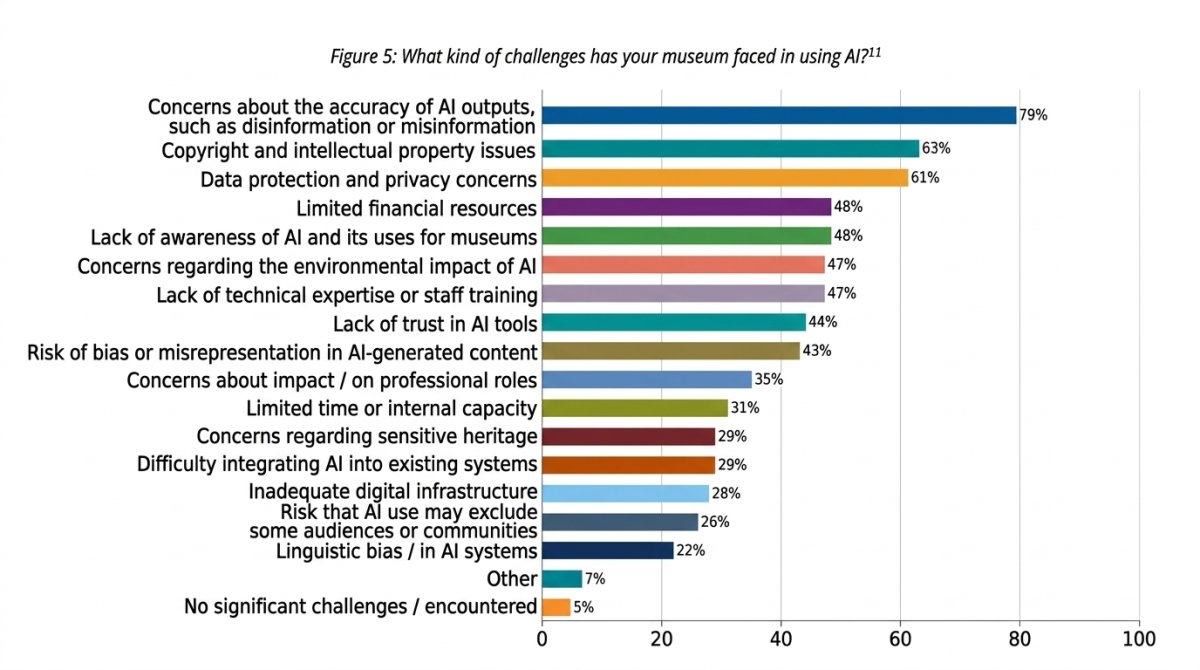
Accuracy is the most frequently reported difficulty (79% of AI-using museums), ahead of copyright and intellectual property (63%) and data protection (61%). The sector's answer is human review: 81% of AI users say outputs are always checked by a person before use or publication, and another 12% say usually.
The stakes are reputational. The report notes that museums are trusted providers of cultural and historical information, a position that inaccurate or opaque AI content could undermine. The Metropolitan Museum of Art reported pushback from some visitors. In New Zealand, the Riverton Heritage Museum consulted its audience about AI-generated promotional images, received mostly negative feedback and decided not to use them.
A two-speed sector
The survey's sharpest finding concerns capacity. Comparing museums with annual operating budgets below USD 100,000 to those with USD 1 million or more (click image to enlarge)
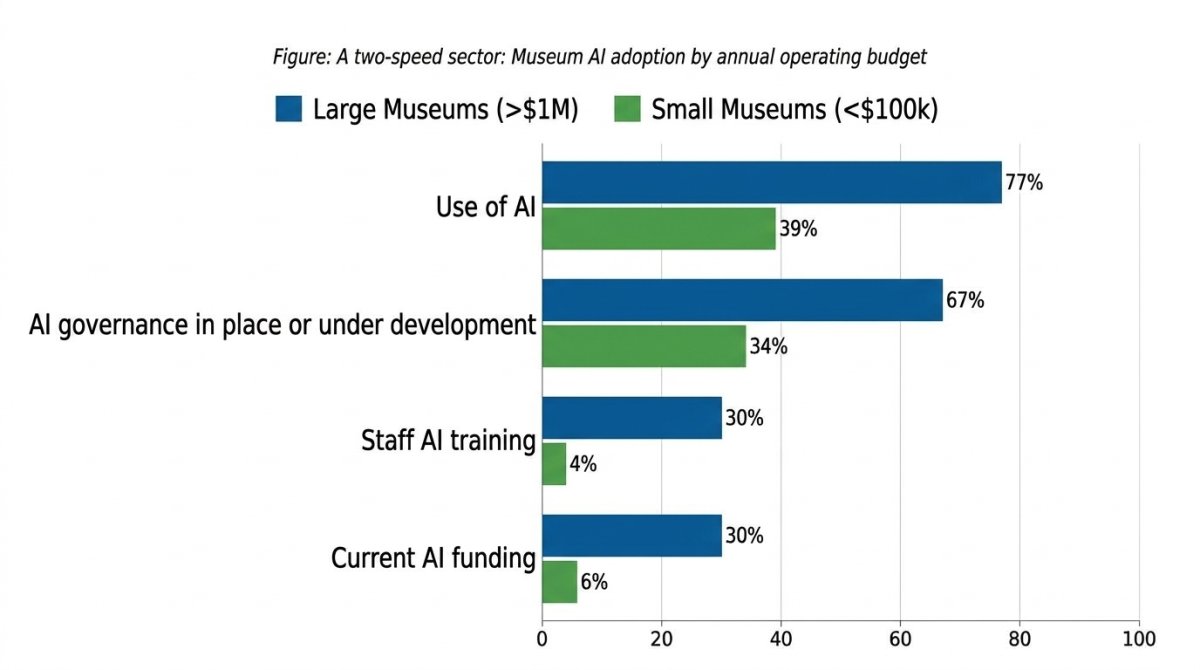
Across all respondents, only 4% have a dedicated AI budget line, 67% allocate no money to AI at all, and 17% train staff in its use. Just 21% of AI-using museums report improvements they consider measurable, while 65% say it is too early to tell. The authors conclude that experimentation is advancing faster than evaluation.
The report cautions that these differences do not prove causation, but they match what small museums say in their own words: limited staff, infrastructure and money, and little practical guidance. A Hungarian regional museum, the Jász Múzeum, called for "museum-specific AI guidelines and practical examples for smaller regional museums."
Dependency is a further risk. 84% of AI users rely on external tools or platforms and 51% on commercial off-the-shelf products. The report warns that heavy reliance on outside suppliers can weaken a museum's own ability to assess providers, govern data and meet ethical standards.
No guidance
For European museums, the lack of national guidance sits against a fast-moving EU backdrop. 62% of respondents say their country has no AI legislation or guidance covering museums. Of the 22% who report some framework, 91% point to broader AI rules rather than museum-specific ones. Several respondents named the EU AI Act and the GDPR as the frameworks they work within (click image to enlarge)
But the AI Act itself has been in flux. The Digital Omnibus on AI, politically agreed on 7 May 2026 and published in the Official Journal in July, postponed the high-risk obligations to 2 December 2027 for standalone systems and to 2 August 2028 for AI embedded in regulated products. The transparency duties in Article 50 began to apply on 2 August 2026. The one concession inside that article is extra time, until 2 December 2026, for providers to mark synthetic content in machine-readable form on systems already on the market. The AI literacy duty in Article 4 survives in softened form: providers and deployers must support the AI literacy of their staff rather than ensure a specific level.
What does this mean for museums? Most uses described in the survey, such as drafting, translation and cataloguing support, would not obviously fall into the high-risk categories, though that depends on the specific use. Museums are mainly deployers of tools built by others. The rules more likely to matter are transparency and literacy. Visitor-facing chatbots and AI-generated historical representations raise disclosure questions, and with only 17% of museums training staff, the literacy duty exposes a clear gap.
The right not to use AI
The report gives space to a quieter ethical argument. The Maasai Heritage Museum in Kenya developed MaasaiGPT with elders, youth and educators, built around community consent and Indigenous data sovereignty. Such collective forms of stewardship may not be fully captured by conventional data-protection frameworks. The Metropolitan Museum of Art argued that AI should be used only where it is the most appropriate tool, not simply because it is available. A few respondents went further and asked how to avoid encouraging AI use in museums at all (click image to enlarge)
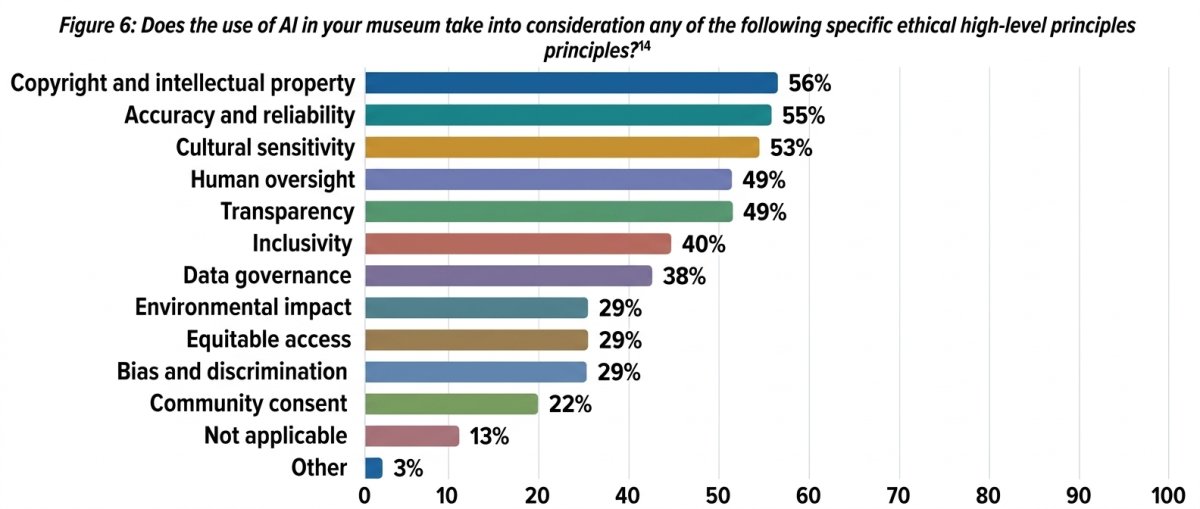
The authors draw a notable conclusion: capacity-building should help museums decide whether and when AI is appropriate, not assume that adoption is always the goal.
The requests are practical. 80% want technical training on using AI for core functions, 67% want guidance on ethical use, 62% on data governance and intellectual property rights, and 50% want an online peer-exchange platform. Awareness of existing norms is low: among AI users, 28% say the 2004 ICOM Code of Ethics guides their use, and 26% cite UNESCO's 2021 Recommendation on the Ethics of AI. Some respondents had not heard of the UNESCO instrument before the survey.
The report also spots areas where AI is barely used despite its importance to museum standards: only 9% of AI users apply it to inventory, and just 1% to fighting illicit trafficking of cultural property.
The survey's own conclusion is that future support should not only encourage adoption but help museums decide when, where and how to use AI, without disadvantaging small institutions or communities whose knowledge is collectively governed. For policymakers, the message is that the regulation debate and the daily reality in museum back offices are still some distance apart.
Image by Easy-Peasy AI