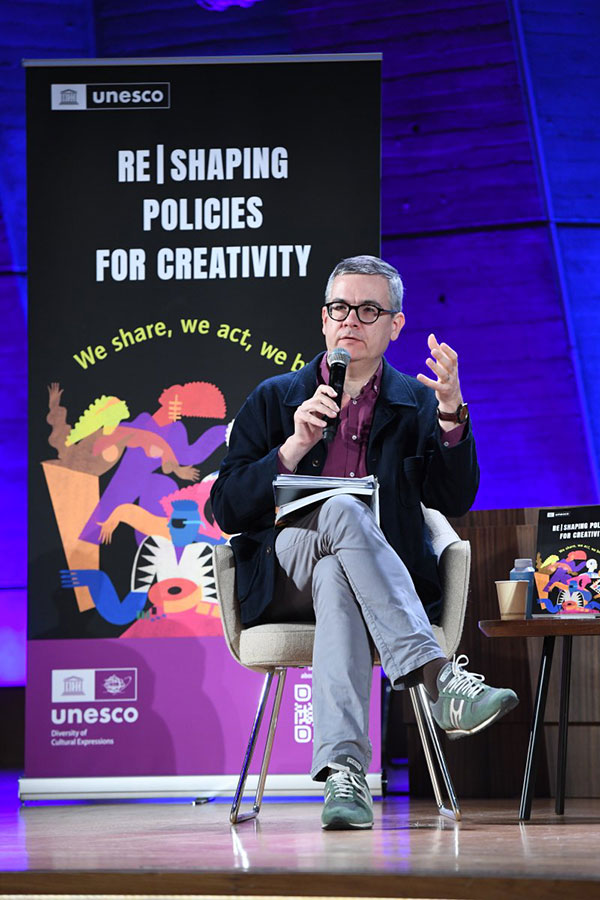



Generative AI could wipe out a quarter of music and audiovisual creators' revenues by 2028 — yet global policy responses remain slow. Jordi Baltà Portolés, principal editor of UNESCO's Re|Shaping Policies for Creativity report, warns that without urgent action, the most vulnerable artists will pay the highest price.
By Matthaios Tsimitakis
Anthropic made headlines recently, warning that AI could soon eliminate half of entry-level white-collar jobs. A company-commissioned study found no systematic rise in unemployment among heavily exposed workers so far, though hiring of younger workers in those fields has visibly slowed. CBS News Similar research from Yale's Budget Lab and a Danish labour market study reach comparable conclusions: the disruption is coming, but its shape is still forming.
In the interview, Jordi Baltà Portolés warns that GenAI could put 24% of music creators' and 21% of audiovisual creators' revenues at risk by 2028. He describes the ongoing revision of UNESCO's Monitoring Framework, calls for stronger national AI regulations, and supports a binding Additional Protocol to the 2005 Convention covering digital platforms — recently endorsed by the Convention's Intergovernmental Committee.
Jordi Baltà Portolés (Barcelona, 1976) is a researcher, consultant and trainer specialised in cultural policies, international relations and sustainability, with a particular focus on cultural diversity, cultural rights and local cultural policy. Between 2001 and 2014 he worked as a researcher and project coordinator at the Fundació Interarts, including the European Expert Network on Culture. He is an adviser to the Culture Committee of United Cities and Local Governments and a member of the UNESCO Group of Experts on the 2005 Convention on the Diversity of Cultural Expressions, for which he served as chief editor of both the 2022 and 2026 editions of the Re|Shaping Policies for Creativity report
CU: I should start with the report’s main finding that there will be 21–24% revenue losses for audiovisual and music creators by 2028 due to GenAI. In your view, are we heading toward a "cultural extinction event" for some independent creators - and perhaps especially in the Global South-, or is there time to reverse that trend?
JBP: It comes as no surprise that artificial intelligence appears as a cross-cutting challenge throughout the report, reinforcing trends we had already seen in the previous edition, in 2022. AI is addressed about its impact on intellectual property and remuneration, and the need to strengthen skills and capacities among artists and culture professionals. Also, about its effects on cultural and linguistic diversity, fundamental freedoms and gender equality. The lack of data transparency concerning AI, and of course policy responses in this field, at the national, regional and international levels, which are generally seen as slow and frequently failing to specifically address how AI impacts on the cultural field, are of concern too.
The report is a collective work, and it draws on a wide range of sources. It quotes a study on the economic impact of AI in music and audiovisual industries carried out by the International Confederation of Societies of Authors and Composers (CISAC) and PMP Strategy in 2024, which estimated that the market penetration by GenAI outputs could put 24% of music creators’ and 21% of audiovisual creators’ revenues at risk by 2028. These forecasts, and the range of developments we’re observing, including the slow adoption of policies and regulations in this field, are extremely concerning.
At the same time, the report presents evidence of some countries that have adopted some policies and measures in this area (including the EU’s Artificial Intelligence Act, the Republic of Korea’s work to protect the interests of rights holders, and the Creative Australia Principles on GenAI and creative work) and provides recommendations for subsequent policy developments. While GenAI will not go away, we need more awareness of its impact, adequate regulation, stronger capacities within governments, civil society and small and mid-sized operators, and new tools to continue supporting the creation, production and distribution of diverse, human-made content. The report also shows some potential opportunities provided by AI, including in enriching the creative process and in improving the dissemination of cultural expressions – this requires, however, adequate analysis and considered policymaking.
CU: You mention that the Monitoring Framework may need to be revised after the June 2025 Conference of the Parties. What new indicators should be added, especially regarding AI, platform discoverability, and artist precarity? Are there urgent measures that UNESCO should expect from governments before the next COP? And in your opinion, is there a realistic possibility for an Additional Protocol to the 2005 Convention specifically for TN and digital platforms?
JBP: The Monitoring Framework is the tool developed to evaluate the results of the Convention and to provide guidance for policymaking. It was first established around 2015, and it hasn’t been updated since 2019. Recent debates have shown it needs to be revised to make some issues more prominent, such as digitisation and AI, as well as how governments in developed countries provide preferential treatment to artists, culture professionals and cultural expressions from the Global South. A consultation process is currently underway to design a new framework, which should include new indicators addressing these issues and others. It is expected that the new Monitoring Framework will be in place next year, when governments and civil society actors are due to submit their next reports describing what policies and actions they have adopted, which should help us see how challenges like AI, platform discoverability and artist precarity are being addressed at the national and regional level.
As to the possibility of an Additional Protocol, the governments that comprise the Intergovernmental Committee of the Convention voted last month in favour of recommending this option, yet this will need to be discussed again next year by the Conference of the Parties of the Convention. For those who aren’t familiar with the term, the Protocol would operate as an annex to the Convention, providing more concrete commitments to protect and promote diverse cultural expressions in the digital environment in a binding form. However, because this would be a new tool, it would need to be signed and ratified by governments individually and would only be binding for those countries that did so. The recent endorsement by the Intergovernmental Committee is a positive step, I think, but since this will still take time, new regulations and policies should be adopted in this field earlier on, with the negotiations on the Protocol advancing in parallel.
CU: The report recommends embedding culture more firmly in the post-2030 development agenda as a global public good. Based on analysis of nearly 4,000 measures, what are the three most concrete and measurable actions that the report suggests that governments, particularly major cultural players such as the European Union, implement between 2027 and 2030?
JBP: It’s difficult to pick only three, but if we focus in particular on the need to anchor culture more strongly in the Post-2030 Development Agenda, measures should include advocating for a stronger recognition of culture in sustainable development frameworks, something which the EU and European governments should be expected to act on when the negotiation process at the UN starts.
Otherwise, because we observe a reduction in public spending on culture, particularly in developed countries, and the share of official development aid devoted to culture remains very low, these are areas that should be addressed. More generally, governments in the Global North need to make preferential treatment for cultural goods and services and artists and culture professionals from the Global South effective, as the Convention suggests. And, finally, it is necessary to scale up measures to enable access to culture, particularly targeting disadvantaged and vulnerable groups and low-income areas.
CU: The report highlights a persistent asymmetry in artist mobility, described as a "visa wall". Why have developed countries, including EU members, been so reluctant to open their markets to cultural goods and artists from the Global South?
JBP: The mobility of artists and culture professionals does not escape the security approaches that prevail across international relations and migration policies in many countries, and this operates as a barrier to the mobility of artists and culture professionals from the Global South. Decisions on the allocation of visas tend to be adopted by consulates and border officials, who frequently ignore the legitimate interest of artists to travel abroad as part of their professional development. While there are some good practices in raising awareness about this, and some countries in Europe and Africa have established protocols to facilitate the issuing of visas. There also seems to be an increasing number of visa rejections, which have very negative impacts on artists’ opportunities and mental health, as well as on the diversity of voices in European cultural life. In this respect, the report also shows that governments are much more likely to adopt policies to support the mobility of their artists when going abroad than to enable the arrival of foreign artists. This is something that should be rebalanced in the benefit of openness, cooperation and diversity.
CU: The convention emerged from the fear that culture would be reduced to a simple commodity. Twenty years later, with GenAI flooding the market and industrialising the production of culture at an unprecedented level, is that fear becoming a reality—or has the Convention provided us with the tools to prevent it?
JBP: I think the report provides a wide set of trends pointing in different directions. There is, of course, substantial evidence and detailed analyses on how GenAI threatens traditional forms of creative expression and related organisations and jobs. At the same time, if you look at developments at the global level, there is an increasing number of countries adopting cultural policies and measures at the national and subnational level, and more engagement of civil society organisations in developing them.
I also think that there is a more complex understanding of the value of cultural expressions, which goes beyond being reduced to a simple commodity. When you look at local communities, a substantial part of access to culture today is digitised and facilitated by digital platforms, but this coexists with other forms of cultural participation. Furthermore, changes brought about by GenAI are more visible in some sectors than others, and the effects of digital platforms also have different impacts across world regions. So, while the threat of seeing cultural expressions as mere commodities remains there, I think the reality is more complex than that – this also means that we need more sophisticated policies, including more engagement in how policies adopted by other ministries and governmental bodies, including those in areas like digitisation, international trade, education or social inclusion, affect cultural life.
CU: Following up, twenty years after the adoption of the Convention, you wrote that "strong foundations" now exist everywhere. However, public funding for culture remains below 0.6% of GDP globally, and development aid for culture is only 0.15%. Is the convention succeeding, or has it become a beautiful but underfunded declaration?
JBP: In the first few years after the Convention was adopted and came into force, one of the major aims was to support the establishment of basic infrastructures for cultural policy across the world. There were several countries that did not have a Ministry of Culture, decentralised competences for culture or had adopted a formal cultural policy, for instance.
The new report, on the other hand, shows that several of those indicators are now approaching universal coverage: 100% of countries that submitted a report have a ministry or agency with competencies and funding for culture, 92% have frameworks for interministerial cooperation, 90% have decentralised responsibilities for culture, and 81% collect cultural statistics. Since this report is also the one with the highest number of countries for which information is available (133), this points to the existence of strong foundations for policymaking.
However, it also points to the need to develop more sophisticated analyses, because, while the foundations are there, we need to be better at examining the actual impact of policies and how specific approaches lead to specific results. Public funding for culture at the national level, as well as the share of culture in international aid, remains a major hurdle. They also point to the need to improve the awareness of the Convention and of the diversity of cultural expressions more broadly among other ministerial departments, and particularly those that have a say in how budgets are distributed.
CU: As the principal editor of the report, what has surprised you most, positively or negatively, about the evolution of cultural policies over the past decade?
JBP: I’m not sure if it’s a surprise, but both this report and the previous one show that there has been an increasing attention to the working conditions of artists and culture professionals, with 74% of countries now having social protection measures in this field and initiatives such as Ireland’s Basic Income for the Arts Pilot Scheme or the adoption and updating of regulations on the status of the artist in many countries. This is, of course, the result of the more challenging reality that artists and culture professionals need to face in many contexts. It can also be related to a more visible rights-based discourse around cultural life. This comprises not only employment aspects but also an awareness of the links between fundamental freedoms and culture in the face of increasing challenges to freedom of artistic expression and, at least in some countries, the adoption of policies and legislation based on cultural rights, including the right to take part in cultural life.
CU: Who is actually "reshaping" policies for creativity in 2026: governments, platforms, or artists themselves? Who should hold the pen in the coming years? How can independent creators and civil society themselves participate more actively in implementing the report's recommendations, rather than just waiting for governments to act?
JBP: The governance of policies for creativity involves all those actors, as well as cultural organisations, citizens, etc. When writing a report like this, you need to rely on what governments will say, but that’s only part of the story – so the report combines governments’ responses with civil society contributions, international databases and many other sources. This should also be reflected in policymaking processes. The report provides many recommendations for governments to act upon, and civil society organisations can adapt them to their specific circumstances and use them for advocacy or lobbying purposes. I hope that the evidence presented throughout the report, which is substantial, can help strengthen arguments for policy change.