



The European Commission's new Strategy on Intergenerational Fairness introduces an index to measure countries' performance in protecting future generations, alongside a multilingual future literacy package for public administrations and a demography forum to address emerging demographic challenges across the European Union.
By Creatives Unite NewsroomOn March 5, 2026, the European Commission adopted its first Strategy on Intergenerational Fairness to further develop the reflex of long-term thinking in EU policymaking while giving greater weight to the views and concerns of young people. Commissioner for Intergenerational Fairness, Youth, Culture, and Sport, Glenn Micallef, unveiled the strategy as a 12-page roadmap to secure sustainable, future-focused policymaking across the European Union.
The strategy was jointly presented by Roxana Mînzatu, Executive Vice-President for Social Rights and Skills, Quality Jobs and Preparedness, and Commissioner Micallef at a press conference on Thursday. Micallef was blunt about what the document does and does not do: "The intergenerational fairness strategy proposes an intergenerational fairness contract. This is a symbolic contract. It's not a contract that we sign, but it reflects a commitment. It reflects a promise that we make politically."
The strategy traces its mandate to the Commission's 2024–2029 political guidelines, in which President von der Leyen stated that the EU must guarantee that "decisions taken today do not harm the future generations and that there is increased solidarity and engagement between people of different ages," tasking Commissioner Micallef to come up with a strategy.
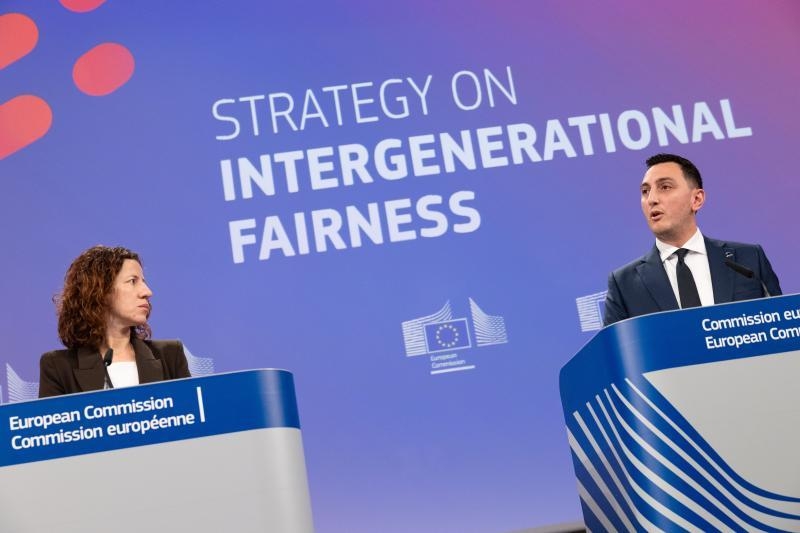
The strategy was developed through four connected phases—scoping, visioning, ideation, and co-creation—led by the Joint Research Centre's EU Policy Lab, which brought together citizens, experts, and institutions throughout 2025.
The European Citizens' Panel on Intergenerational Fairness was organised by the Directorate-General for Education, Youth, Sport and Culture, together with the Joint Research Centre and the Directorate-General for Communication, between September 12 and November 16, 2025. Over three weekends, the panel brought together 150 randomly selected citizens from all 27 member states, who were tasked with answering: "What should we do today to make the European Union fair for all current and future generations?" These 150 citizens delivered 24 recommendations on fostering fairness across generations.
The Citizens' Engagement Platform, which ran in parallel between February 25 and November 30, 2025, recorded 354,041 page views, 215,000 visitors, and 179 contributions. The separate call for evidence closed on November 11, 2025, and received 106 contributions—28 from EU citizens, 46 from NGOs, 3 from public authorities, 9 from business associations, 5 from environmental organisations, 3 from academic and research institutions, and 2 from companies.
The strategy is shaped around the concept of an "intergenerational contract", built on a threefold foundation: fair policymaking, by applying a "youth check" and foresight tools; fair opportunities, to address the risk of age discrimination; and fair places, so that regional and territorial disparities do not leave communities behind. It promotes policy approaches that combine economic prosperity and well-being, environmental responsibility, social and territorial cohesion, fiscal sustainability, and democratic participation.
Intergenerational Fairness Index: The Commission will develop an intergenerational fairness index to measure how well countries are protecting the future of younger and future generations, helping identify opportunities and gaps, informing policy decisions, and promoting fairness across generations.
Multilingual Future-Oriented Policymaking Package: A multilingual future-orientated policymaking package will be introduced to strengthen "future literacy" within public administrations across EU Member States.
Demography Forum: A dedicated Demography Forum will be organised to exchange views on demographic developments.
Voices of the Future: The initiative will be launched in partnership with the Committee of the Regions, inviting local and regional authorities to engage in shaping their regions' futures.
The strategy also directs the European Group on Ethics in Science and New Technologies to recommend fair AI and digital policies and to integrate intergenerational considerations into the Multiannual Financial Framework through the European Social Fund+ and the European Semester.
The strategy builds on existing EU policy instruments and aligns with the UN Declaration on Future Generations. It references the 2023 Communication on Demographic Change, which placed fairness between generations at the heart of policy, and the 2025 Strategic Foresight Report, which named intergenerational fairness as one of eight key priorities.
Additional policy touchstones include the European Child Guarantee, the European Care Strategy, the Union of Skills framework adopted in 2025, and a Longevity Roadmap, which will support mapping of age-specific policy issues for all age groups.
Almost half of Europeans believe they have equal opportunities in life, according to a 2023 Eurobarometer survey, a finding that underpins the strategy's focus on reducing perceived inequality.
A progress report on the strategy will be published in 2028, intended in part to inform UN follow-up processes on future generations. The Commission will also publish several reports on social protection systems in 2027.
The strategy has drawn some pushback from civil society organisations representing older Europeans. AGE Platform Europe, which actively contributed to the consultation process and submitted a proposal for an EU Action Plan to Combat Ageism—the most widely endorsed recommendation during the citizens' consultations—noted that the proposal was not reflected in the final strategy.
The organisation argued that the strategy falls short of setting out a comprehensive and transversal approach to age equality across all areas of life, stating, "We are concerned that age discrimination remains largely invisible in a strategy that should have placed equality across generations at its core."
When challenged at the launch on whether the Commission's deregulation push—through its so-called "omnibus" legislative packages—risked undermining the strategy's environmental commitments, Micallef responded, "The simplification agenda is about reducing administrative burdens and simplifying the processes, not about going back on principles that were already established."
Candidate and potential candidate countries will be invited to participate in the strategy's actions alongside EU member states wherever possible and feasible. The Intergenerational Fairness Index, once operational, will serve as the key benchmark for measuring whether the "intergenerational contract" is being honoured in practice ahead of the 2028 progress report.