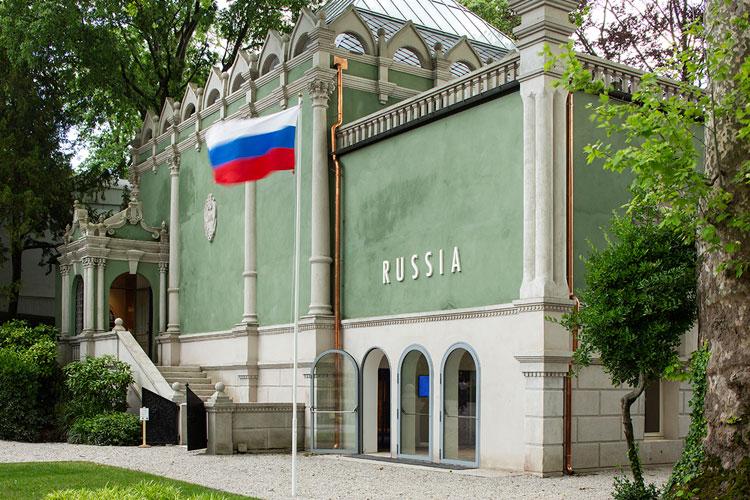


The European Commission has formally recommended terminating a €2 million grant to the Venice Biennale, the culmination of a four-month confrontation between Brussels and the world's oldest contemporary art exhibition over its decision to allow Russia back into its national pavilions. The European Commission says the Biennale’s explanation was not sufficient and has backed the termination or suspension of the grant, which covers the 2025-2028 period.
Henna Virkkunen, the Commission's Executive Vice-President for Tech Sovereignty, Security and Democracy, announced the recommendation on X on July 11: "The Commission officially recommends EACEA to terminate the €2 million grant to the Venice Biennale. This follows a thorough assessment of the replies from the Biennale to justify the reopening of Russia's pavilion [sic]." In a follow-up reply to her own post, she added: "Culture in Europe – funded with taxpayers' money – should promote and safeguard democratic values. These values are not respected in today's Russia."
The row began in March, when Brussels warned that it would end or suspend support if organisers went ahead with plans to permit Russia back into the event. By April, the Commission had formally notified the Biennale of its intention to cut the money, saying the decision followed a breach of the terms under which the grant had been awarded.
The Biennale’s board had responded by defending the event as a forum for dialogue rather than a political court. In a speech reported by Reuters, the foundation’s president said the exhibition was “a space of dialogue to prepare peace” and not “a court”, while also insisting that the Biennale cannot simply bar a pavilion from a country recognised by Italy.
A few days later, on March 10, Henna Virkkunen and Glenn Micallef, the EU's commissioner for Intergenerational Fairness, Youth, Culture and Sport, issued a joint statement warning that "this decision by the Fondazione Biennale is not compatible with the EU's collective response to Russia's brutal aggression" and that Brussels would "examine further action, including the suspension or termination" of the grant if the Foundation went ahead.
Twenty-two EU culture ministers wrote separately to the Biennale's board, joined by 37 MEPs calling for a funding suspension, while Kyiv and 21 other EU states warned that "granting Russia a prestigious international cultural platform sends a deeply troubling signal".
The row also split the Biennale's own jury. On April 22, its five members — Solange Farkas (president), Zoe Butt, Elvira Dyangani Ose, Marta Kuzma and Giovanna Zapperi — published a "Statement of Intention" on e-flux saying they would not consider prizes for artists representing countries whose leaders face International Criminal Court charges — understood, without either being named, to cover Russia over President Vladimir Putin (indicted 2023) and Israel over Prime Minister Benjamin Netanyahu (indicted 2024).
On April 30, the same five jurors resigned in a one-line statement on e-flux: "As of 30 April 2026, we, the international jury selected by Koyo Kouoh... have resigned. We do so in acknowledgement of our Statement of Intention." La Biennale confirmed the resignations in its own press release the same day and postponed its awards ceremony from May 9 to November 22, replacing the jury-selected Golden and Silver Lions with two visitor-voted "Lions" open to all national participants.
The Commission's position echoes conclusions of the European Council on June 18–19, which stated that "as long as there is no just and lasting peace in Ukraine, there should not be a normalisation of Russia's participation in international sports and cultural events".
The current Commission recommendation is not the final word. The €2 million covers the Biennale Foundation's international co-operation activities for 2025–2028 under the Creative Europe programme, and the binding decision rests with the European Education and Culture Executive Agency (EACEA), which administers EU cultural grants. The agency had already signalled it favoured the cut before Virkkunen's announcement.
Should EACEA confirm it, the Biennale says the sum covers only a marginal part of its overall programming, and the exhibition will continue regardless.
While the funding at stake is modest in the context of the Biennale’s wider finances, the symbolism is considerable. The dispute has become a test case for how far an EU-funded cultural institution can claim neutrality when its programming collides with the Union’s foreign-policy objectives.