



The European Commission's mid-term review reveals significant momentum for Europe's social economy, with 21 member states developing strategies and substantial funding allocated, while acknowledging persistent inequalities among member states regarding growth and recognition of the sector.
By Creatives Unite Newsroom
The European Commission has published a mid-term review of its Social Economy Action Plan, the programme launched in December 2021 to strengthen the bloc's patchwork of co-operatives, mutuals, charities and social enterprises, a sector that, by Brussels's own count, encompasses more than 4.3 million organisations and sustains 11.5 million jobs across the EU.
The report, published on Monday, assesses progress since the plan's adoption and sets out priorities for the remaining years to 2030. It's the first formal stocktake of an initiative designed to bring greater coherence to a sector whose legal recognition and access to public funding have historically varied sharply between member states; the social economy's share of employment ranges from under 1 per cent in some countries to nearly 10 per cent in others, against an EU average of 6.3 per cent.
 The headline figures make reasonably encouraging reading for the Commission. Twenty-one of the EU's 27 member states have either adopted or are in the process of preparing national or regional social economy strategies, and 12 have passed legislation to improve recognition and operating conditions for social economy actors. More than €1.62 billion in EU funds and around €1.2 billion in InvestEU guarantees have been directed towards the sector for the 2021–2027 budgetary period.
Roxana Mînzatu, the Commission's Executive Vice-President for Social Rights and Skills, Quality Jobs and Preparedness, made the case for the sector's relevance beyond its obvious social purpose. "As Europe faces geopolitical challenges, industrial transformation and growing social pressures, the social economy is increasingly becoming a driver of resilience, inclusion and competitiveness," she said. She added that social economy organisations provide affordable housing and deliver care services, two areas of acute political sensitivity across the continent, but conceded that more must be done.
The review identifies a series of persistent weaknesses. State aid rules remain unclear for many social economy operators, deterring growth and investment. Frameworks for private social investment and blended finance are fragmented. Honestly, data collection across member states is still patchy, making it difficult to measure impact consistently. The Commission intends to address each of these through further action, including a practical toolkit to help regional and local authorities design tailored policies.
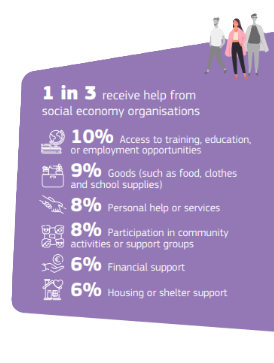 The report includes a special mention of the interrelation of culture with the social economy sector: 'Social economy organisations are drivers of Europe’s cultural vitality, creative innovation and sustainable tourism. They preserve and promote cultural heritage, providing accessible spaces for cultural participation and community life in neighbourhoods and rural areas." In the creative and cultural industries, the social economy nurtures experimentation, collaboration, and shared ownership across sectors such as media, performing arts, design, and crafts.
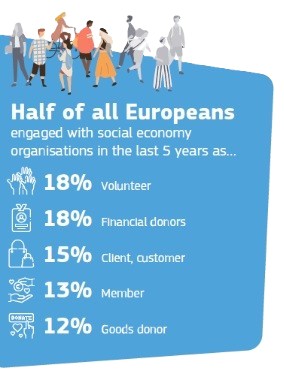
The findings draw on a special Eurobarometer survey published in October 2025, which found that three-quarters of Europeans consider the social economy important for society's well-being and that roughly half had engaged with a social economy organisation in some form, typically through volunteering, donations or as customers, over the preceding five years. The same survey found that 93 per cent of respondents believed businesses should be guided by social economy values such as reinvesting profits in communities and operating democratically.
Despite widespread public support, the report acknowledges that social economy organisations still face uneven access to markets and finance. The Commission's ambition is to make the sector more competitive and better recognised before the plan's 2030 deadline.