


https://culture.ec.europa.eu/news/seven-finalists-announced-for-the-2026-eu-prize-for-contemporary-architecture
On 5 February 2026 the European Commission and Fundació Mies van der Rohe revealed the seven finalists for the 2026 EU Prize for Contemporary Architecture – Mies van der Rohe Award. Selected from 410 nominations and a 40-project shortlist by a jury chaired by Smiljan Radić, the works embody the prize’s core mission: recognising excellence and innovation while spotlighting architecture’s role in Europe’s sustainable and inclusive transformation.
Five projects compete in the main Architecture category (€60,000 prize); two in the Emerging category (€30,000). Winners will be announced on 16 April 2026 in Oulu, Finland (European Capital of Culture), with the awards ceremony in May at the Mies van der Rohe Pavilion in Barcelona. What unites them all? A profound human focus, material honesty, and the intelligent reuse or gentle insertion of architecture into real places and real lives.
Charleroi Palais des Expositions: Opening the 1950s Giant to the City
In post-industrial Charleroi, Belgium, AgwA (Brussels) and architecten jan de vylder inge vinck (Ghent) have turned a monolithic 1950s convention centre into a generous public destination. Instead of demolition, they opened the once-closed central hall to create flowing interior public space and replaced surrounding hard paving with a continuous green park. The result preserves the building’s original robust character while dramatically improving accessibility and environmental quality – a textbook example of sensitive regeneration in a city that needs it most.
Rehabilitation of Vapor Cortès – Prodis 1923: A New Street for an Inclusive Future
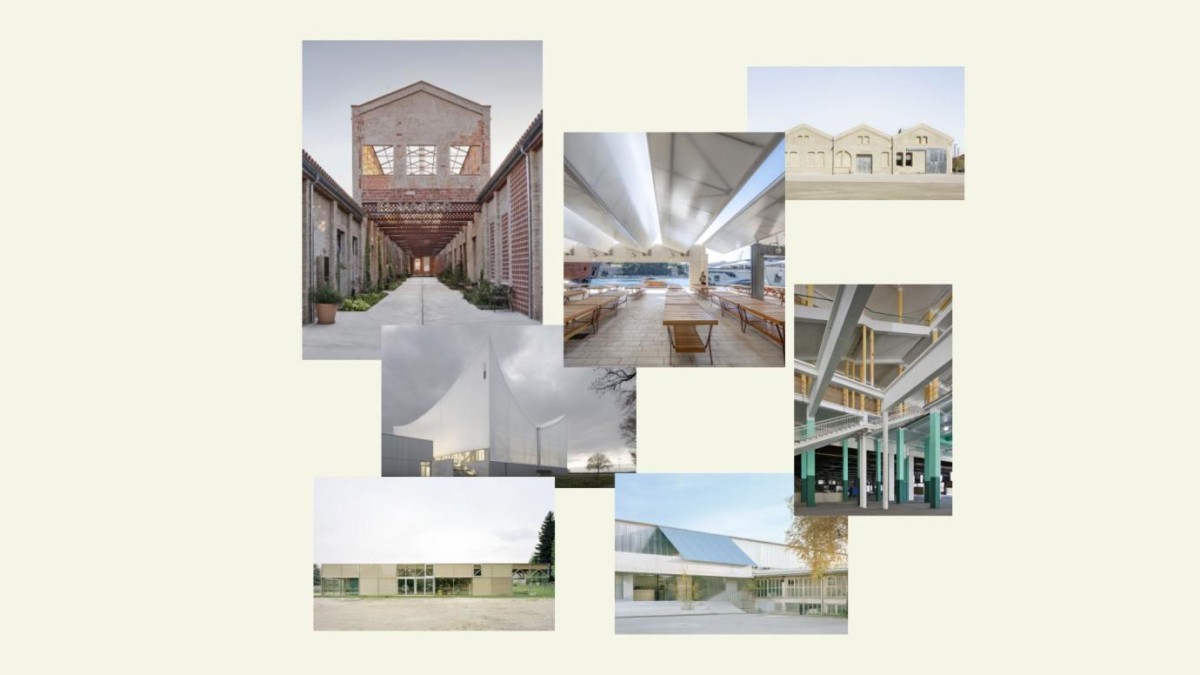
H ARQUITECTES (David Lorente, Josep Ricart, Xavier Ros, Roger Tudó) transformed early-20th-century industrial warehouses in Terrassa, Catalonia, into the new headquarters and workshops for PRODIS, a foundation supporting people with intellectual disabilities. The architects recovered a historic service passage and turned it into a new public “boulevard” that stitches the complex back into the city fabric. Brick walls remain, new wooden structures and skylights bring light and passive climate control, delivering both social inclusion and architectural poetry.
Lot 8, LUMA Arles – Renovation of Le Magasin Électrique: A Bioregional Design Lab
In Arles, Atelier Luma, BC architects & studies and ASSEMBLE have converted a 19th-century railway depot into a living laboratory for regenerative design. Using only materials and knowledge from the Camargue region, the project demonstrates circular, socially engaged architecture at scale. Part of the wider LUMA Arles campus, it proves that industrial heritage can become a catalyst for local innovation and ecological thinking.
Josephine Baker – Marie-José Perec Sports and Cultural Centre: A Landmark for a Small Town
In rural La Bouëxière, Brittany, French studio onze04 (Gustavo Silva-Nicoletti) designed a new multi-purpose sports and cultural centre that hosts regional competitions and daily community life. A striking textile roof floods the main hall with natural light and ventilation; the building carefully integrates existing facilities and reconnects fragmented neighbourhoods. It is both functional landmark and quiet urban healer.
Gruž Market, Dubrovnik: A Floating Canopy for Heritage and Shelter
In the historic Gruž neighbourhood of Dubrovnik, Croatian practice ARP / Peračić-Veljačić (Dinko Peračić, Miranda Veljačić) placed a lightweight, adjustable canopy over the market square. The optimistic, almost sculptural roof provides climatic protection, restores spatial integrity to the square, revives heritage, and gives the city a fresh public identity – all with minimal intervention and maximum generosity.
Multi-Service Cultural Centre Le Foirail, Laguiole: A Radical, Reversible Rural Hall
In the small Occitan town of Laguiole, Betillon & Freyermuth and Crypto Architectes created an open, adaptable public hall using local resources and reversible construction techniques. Designed to evolve with the community’s needs – library, music venue, youth space, civic gathering point – the project rejects nostalgia in favour of honest, flexible rural architecture that strengthens local identity without imitating the past.
Temporary Spaces for Slovenian National Theatre Drama, Ljubljana: Industrial Hall Becomes Cultural Heart
When Ljubljana’s historic theatre closed for renovation, Vidic Grohar Arhitekti (Anja Vidic, Jure Grohar) turned a derelict 1960s industrial hall on the city’s edge into a fully functioning temporary national theatre. With low-budget, high-impact interventions completed in record time, the project proves that temporary architecture can be culturally ambitious, programmatically complete and publicly beloved – breathing new life into an overlooked industrial zone.
Across Belgium, Spain, France (three projects), Croatia and Slovenia, the finalists demonstrate a shared European language: context before spectacle, reuse before new build, people before ego. They show how architecture can respond to climate urgency, social inequality and cultural continuity without sacrificing beauty or rigour.
The jury praised their “strong focus on the human dimension” and their ability to balance “innovation and sensitivity to context”. In an age of political, environmental and social challenges, these projects quietly reaffirm that thoughtful design still improves everyday life.
The final winners will be revealed in April. Until then, these seven already stand as beacons of what contemporary European architecture can – and should – be.