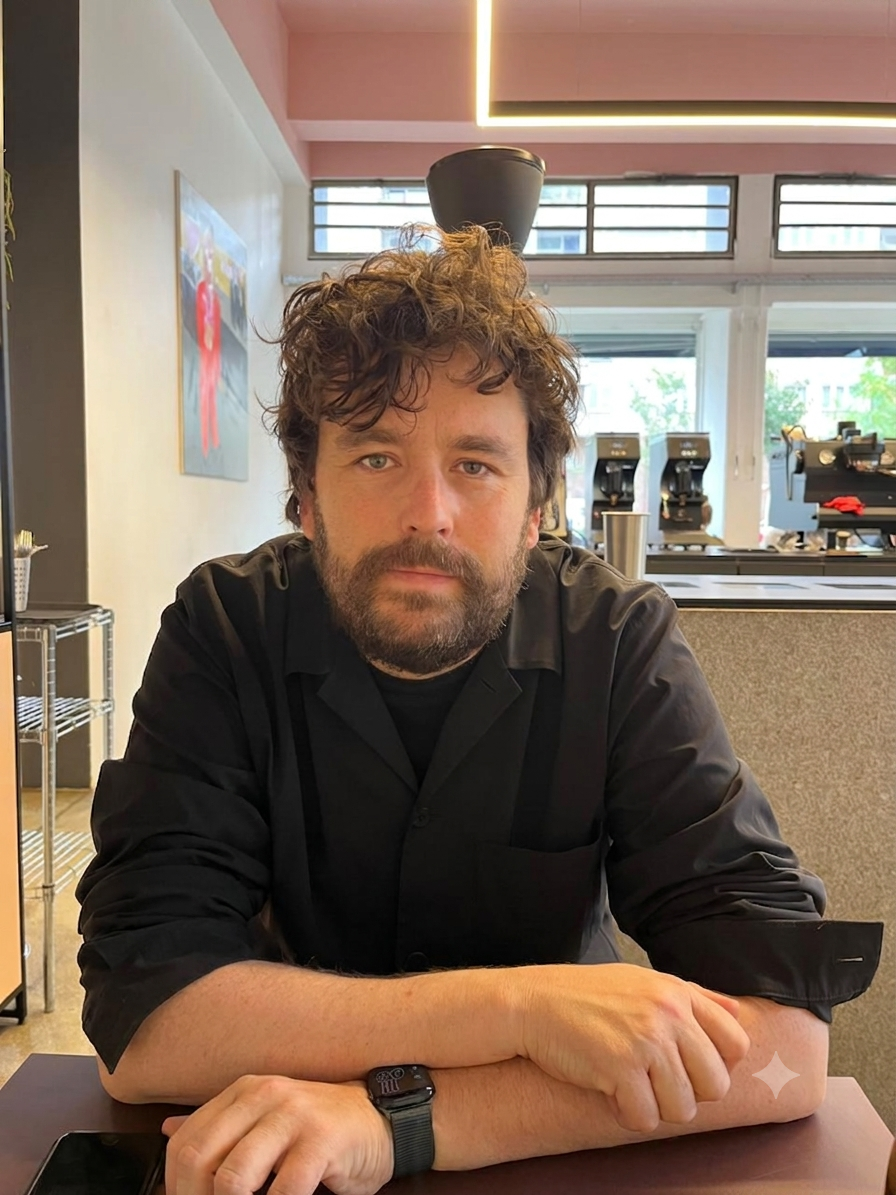


Arthur Steiner co-founded the agency New Silk Roads after travelling the ancient Silk Road from Asia through the Middle East to Europe. The agency operates primarily in North Africa and Europe. They work with cultural institutions, artists, start-ups, investors, UN agencies and philanthropic foundations, offering research, facilitation, coaching and strategic advice. He believes that innovation does not flow from centre to periphery. It emerges from the margins, from distributed networks, from communities that have been quietly developing their own solutions for centuries.
I met Arthur Steiner for the first time when he and Martijn Blom were working on a feasibility study towards a cultural and creative impact investing fund for DOEN Ventures in the Netherlands. This study was published in 2025 and spurred a lot of discussion on the possibilities of impact investing in the cultural and creative sector.
Q: Impact investing is a concept with growing attention, also in the cultural and creative sectors. But what is it?
A: Impact investing has emerged in the last decades as a new form of investment between philanthropy and traditional investments. In essence these are investments with the intention of generating positive social or ecological impact alongside financial returns. This raises a lot of questions: what is impact, how do you measure it and what kind of investing works best for the cultural and creative sector. There is strong evidence that art and culture has the power to unleash system-level change. They strengthen democratic culture, health and wellbeing, and most importantly they change hearts and minds. But many investors do not know how the cultural sector operates, its value and its peculiarities. This is the gap we are working to close. Together with Martijn Blom of 100Funds, we have spent the last few years researching, convening and organising workshops and events across Europe, creating the conditions for investors, financiers and cultural operators to find each other, and to build something meaningful together. Elsewhere, impact investment in culture already exists. In the United Kingfom, Figurative, manages a £16 million social impact investment fund supporting socially driven arts, culture, and heritage organisations through flexible repayable finance. In the United States, Upstart Co-Lab has become one of the global pioneers of impact investing in the creative economy, and in Canada, they are building a “Arts & Social Finance” fund. The idea is to introduce repayable capital, loans, hybrid finance, potentially revenue-based finance, into the cultural sector as a complement to grants and philanthropy, not as a replacement.
Q: In the feasibility study for DOEN Ventures you describe the existent gap between impact investors and the cultural sector. What is this gap?
A: Impact investors look for initiatives that combine financial sustainability with measurable social or ecological outcomes, ventures that demonstrate not only that they can generate financial returns, but that those returns are inseparable from the positive change they create. In the cultural sector there are a lot of ventures working with hybrid business models and a continuously changing patchwork of revenue streams, but they are not familiar with the jargon and metrics of impact investors. Also many within the sector are unaware of the difference between impact investors and conventional investors. And investors do not know the tangible and intangible assets of the cultural sector, let alone how to value those and how to measure their impact. And their existing investment models based on technology-driven startups often do not apply. So there is a lot of work to do on both sides.
Q: You also cooperated on a recent Dutch UNESCO-report, named Priceless, focusing on heritage communities, where you describe 5 directions towards changing the way heritage communities can be financed. What are those directions?
A: Many heritage communities, especially originating from underserved communities, function outside existing funding structures, they are informal or hybrid (f.e. combining donations and commercial activities) networks or collectives and do not fit in the strict separation between non-profit or profit. And the Dutch UNESCO Committee is looking for alternative funding modes for these initiatives beyond the traditional top-down approach. We found 22 inspiring practices in 5 categories:
Open and transparent dialogue between funders and funded, f.e. by using intermediaries within the community or simplifying application processes through events in cooperation with the community.
Trust-based philanthropy is a growing global movement that fundamentally reimagines the relationship between funders and recipients, shifting from a transactional, funder-driven model towards one rooted in shared power, mutual accountability and genuine partnership.
Participatory grant-making is a way to give heritage communities decisive influence on funding decisions. F.e. by choosing representatives of communities for the deciding panel or to provide funds to an assembly of groups which decide collectively on the division of money.
Peer-2-peer financing. Examples are crowdfunding or combinations of crowdfunding and matchfunding by formal funds and also membership or fan platforms such as Metalabel which enables communities to collectively finance, produce, and distribute artistic works.
Revolving funds. The Boston Ujima Project runs a cooperative venture capital fund through participative decision making for neighbourhood creative entrepreneurs with a positive impact on the community through products, services and job creation. Another inspiring model is the Lease-to-own model by HEVA Fund in East Africa where f.e. craftspeople can acquire machines to support their work. At the end of the lease period they own their machinery.
In the report you will find more examples.
Q: In the cultural sector there is a lot of discussion on how to measure impact. Should it be qualitative and through creative means or should it be quantitative to have more convincing proof towards investors?
A: It is important to make a distinction between “effect” and “affect”. Effects are usually measurable, but maybe the most important impact occurs on an individual level: emotions are stirred, perceptions shift, and meaning is felt in the body before it is understood by the mind. And over time these changes ripple outward into a broader cultural shift in society. This slower, deeper transformation is harder to count, but it may be the most powerful thing culture does.So we need a constant balancing act between looking at the metrics of an impact domain outside the arts (like health, climate, innovation, etc.) and the affective realm.
When looking at impact I like the Creatures-framework, used in the UNESCO-report, which shows 9 aspects of impact. It revolves around 3 dimensions, Changing Meaning (through embodying, learning and imagining), Changing Connections (through caring, organising and inspiring), and Changing Power (through co-creating, empowering and subverting).
But the discussion on impact investing in the cultural and creative sector, is far from over, it is just beginning.