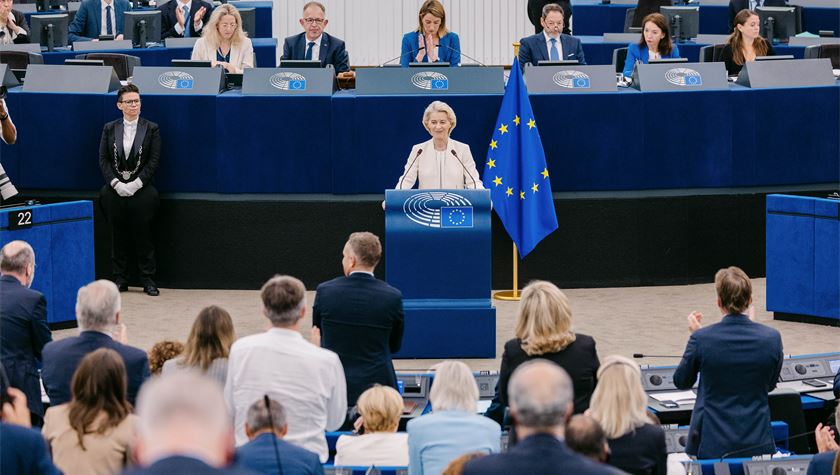

When Ursula von der Leyen rose in Strasbourg on September 16 to deliver her second State of the Union address, the bulk of her hour-long speech went to the themes now dominating Brussels: European security, the trade stand-off with China, artificial intelligence, and a striking new "associate membership" offer to Canada. Culture featured only once, right at the close of the address — but as a deliberate, symbolically loaded flourish rather than an afterthought.
Mrs von der Leyen announced that in 2027, to mark the 70th anniversary of the Treaty of Rome, the Commission will convene a new Congress of Europe, explicitly modelled on the 1948 gathering in The Hague that helped set the continent on the road to integration. She wanted Europe's most creative and intellectual figures, together with citizens and civil society representatives from across the Union and the wider continent, to help "reclaim our European imagination" for a new generation.
It was a striking image in a speech otherwise dominated by hard security and industrial policy — and, notably, the only new cultural announcement in the entire address. There was no mention of a budget for AgoraEU, the programme meant to succeed Creative Europe; no update on the long-promised EU Artists' Charter; no word on a proposed EU Artistic Freedom Act. For a sector that has spent the past year lobbying hard for exactly that kind of specificity, the gap was conspicuous.
The speech came three months after the EU's three main institutions — the Commission, Parliament and Council, then under Cyprus's rotating presidency — signed a joint declaration titled "Europe for Culture, Culture for Europe" on June 18, the first time the three bodies had united behind a single political statement on culture. It built on the Commission's Culture Compass strategy, adopted the previous November under Glenn Micallef, the Commissioner for Intergenerational Fairness, Culture, Youth and Sport, which set out plans for an EU Artists Charter, a new Cultural Data Hub and an AI strategy for the cultural sectors. Signing the declaration, Mrs von der Leyen said culture lay at the core of Europe's identity.
That recognition is why Culture Action Europe (CAE), one of the sector's largest pan-European networks, struck a markedly warmer tone in its pre-speech letter to Mrs von der Leyen than it had a year earlier, when it complained the sector had been left off the Commission's agenda altogether. Writing on August 27, CAE told the Commission president culture was now "finally present" — but warned that presence was not the same as delivery.
Likewise, ahead of the 2026 State of the European Union address, Europa Nostra sent a letter urging European Commission President Ursula von der Leyen to position cultural heritage at the core of the EU's political agenda. The organisation commended recent milestones, including the Culture Compass for Europe, and emphasised that cultural heritage serves as a strategic asset for Europe's resilience, security, and democratic cohesion.
Culture Action Europe (CAE) expressed mixed feelings regarding the 2026 State of the European Union (SOTEU) address, noting a sharp contrast between its rhetorical commitment to European values and its complete omission of concrete sectoral support for culture. On one hand, the network welcomed the address's focus on protecting Europe's social model, defending fundamental rights, and proposing a Congress of Europe—an initiative that could provide a vital space for artists to help shape a new vision for the continent.
On the other hand, the address marked 1,099 days since cultural diversity was last explicitly mentioned in a SOTEU speech, reducing culture to an invisible enabler of democracy rather than a recognised industry. Furthermore, CAE criticised the speech for praising AI and data treasures while ignoring copyright exploitation, failing to address rising censorship with an EU-wide protection for artistic freedom, and leaving the precarious working conditions of cultural workers unaddressed by upcoming labour initiatives like the Quality Jobs Act.
Wider reaction to the speech has so far been thin, but one post-speech analysis, compiled by the Brussels-focused EU-affairs blog Der (europäische) Föderalist, flagged a gap in a similar tone. Sophie Pornschlegel pointed out that EU funding for democratic resilience broadly — the budget area that also underwrites civil society, independent media and the cultural sector — currently amounts to only around 0.5 per cent of the entire EU budget. Cuts there would yield minimal savings, she argued, while falling disproportionately on those same actors—an issue Mrs von der Leyen did not raise in her address.
CAE's letter to Mrs von der Leyen ahead of the SOTEU speech anticipated exactly this : whether a year of political recognition — the Culture Compass, the joint declaration, now the promise of a new Congress — will be followed, in budget negotiations that EU leaders hope to conclude by the end of the year, by money, seats at the table and enforceable protection for artistic freedom. Consequently, the organisation continues to demand structural reforms, specifically pushing for an EU Artistic Freedom Act, a larger cultural budget, and an EU Artists' Charter.
On a more positive note, policy expert Elena Polivtseva underlines that the tone in this year's State of the Union address has clearly shifted from 2025. Last year’s call for Europe's independence and autonomous path has led to greater confidence that this path has now been chosen and "culture has a place". The Congress of Europe announcement gives the cultural sector a genuine, if still undefined, role in shaping how Europe imagines its own future, rather than treating it merely as a contributor to tourism or growth statistics. As Elena Polivtsevna notes in her analysis, "imagination, future-making and the capacity to envision alternatives are precisely where art and culture should be central to Europe’s political thinking." Without that contribution, who will shape Europe's future narrative, and what future might that be is anyone's guess.
Image: State of the Union Address 2026 by Ursula von der Leyen, President of the European Commission, on Sept. 16. (European Union, 2026)