For three years, 36 experts from 25 EU member states — with additional input from Georgia, Iceland, Moldova, Norway, Switzerland, Türkiye, Ukraine and the United Kingdom — worked through a question that needs a new answer in 2026: What, exactly, are public libraries for now?
Their answer, published this summer by the European Commission's Directorate-General for Education, Youth, Sport and Culture, is the first high-level EU report devoted entirely to public libraries. Titled Strengthening Europe through public libraries, it was commissioned by a 2023 Council of the European Union mandate and carries a joint foreword from Executive Vice-President Roxana Mînzatu and Commissioner Glenn Micallef. Its conclusion: libraries have quietly become one of the few pieces of public infrastructure that show up for citizens in a language class, a disinformation workshop, a heatwave shelter and a wartime bomb shelter alike – and most governments, including those at the EU level, are not treating them that way.
A scale most people don't see
The raw numbers, gathered by the group over 2012, 2017, 2022, 2023 and 2024, are the report's strongest argument. Europe counts an estimated 67,000 public libraries, which recorded 757 million visits and served 75 million registered users in 2023. Staffing has held roughly steady at around 170,000 professionals for a decade — even as libraries picked up an estimated eight million additional users over the same period.
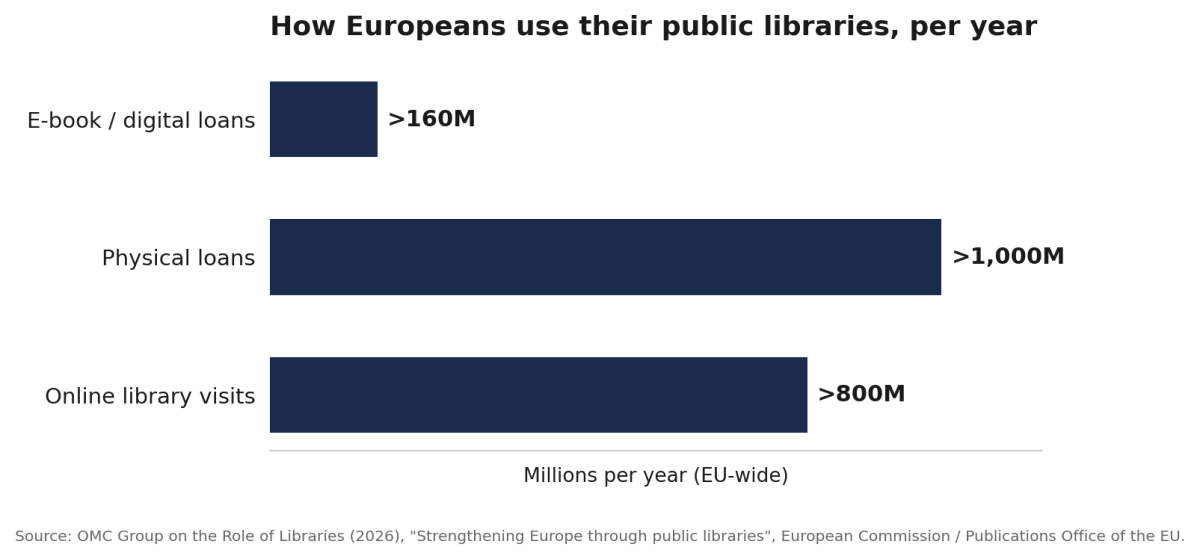
Usage has not just held up; parts of it are growing. Physical loans still exceed one billion a year across the EU. Digital lending — e-books, e-audiobooks, and e-journals — has passed 160 million loans annually, and libraries now register more than 800 million online visits a year, reaching younger and more remote audiences than their buildings alone ever could.
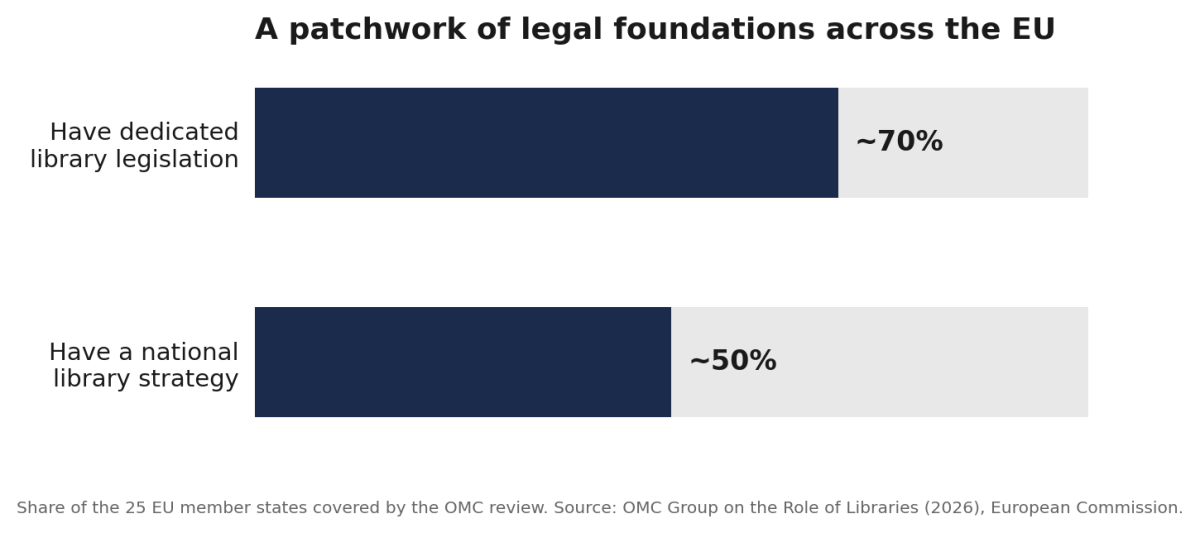
The report is less flattering about the legal and financial scaffolding underneath those numbers. Around 70% of the member states reviewed have dedicated library legislation; roughly half have a national library strategy. Funding is overwhelmingly local: a 2020 study by the European Bureau of Library, Information and Documentation Associations (EBLIDA) found that in 13 of 22 countries surveyed, municipalities covered between 51% and 100% of total library funding — leaving service levels dependent on the health of individual town budgets rather than any EU or national floor.
The consequences show up in the data: since 2012, roughly 3,000 library service points have closed across the EU, with only a handful of countries — France, Croatia, Portugal and Slovenia — reporting net increases over the same period.
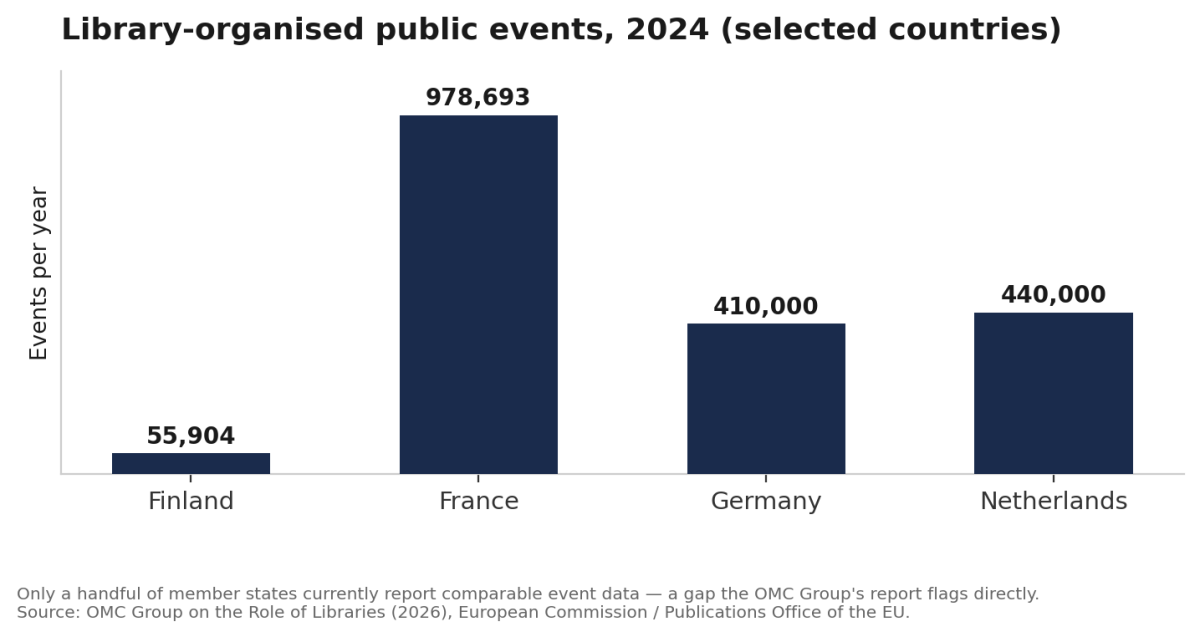
The report's authors also point to a more basic problem: countries barely measure the same things. Only a few member states currently publish comparable data on library programming, for instance — France counted 978,693 library-organised events in 2024, Germany reported roughly 410,000, the Netherlands about 440,000 (up from 75,000 in 2015) and Finland 55,904 — but without a shared methodology, none of these figures can really be compared with confidence. The OMC Group's top recommendation to the Commission is to build a harmonised EU-wide data framework before anything else.
Some of the report's most striking material sits outside the spreadsheets. In Ukraine, where more than 14,350 public libraries were operating at the start of the full-scale invasion, the Ministry of Culture and Strategic Communications says Russian strikes have damaged or destroyed 808 libraries since 24 February 2022, out of 2,302 damaged cultural sites overall.
Libraries that remain standing have become part of the country's civil infrastructure by necessity: the Central City Library for Children in Mykolaiv now operates as a round-the-clock bomb shelter for up to 180 people, and roughly 6,000 libraries have joined a national digital-literacy campaign for displaced and returning residents. A separate campaign, "Library of the Ukrainian Warrior", collects and ships books to soldiers in military hospitals and units.
Türkiye offers a parallel case from natural disaster rather than war. After the twin earthquakes of 6 February 2023, the General Directorate of Libraries and Publications deployed 48 mobile libraries and more than 250 trained librarians to affected regions, running upward of 73,000 rehabilitation activities and setting up temporary libraries in tents and prefabricated buildings. Of the ten libraries damaged, fourteen new facilities were built within a year, with 43 more planned by 2026.
The pattern recurs at a smaller scale across the pandemic-era case studies the report collects: in Ireland, library staff were designated key workers by the Taoiseach in March 2020, and a rapid pivot to e-lending produced more than 150,000 new digital library users that year and over 200,000 the next.
The report's sharpest political point concerns democracy policy. It notes that the Commission's own European Democracy Shield — the flagship initiative meant to counter disinformation and rebuild trust in institutions — does not mention libraries at all, even though the Shield calls for turning Europe Direct information centres into local "micro-hubs of democracy", and many of those centres already operate inside public libraries. The OMC Group calls this a missed opportunity, noting that separate Council conclusions have explicitly recognised libraries' role in safeguarding democracy through informed citizenship and civic participation.
Where EU funding has reached libraries directly, the results are held up as a model: CLAD ("Citizens and libraries against disinformation"), a project coordinated by the Goethe-Institut with partners in Portugal and Slovakia and funded through the EU's Citizens, Equality, Rights and Values programme (CERV) between 2024 and 2026, trains librarians and citizens to identify disinformation and runs public forums on the subject in libraries in both countries.
Libraries as the EU's unlikely AI-literacy hub
The report also positions libraries inside the EU's digital and AI policy debates. Only 56% of adults in the EU had "at least basic" digital skills as of 2023, according to Eurostat — well short of the Digital Decade target of full online availability of public services by 2030. Denmark's central libraries are cited as the report's flagship response: a 2023–2025 programme, developed with the Copenhagen Institute for Futures Studies, built a national framework for how libraries should handle artificial intelligence, alongside a children's course introducing AI concepts through play.
The report closes with six recommendations: a stronger EU-wide legal and policy framework for libraries; multilevel and more predictable funding, with libraries explicitly named in Erasmus+, Creative Europe, Horizon Europe, Digital Europe, the European Social Fund Plus and CERV — and, eventually, in AgoraEU, the roughly €8.6 billion successor programme currently envisaged for the EU's 2028–2034 budget; harmonised data collection; investment in library staff; sustainable and accessible library buildings; and digital and AI maturity.
The OMC Group wants a follow-up written into the EU Work Plan for Culture for 2027–2030, backed by fresh Council conclusions, and is pushing for an annual "European Week of Libraries" to be held across the continent. The report is expected to be formally presented at a conference in Dublin under Ireland's EU Council presidency later this year.
The report leans, in the end, on a simple argument: the public doesn't need convincing. A 2025 Special Eurobarometer on culture found that 87% of Europeans think culture and cultural exchange should have a very important place in the EU, and 86% see culture and the arts as important to welfare and economic development. A separate 2024 study spanning Belgium, Germany, France, Italy, the Netherlands and Austria — surveying more than 160,000 adults and 22,600 children and adolescents across over 1,000 libraries — found unusually high satisfaction with library services among users and non-users alike.
The question the OMC Group leaves for policymakers is whether that trust will translate into the legal status, funding and data infrastructure the report says libraries still lack.