
When machines learn to write by consuming the work of writers without payment or permission, what happens to the writers — and to writing itself? Nina George, commissioner for political affairs of the European Writers' Council, has some answers and some demands.
By Matthaios TsimitakisThere is a battle underway in Brussels that most people do not know they have a stake in — and Nina George is one of the few willing to say so in plain language. The legislative battlefield is the CDSM Directive — the 2019 copyright law that was supposed to close the value gap between creators and digital platforms. On the occasion of its fifth anniversary this June, the EWC published a damning assessment.
The EWC argues the directive is today suffering from massive misinterpretations, with national implementations leaving authors with no means of enforcement and the text and data mining exception being overinterpreted as a free pass for AI development — an outcome never intended by the Parliament that passed it.
Their own monitoring found that only 42% of writers receive any advance payment for their books, remuneration has declined since 2021, and up to 85% of authors receive no figures from commercial e-lending platforms. The EWC is now calling on the Commission to remove the TDM exceptions entirely and replace them with a voluntary, author-controlled licensing regime — because, as George puts it, only "yes" means yes.
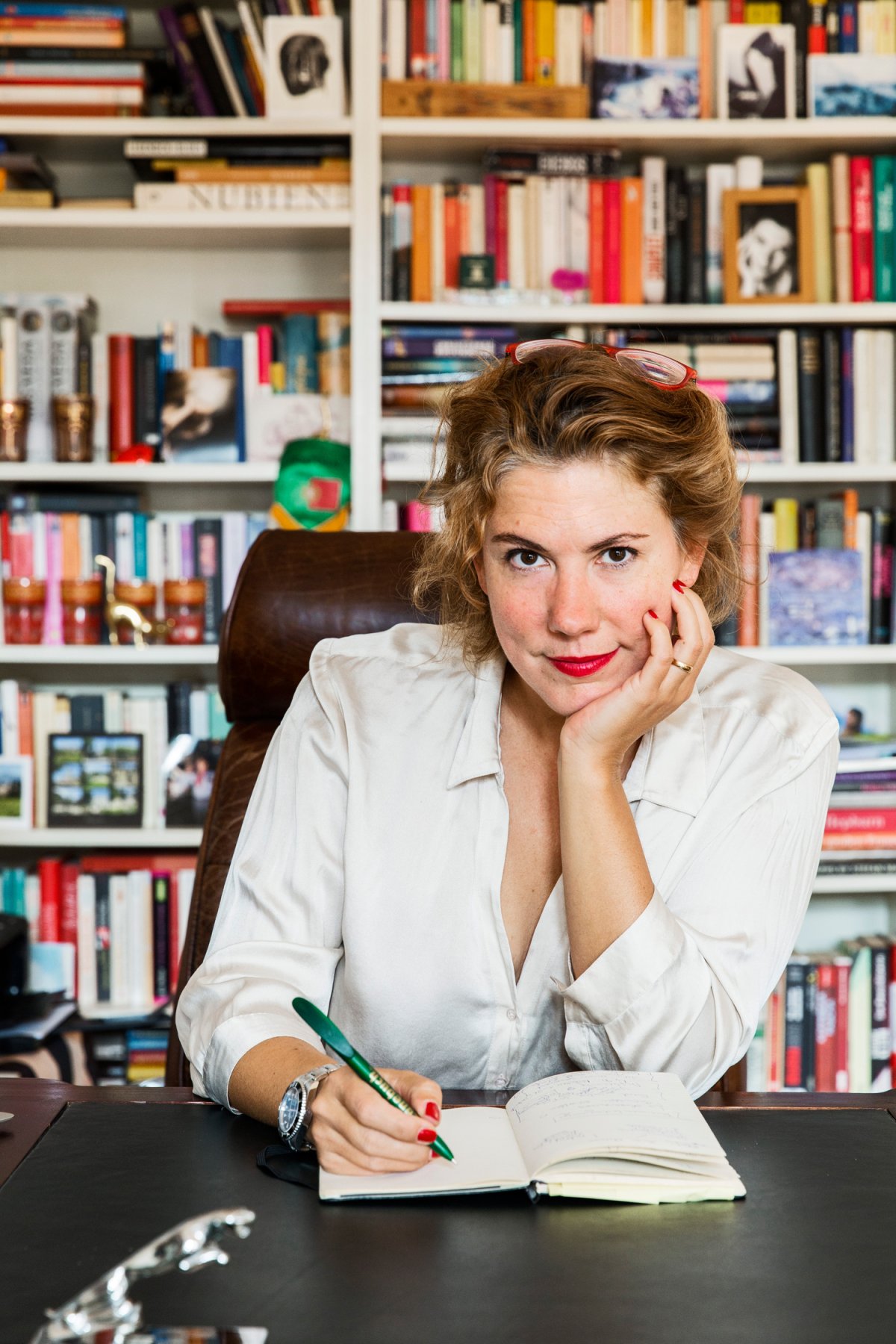
George is a bestselling novelist and the Commissioner for Political Affairs of the European Writers' Council (EWC), the umbrella body representing authors across the continent. Her novel The Little Paris Bookshop has been translated into 36 languages. She is someone who has spent years mapping the collision between literature, technology, and power — and who has arrived at the conclusion that the collision is not accidental. But the questions George raises go far beyond royalties and opt-out clauses, though those matter enormously.
They go to something more fundamental: who decides what gets written, what gets read, and what gets remembered. The Little Paris Bookshop story follows Jean Perdu, a literary apothecary who runs a bookshop on a barge on the Seine. He believes that novels can act as medicine to cure the soul, a question that couldn't be more relevant than in our times when machines are taking over the so-called natural language world.
In an age when algorithms curate visibility and large language models are trained on decades of unconsented creative labour, the freedom to tell a story — and to be paid for telling it — has become a political question, not merely a commercial one. What follows is a conversation about literature, power, and the real value of words.
CU: We get the feeling that this is a visual time, but in fact, we live in media environments that are full of text every day. How does a writer feel in this environment where acceleration and fragmented meanings are the norm?
NG: In Greek philosophy of rhetoric, there were seven different forms of how to tell people something and persuade them, based on the principles of logic, pathos, and ethos. You can do it with clarity, in an entertaining way, in a poetic way, or in a convincing way that manipulates emotions.
Compared with the environment we currently see – the legal environment, the market environment, social media taking up time – I think this is a totally usual crisis we are in, in which, however, the rhetorical manipulation of emotions without any real ethos clearly predominates. Writers are part of the seven liberal arts, so they have their freedom within to be independent, to say what they want to say and how they want to say it.
This is often dangerous. For example, being a writer in Ukraine would currently mean, 'How am I physically secure to write?' Being a writer in Belarus or in Turkey would mean asking yourself, ‘How can I tell things as they are without being harassed by my government?'
To be a writer in the Western sphere is to ask oneself the question, 'Should I use my writing to heal the world from the current polycrisis and do something against emotional manipulations? 'And should I try to tell stories to give them hope or logic back? The main duty of a writer is to help people express themselves and to connect.
CU: In an environment where writing has been so industrialised, and you have all these machines imitating writing, what is happening to the reader? The writer has the freedom inside to express, and they do it. They cannot do otherwise. But the reader? Especially the younger generation?
NG: A book is nothing without its reader. As much as I trust the real writer, I also trust the real reader. When we look into market research, we see that there are 10% of people who frequently buy books, read and need them to “breathe”.
And this sometimes goes up in certain epochs, and other times it goes down, but in principle, it's stable. That is the reader for me: someone who will not spend time with a book when the author did not take the time to write it. It's not easy to betray the reader. Betrayal in the sense that AI text can write polished, mainstream, good-sounding text.
But reading is everything but the text. It's in between the lines; it's a sort of energy given to the text, and a reader can sense it. AI is not good enough for a long journey of 300 or 400 pages and lacks pathos and ethos, too.
I also trust a certain part of the younger generation. They live in an environment full of digital media; they struggle to connect with their inner self and with each other. But they are also disgusted with AI. They find it "cringe", not authentic; cheating. For young people, culture is identification and connection – you lose both by using or receiving machine-reproduced slop.
CU: But what about AI dictating what is going to be read? Dictating how we are going to think about reading and about writing?
NG: There's a content policy in each robotic text software. 300, 400, or even more words are forbidden to appear in the output, so to speak. It's up to the company developing these robotics, which words, subjects or topics are avoided. So you will never get a text that is robotic to be sarcastic, ironic, polemic, or mean. But we need all these so-called negative emotions to tell, for example, stories to kids so they understand the real world.
So-called AI is also often used for algorithmic decisions of what is visible, what is prominent in most communication scenarios, portals, social media, and so on. We do not know which kinds of principles are behind those algorithms, but they jail us in knowledge prisons, only getting to see what they like us to see.
A recent study on the visibility and discoverability of European artists had some devastating findings regarding their discrimination in digital platforms, making niche topics, lesser-spoken languages or non-successful books invisible.
A few years ago, I wrote an article on how a reader's behaviour is tracked when you use your Kindle or your tablet to read, and the findings are used to construct books people want to read. But people should also read what they “do not want”. This is the most interesting part of culture, to discover the world outside the usual.
CU: You are sketching a bigger question around the freedom of expression. Let me change the scale and put it in the context of digital colonialism, a big European problem. There's also the issue of copyright. A writer who needs to live by their work is being exploited by the algorithms of American monopolies that cannot even be regulated. How do you see that evolving?
NG: When the directive on copyright and related rights was voted on in 2019, it introduced this text and data mining exception without the intention of covering AI development. However, all the AI developers misuse this exception. They have already been using our work for 30 years because it's not a new technology. Large language models have been around for decades; we all remember the computer program, ELIZA, in the 70s.
Now it has become a billion-dollar business, and the parliamentarians say, 'Sorry, it wasn't our intention to rob all the cultural works.' We have to remedy this. Tech companies rob us of work we have sometimes spent two years, 10 years, or 1,000 working hours on. At the EWC, we say that a provider has to pay at least for the working hours. So let's start with 60,000 per book as a minimum per working hour to stop this, indeed, digital colonialism.
CU: Can there even be a fair way for the remuneration of authors? It has been proposed that the intellectual property office (EUIPO) should take over and create a registry, but maybe the author should have the right to deny the use of his work completely.
NG: On the practical side of this, as writers, we want to be asked nicely and decide to say "yes" to the use of our work. Currently, we are only allowed to deny and say no, but this opt-out mechanism is technically not working. Our “no” is ignored.
Then, we need a remedy for the damage done. First, at the input level, with a licensing fee for used works and labour time. Secondly, the damage done by the output of AI systems to the market, meaning invisibility, AI bogus books, and taking away our income, replacing jobs,s like translators, scouts or even editors and working writers. And finally, a remedy for the damage to society.
CU: You wrote in the Green European Journal that the real innovators are not Sam Altman and Mark Zuckerberg but George Orwell, Mary Shelley, and Isaac Asimov. What do you mean? There's this ideology that the engineers are solving our problems and the rest of us are just using the tools they're giving us.
NG: People are not used to understanding the mechanisms of imagination and fall for AI promises and the persuasive rhetoric coming with it. It's a wonderful plot. Use AI, and you will be relieved of all the stress of decisions; all the responsibility will be taken away. And 'innovation' is such a pathetic term, always a protective shield for all kinds of business promises.
But there would be no real innovation if engineers did not use our work, and they need fresh work constantly. AI is just reproducing what already exists; it's totally boring and the opposite of invention or evolution.
E.M. Forster wrote a short story titled "The Machine Stops" in 1909. And he described a world where people sit in front of monitors, communicating only through them and sharing ideas they have read elsewhere, and after these ideas have been automated and summarised for them.
This was written over a hundred years ago. I was fascinated when I read it and started to research who these science fiction writers were. And sometimes they were ordinary writers with jobs like painters, scientists, butchers, or a cleric like Jonathan Swift. But they developed a vision.
That is what defines innovation in literature and the so-called innovation in engineering. We are used to building visions and plots. The more you write, the more something happens, and you discover an idea. Writing is bringing it to you. And then, engineers get inspired by literature. That is the chain of innovation. Everything had been in the literature before any system was installed.
Avatar, metaverse, robot – these are all expressions coming from literature. 300 years ago, Jonathan Swift imagined in Gulliver’s Travels the structure for LLMs and mocked the idea of a mechanical “word loom” to replace human wisdom and genius. The world exists because someone has sung a song. Words have built mountains; the words of writers have built the visions of engineers.
CU: In Europe, we're very much into protecting our heritage, focusing on our cultures. We understand that culture is deeply political. The Americans don't exactly see it that way. They create the market first, and the rest will follow. What should a demand be like as the Parliament of the European Commission and the Council are discussing that?
NG: We are also knowledge workers. And we are not endless. We also need incentives and need to feed our kids or cats. First, I think that every programme that they put under the MFF (Multi-Annual Financial Framework) is public money from human taxpayers, so it should be directed for the benefit of the people, not AI. Today, when something is published under the Horizon programme using public money, it must also be published under open access.
This means that you cannot apply a TDM opt-out and that everything you have produced can be used by non-European AI players. So I would say, Horizon, Open Access should not be your standard. OA violates the freedom to choose one's metier and the right to publish. The funny thing is that we talked to the guys from Creative Commons, and they're not happy that authors publishing under Creative Commons and/or open access are also unwilling to allow their work to be used by AI in any way. Brussels needs to understand that only “yes” means yes.