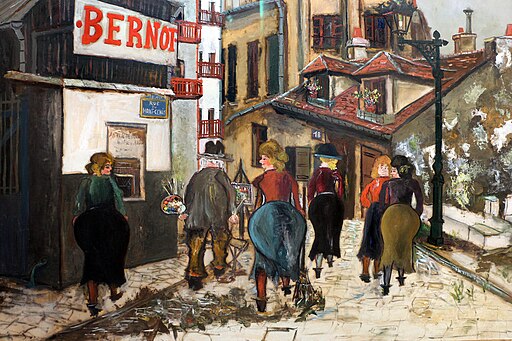

Maurice Utrillo's paintings, Charlie Parker’s compositions and Albert Einstein’s papers are among the creative works entering the public domain in the EU in 2026, following Henri Matisse’s and Frida Kahlo’s paintings in 2025. Betty Boop's very first version enters the public domain in the USA, while different legal provisions apply across countries. Read on.
By Eirini PolydorouAs the 1st of January marks the Public Domain Day, every year new art and creative works enter the public domain, but with variations across countries.
As announced by EUIPO (European Union Intellectual Property Office), masterpieces which transition into shared cultural heritage in the EU in 2026 include:
- George Enescu’s and Arthur Honegger’s musical compositions
- Nicolas de Staël, Max Pechstein, Maurice Utrillo and Fernand Léger’s paintings and other artistic works
- Thomas Mann’s and Concha Espina’s literary works
- Albert Einstein’s papers and publications
- Charlie Parker’s compositions
Artworks that entered the public domain in the European Union in the previous year 2025 included:
- Henri Matisse, Frida Kahlo and André Derain’s paintings
- Robert Capa’s photographies
- Zofia Nalkowska, Colette, Stig Dagerman and Martin Andersen Nexo’s literary works
These artworks entered the public domain, as in the European Union the duration of copyright typically extends for the lifetime of the author plus 70 years.
However, the duration of copyright protection may vary or other rules may apply in different parts of the world.
For example, in Italy and Greece there may be legal limitations on the use of publicly-owned works. That was the case when the Uffizi gallery reacted on the commercial use of Botticelli's Birth of Venus by fashion designer Jean-Paul Gaultier in 2022.
The very first version of Betty Boop as she appeared in Dizzy Dishes in 1930 (later versions of the character remain protected by copyright) was already open to reproduction and distribution in the European Union but entered the public domain in the United States in 2026.
This is because the length of copyright protection in the United States depends on when the work was published. It lasts for 95 years from the first publication of a work published before the 1st of January, 1978, or for the life of the author plus an additional 70 years, for a work published after the 1st of January 1978.
Faulkner’s As I lay dying and Agatha Christie’s The Murder at the Vicarage also enter the US public domain as published in 1930 and listed by Jennifer Jenkins and James Boyle of the Duke University.
T.S. Eliot’s, Ash Wednesday and Sigmund Freud’s, Civilization and Its Discontents (in the original German, Das Unbehagen in der Kultur) also in the highlights of the list.
As noted by EUIPO, further limitations on the use of public domain works may be linked with contractual agreements or moral rights – which can vary in duration across different jurisdictions – include, for example, the obligation to mention the artist’s name (right of attribution) and to respect the essence of the artist’s work by using it in conditions as close as possible to those intended by the author (right of integrity).
According to the Berne Convention for the Protection of Literary and Artistic Works, the length of copyright is at least 50 years after the author’s death. The Convention was adopted in 1886 and ratified by 182 countries, Maldives the most recent in 2025.
Find more here
Image Maurice Utrillo, La maison Bernot, 1924 - Francesco Bini, CC BY-SA 4.0, via Wikimedia Commons