


The European Broadcasting Union's confirmation last Thursday of Israel's participation in Eurovision Song Contest 2026 has triggered an unprecedented crisis, with Spain, the Netherlands, Ireland, Slovenia and as of today (11/12/2025) Iceland announcing their withdrawal from the competition.
The withdrawals probably represent the largest upheaval in Eurovision history, following the 2024 crisis (but here's a list with more controversies). Spain's exit is considered particularly significant as one of the “Big Five” countries that provide the contest's largest financial contributions.
Iceland has become the fifth country to boycott the 2026 Eurovision Song Contest. Stefan Eiriksson, director-general of Iceland's national broadcaster RÚV, stated that there is “no peace or joy” in the contest under the current circumstances. The broadcaster cited concerns about Israel's participation, including tensions related to the war in Gaza and controversies surrounding voting processes.
RTÉ, Ireland's national broadcaster, declared participation in the 2026 edition “unconscionable” given the humanitarian crisis and death toll in Gaza. Dutch broadcaster, AVROTROS, stated that “Culture unites, but not at any price.”
The president of Spain's RTVE, criticised the decision as evidence that “Eurovision is not a song contest, but a festival dominated by geopolitical interests.” Slovenia's Radiotelevizija Slovenija questioned the legitimacy of the Israel-Hamas ceasefire agreement, citing ongoing casualties.
Radiotelevizija Slovenija also reported that seven countries—including Spain, the Netherlands, Montenegro, Turkey, Algeria, and Iceland—requested a secret vote on Israel's participation, but the request was denied.
Instead, EBU's officials implemented new rules limiting government influence on contest results and capping public votes at 10 per payment method, a measure RTVE called “insufficient.”
Several major European countries, including host nation Austria, along with Germany, France, Britain, Portugal, and Sweden, have supported Israel's inclusion in the competition, according to different sources.
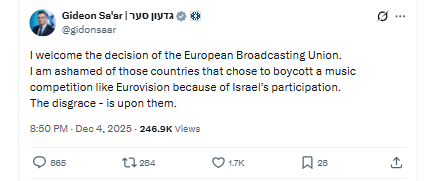
The Israeli Public Broadcasting Corporation, in an announcement, characterised the withdrawals as a “cultural boycott,” while Foreign Minister Gideon Sa'ar expressed shame over the boycotting countries' decisions.
Israel's participation in Eurovision 2025 in Basel proved contentious, with Yuval Raphael's “New Day Will Rise” finishing second and securing the largest public vote — a questionable process. The performance was accompanied by large-scale protests by Palestinian demonstrators, requiring riot police.
Israel remains eligible for Eurovision as its broadcaster is a member of the European Broadcasting Union, which determines participation eligibility.