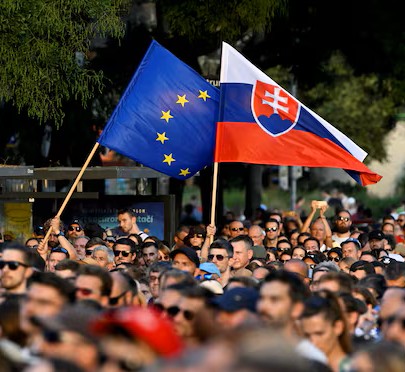



The European Parliament has passed a formal resolution calling on the European Commission to determine whether the Slovak government poses a ‘clear and serious risk’ to the European Union’s founding values. The move represents one of the most direct parliamentary challenges to a member state since proceedings were launched against Hungary in 2018.
Adopted on Wednesday by 347 votes to 165, with 25 abstentions, the resolution signals deepening alarm in Brussels over the direction of Prime Minister Robert Fico’s administration. MEPs declared themselves ‘deeply concerned’ by a deterioration of democratic standards, the rule of law and fundamental rights in Slovakia, warning that systemic deficiencies were endangering the protection of the EU’s financial interests.
MEPs urged the Commission to deploy all preventative and enforcement tools at its disposal. These include formally launching infringement proceedings and activating the EU’s rule-of-law conditionality mechanism, which allows Brussels to suspend funding to member states that fail to uphold judicial independence and anti-corruption standards.
The most pointed sections of the resolution concern changes to Slovakia's criminal law framework. Parliament expressed alarm at modifications that include the relaxation of rules on corruption offences and the closure of specialised anti-corruption bodies. MEPs also cited reports of the harassment of former investigators who had worked in those units.
The government’s attempt to dismantle the Slovak whistleblower protection office also drew condemnation, as did recent constitutional amendments which MEPs warn restrict fundamental rights and challenge the primacy of EU law – a foundational principle of the bloc’s legal order.
The resolution called on Slovak authorities to strengthen judicial independence and implement anti-corruption recommendations issued by the European Commission and the Council of Europe.
Parliament also raised concerns over the functioning of the Slovak agricultural paying agency and alleged irregularities in the allocation of EU money. Specifically, MEPs pointed to committee evidence suggesting that EU-funded rural development and tourism projects had been channelled into building or renovating luxury private estates – a potential misappropriation of funds from the EU budget.
Similar concerns were flagged last month, when Parliament called for the conditionality mechanism to be triggered against Slovakia. The demand was made in a resolution accompanying a review of the Commission’s management of the 2024 EU budget.
The resolution addresses a broad range of domestic issues beyond finance. MEPs expressed ‘deep alarm’ at the deterioration of media freedom and pluralism in Slovakia, condemning what they described as political interference in public service broadcasting.
Slovak authorities were also urged to prevent and combat violence against women and guarantee access to sexual and reproductive health services, including safe and legal abortion. MEPs further criticised the government’s record on the rights of LGBTQ+ people and reiterated long-standing concerns over the allocation of EU funds to Roma communities.
The resolution is the latest in a series of escalating parliamentary interventions. Fact-finding missions to Slovakia in 2025 led MEPs to sound the alarm over both the state of EU values in the country and the alleged misuse of EU funds. Parliament subsequently formalised those concerns in a dedicated resolution in September last year.
On 29 April last month, Parliament passed a separate resolution calling for tougher enforcement of rule-of-law provisions, concluding that threats to democratic norms persisted in several member states and sounding the alarm over the state of fundamental rights across the bloc.
The mechanism at the heart of Parliament’s demands – Article 7 of the Treaty on European Union – allows the Council to determine whether a member state poses a clear risk of a serious breach of EU values. In extreme cases, it permits the suspension of certain rights, including council voting rights. The procedure has previously been triggered against Hungary and Poland; Slovakia would become the third such case if the Commission acts on Parliament’s request.