



Socially engaged artists often describe their work as reclaiming ordinary places – a park, a market square, or a day centre – as sites where people can rebuild collaborative relationships. "We understand the city as a relational space where meanings, conflicts, and relationships between different social and cultural groups are constantly negotiated," says Serenella Martufi, co-artistic director of Medeber Teatro in Belgium, quoted in a new report on the field. That report, Constellations of Change, was published this month by the Alliance for Socially Engaged Arts, and its central finding is that this kind of work — participatory, community-led and difficult to measure in the short term — is growing across Europe even as its funding base remains unresolved.
The report was produced over four months by three organisations commissioned by the Alliance — The Field Società Cooperativa, Fondazione Santagata per l'Economia della Cultura and KEA European Affairs — drawing on an existing database of 887 applications to the Alliance's fellowship programme, a survey of 274 organisations, interviews and focus groups with 20 more, and two webinars involving over 150 further groups. In total, the underlying database spans 1,128 organisations across 39 European countries, which the Alliance describes as one of the most comprehensive mappings of the field to date.
Socially engaged arts – SEA, in the report's shorthand – describes participatory work made with communities rather than performed for them: co-created theatre, collective murals, oral history projects, and participatory films. The report finds that 85 per cent of surveyed organisations co-create their work directly with the communities they serve, and 38 per cent involve those communities in organisational governance. The researchers describe this as producing "complex social impact" — change operating simultaneously at the personal, relational and structural levels, rather than the single measurable outcome that most grant applications are designed to capture.
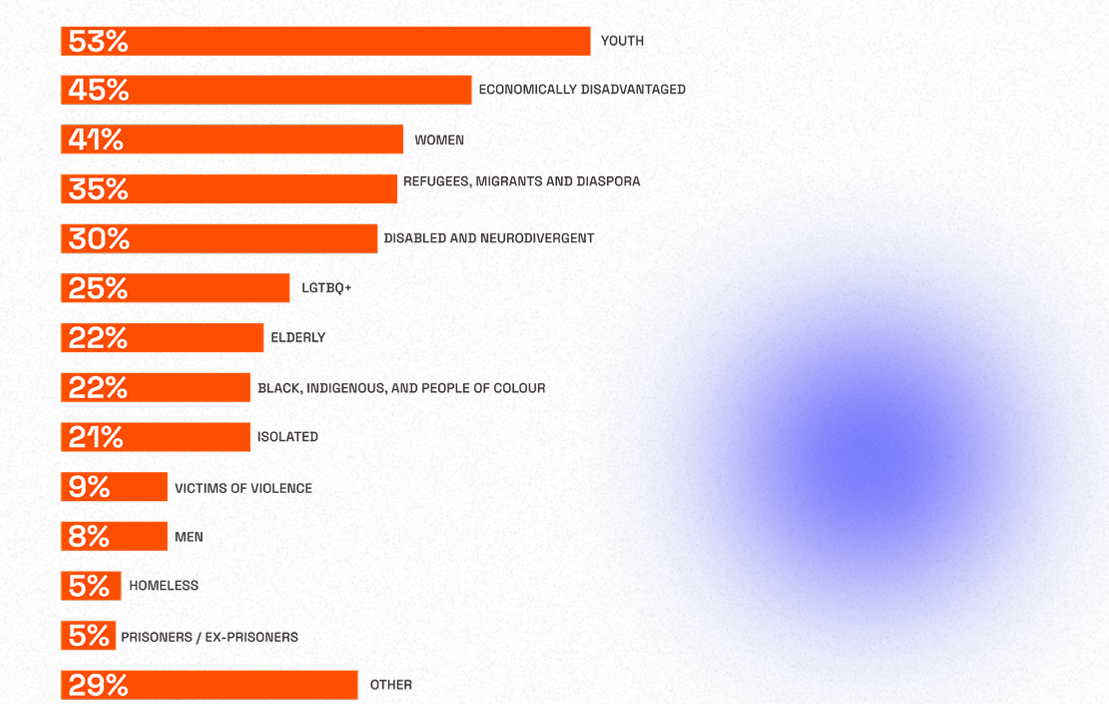
-Percentage of surveyed organisations working with specific target groups:
"All our work is driven by striving for a more just and fair world. The foundation of our practice is based on the idea that we never know enough, and we need different places, people, realities and perspectives to counter the assumptions we hold as individuals to co-create new realities on the basis of knowledge of each other and of different contexts and realities. It’s an immersive space for learning and imagining about what connects us as human beings rather than what divides us. From this place of understanding, a beginning of what it means to be human, we believe we can imagine more open and tolerant societies that thrive on embracing diversity instead of the concept of identity," said Inge Ceustermans, General Director of The Festival Academy in Belgium, for the report.
That framing helps explain the funding difficulties the report documents. Asked to name their greatest challenge, 79 per cent of surveyed organisations pointed to funding; only 22 per cent said their work was well aligned with existing funding and policy frameworks. The organisations most exposed are not the smallest but the mid-sized ones — those with annual budgets between €500,000 and €1 million, over 90 per cent of whom report funding difficulties. The report notes these organisations are large enough to run structured programmes but lack the reserves to absorb a difficult year. The field as a whole is modest in scale: roughly two-thirds of surveyed organisations turn over less than €250,000 annually, and over 44 per cent report budgets under €100,000.
The report attributes much of this to a structural mismatch: arts funders tend to assess SEA organisations by artistic merit, while social-policy funders assess them by measurable outcomes such as inclusion or regeneration indicators. SEA organisations, the report argues, rarely fit either category comfortably and are often required to reshape their language and priorities to match whichever funding stream happens to be open.
This is occurring as public cultural funding in several European countries is being reduced rather than expanded. In France, the culture ministry's budget was reduced by €150 million in the 2025 national budget, with some local and regional authorities cutting their own arts funding by as much as 70 per cent, according to reports. In the United Kingdom, the 2025 Spending Review means the government is projected to be spending well over a third less per person on Culture, Media and Sport in real terms by 2029 than it did in 2010, according to analysis by the Campaign for the Arts. The report also cites reductions to Estonia's culture budget, which it links to rising national defence spending.
These reductions sit alongside a shift in EU cultural policy rhetoric. On 12 November 2025, the European Commission launched the Culture Compass for Europe, presented by Commissioner Glenn Micallef, which frames culture explicitly as a contributor to social cohesion, democracy and community resilience — closely echoing the language SEA organisations use to describe their own work. The report describes a "persistent gap between policy and implementation" across Europe: policy documents increasingly recognise participatory culture's civic value, but funding frameworks have not moved in step.
The report presents Finland as a comparatively developed example. Within Finland's welfare model, cultural participation is treated as a social right, and Uniarts Helsinki now offers a postgraduate diploma in participatory, community and socially engaged arts, developed by researcher Kai Lehikoinen. Two national networks, Taikusydän and Kulttuurihyvinvointipooli, coordinate advocacy, knowledge-sharing and cross-sector collaboration between the cultural and welfare systems — a structure the report credits with embedding SEA practice within Finnish public services over time.
The report's recommendations are organised under five headings — Recognise, Resource, Embed, Measure and Connect — and are directed mainly at policymakers and funders, whom the authors identify as holding most of the influence over the field's conditions. They include naming socially engaged arts explicitly in policy and funding documents, shifting from short-term project grants toward multi-year core funding, and developing evaluation frameworks capable of capturing impact that a single annual grant report cannot.
Whether these recommendations shape the EU's next Multiannual Financial Framework, still under negotiation for the 2028–2034 period, remains to be seen. What the report documents in the meantime is a specific and measurable gap: a field increasingly cited in EU and national policy language as contributing to social cohesion and democratic resilience, funded, according to the organisations it surveyed, in a manner that has not yet caught up with that language.
---
Read and download the Constellations of Change Report – Alliance for Socially Engaged Arts, July 2026